
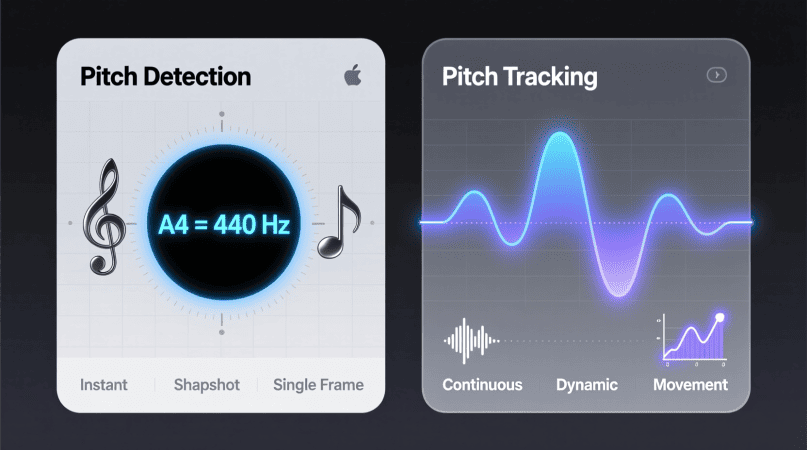
“Pitch detection” and “pitch tracking” are often used interchangeably — but they’re not the same.
Both are core parts of how a pitch detector or voice analyzer works, yet they serve slightly different purposes.
In simple terms:
- Pitch detection finds the instantaneous pitch at a specific moment in time.
- Pitch tracking follows how that pitch changes over time.
Understanding this distinction helps musicians, producers, and developers interpret readings correctly — whether you’re training your voice, tuning an instrument, or analyzing a full audio file.
What Is Pitch Detection?
Pitch detection is the process of determining the fundamental frequency (F₀) of a sound at a given instant.
It’s what your browser-based Pitch Detector does when you sing or play a note — it identifies the dominant periodic pattern in the waveform and converts it to a note name (like A4 = 440 Hz).
How It Works
Pitch detection uses short segments of audio, often called frames (e.g., 20–40 milliseconds).
For each frame, algorithms such as:
- Fast Fourier Transform (FFT)
- Autocorrelation
- YIN
analyze the waveform and estimate the dominant frequency.
The result: one frequency reading for that moment.
💡 Example: You sing “A4” for one second.
Pitch detection might sample it 50 times and say:
440.1 Hz, 439.9 Hz, 440.0 Hz, etc.
Each reading is detection — individual measurements.
Learn more:
👉 How FFT Works in Pitch Detection
👉 Autocorrelation vs YIN Algorithm
What Is Pitch Tracking?
Pitch tracking connects those individual pitch readings into a continuous timeline.
It’s the temporal evolution of pitch — how it rises, falls, and fluctuates over time.
Tracking adds:
- Context: How the frequency changes from frame to frame.
- Stability: Smoothing or filtering of erratic readings.
- Meaning: Understanding vibrato, glides, or phrasing.
While detection gives you data points, tracking gives you a curve — the visual line you see in a Voice Pitch Analyzer.
Detection vs Tracking — Side-by-Side
| Feature | Pitch Detection | Pitch Tracking |
|---|---|---|
| Definition | Identifies the frequency of a sound frame | Connects frequencies over time |
| Output | Individual values (Hz or notes) | Continuous contour or curve |
| Purpose | Instant frequency analysis | Follow pitch movement (intonation, vibrato) |
| Used in | Tuners, real-time tools | Voice analyzers, melody extraction |
| Algorithms | FFT, Autocorrelation, YIN | YIN + smoothing filters, ML trackers |
| Example Tool | Online Pitch Detector | Voice Pitch Analyzer |
Why Tracking Is More Complex
Pitch detection alone can be noisy — especially for human voice or live instruments.
That’s why tracking uses post-processing to make sense of the data.
Techniques include:
- Smoothing filters — average adjacent frames for stability
- Dynamic thresholds — ignore low-confidence detections
- Time-based interpolation — fill short gaps in voiceless frames
- Machine learning models like CREPE or SPICE (neural pitch tracking)
Tracking turns raw detection into something interpretable and musical.
Musical Applications
| Use Case | What’s Needed | Tool Recommendation |
|---|---|---|
| Tuning instruments | Quick, accurate detection | Main Pitch Detector |
| Practicing singing or ear training | Real-time pitch tracking | Voice Pitch Analyzer |
| Analyzing vibrato and pitch control | High-resolution tracking | Vibrato Stability Guide |
| Speech tone and inflection | Smooth tracking curves | Pitch Detection in Speech Therapy |
Technical Example (For Developers)
Here’s how a simplified process might look inside your browser using the Web Audio API:
getUserMedia()captures microphone inputAnalyserNodebuffers waveform chunks- Each chunk is processed via FFT or Autocorrelation → pitch detected
- Detections are plotted over time → pitch tracking curve
- Smoothing algorithms reduce noise and improve accuracy
That’s how tools like PitchDetector.com provide real-time visual pitch graphs directly in your browser — no app installation needed.
Further reading:
👉 Real-Time Browser Pitch Detection Explained
👉 Web Audio API Pitch Detection
Advanced Topic: Machine Learning & Pitch Tracking
Modern pitch trackers increasingly use neural networks instead of purely mathematical algorithms.
Systems like CREPE, pYIN, and SPICE learn patterns of harmonics, tone color, and noise — making them more resilient to complex, polyphonic signals.
However:
- They require more computational power
- They’re often cloud-based (not local)
- Browser detectors like ours prefer local DSP methods for privacy and speed
Learn more: Machine Learning in Pitch Detection
Which One Do You Need?
- If you want instant note accuracy → use Pitch Detection
- If you want to analyze movement, vibrato, or phrasing → use Pitch Tracking
- Most modern analyzers (like ours) do both simultaneously — detection for precision, tracking for interpretation.
Try them both:
🎯 Pitch Detector (Live Mic)
🎤 Voice Pitch Analyzer (Tracking Mode)
Ornella is a music technology writer and vocal tools specialist at Pitch Detector. She creates practical content around pitch detection, note recognition, vocal analysis, and singing education tools for beginners, singers, and audio creators.