
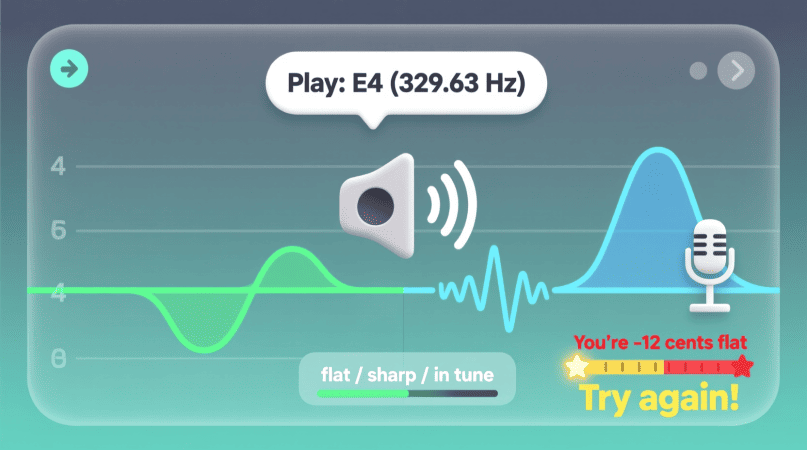
Many singers wonder: “How can I train my ear so I stop drifting flat or sharp?” One of the most effective (and fun) ways is through pitch matching games. These exercises turn ear training into a challenge where you listen, copy, and check accuracy in real time. Instead of guessing, you get instant feedback that helps you build confidence and precision.
Why Pitch Matching Matters for Singers
- Improves accuracy: Matching notes teaches your ear and voice to lock onto pitch.
- Builds consistency: With practice, your pitch becomes steady instead of wavering.
- Boosts confidence: When you know you’re in tune, you can focus on expression instead of worrying about wrong notes.
- Supports harmony: Essential for choir, duet, or band singing where blending matters.
👉 To check how close you already are, start with the Voice Pitch Analyzer and see how well you can match a single note.
Fun Pitch Matching Games to Try
1. Single-Note Challenge
- A note plays—you sing it back.
- The goal: land right on pitch.
- Use a pitch detector to see if you’re sharp or flat.
2. Higher or Lower Game
- Sing a note, then match one step up or down.
- Great for learning intervals and scale steps.
👉 The Singing Pitch Detector gives real-time visual feedback so you can see every step.
3. Pitch Memory Game
- Listen to a short 2–3 note pattern.
- Repeat it back without checking until the end.
- Trains both your memory and your ear.
4. Song Line Match
- Play a single line of a song.
- Sing it back while tracking with real-time feedback.
- This turns practice into a game while training your performance ear.
5. Real-Time Tracking Race
- Sing through scales or simple melodies.
- Watch the detector graph and try to keep your line centered.
👉 Use Real Time Pitch Detection to gamify your progress and see instant corrections.
A 5-Minute Daily Pitch Game Routine
- Warm up with humming or lip trills (1 minute).
- Play 5 rounds of single-note matching (1 minute).
- Try a higher/lower challenge (1 minute).
- Do one pitch memory game (1 minute).
- End with a real-time tracking exercise (1 minute).
Small, consistent practice makes your ear sharper and your pitch steadier over time.
Tips for Getting the Most Out of Pitch Games
- Record your attempts and notice patterns—flat on low notes, sharp on highs, etc.
- Keep sessions short so you stay fresh and focused.
- Combine ear training with warmups for faster results.
- Celebrate small wins—hitting one tricky interval correctly is progress.
Ear training becomes more structured when you follow the free singing course.
Matching tones accurately improves when you test yourself with the singing note detector.
Learning how wide your ear can stretch is easier after taking a vocal range test.
Practicing consistent pitch is smoother when guided by a voice pitch analyzer.
Comparing your voice to target notes works well with a note to frequency converter.
Tracking improvement over time is easier when you use a pitch accuracy checker.
Refining listening skills fits nicely alongside beginner vocal lessons.
Ornella is a music technology writer and vocal tools specialist at Pitch Detector. She creates practical content around pitch detection, note recognition, vocal analysis, and singing education tools for beginners, singers, and audio creators.