People often ask: “What is the best frequency for music?”
The answer depends on what type of music you mean—standard, meditation, sound therapy, or audio engineering.
There isn’t one magically perfect frequency for everything, but there are several important frequencies commonly used in music creation and listening.
This SEO-optimized guide explains the best frequencies and how they affect the sound we hear.
What Does Frequency Mean in Music?
In music, frequency refers to how many times a sound wave vibrates per second, measured in Hertz (Hz).
- Low frequencies = Deep bass
- High frequencies = Bright treble
Human hearing spans 20 Hz to 20,000 Hz, but most musical content sits between 20 Hz and 5,000 Hz.
Understanding music frequency is essential for tuning instruments, mixing audio, and even creating healing or meditation music.
1. Best Frequency for Standard Music: A = 440 Hz
The global standard tuning frequency for modern music is:
A4 = 440 Hz
(Also called concert pitch)
This means the note A above middle C vibrates at 440 cycles per second.
Why 440 Hz is the Standard
- Universally recognized tuning reference
- Used by orchestras, studios, and digital instruments
- Works perfectly with modern equal-tempered scales
- Standardized internationally by ISO in 1955
Best For:
- Classical music
- Pop & rock
- Jazz
- Film scores
- Digital production
- Live performance tuning
If you mean regular music, 440 Hz is the best and official tuning frequency. Once you identify inaccurate tones, you can refine them using the pitch shifter to correct the pitch.
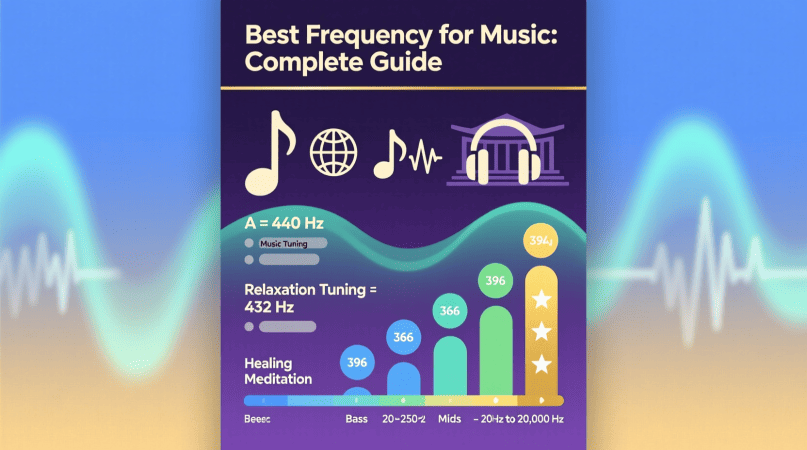
2. Best Frequency for Relaxing or Calming Music: A = 432 Hz
Some musicians prefer tuning to:
A4 = 432 Hz
Listeners describe 432 Hz music as:
- Softer
- Warmer
- More natural
- More emotional
Claimed Benefits of 432 Hz
(Some are based on personal experience rather than science)
- More pleasant to the human ear
- Matches naturally occurring frequencies
- Feels more relaxing
- Supposed to reduce stress
Best For:
- Meditation music
- Yoga tracks
- Ambient relaxation music
- Nature-inspired compositions
Although not scientifically proven to be “better,” 432 Hz has a large fanbase for soothing music.
3. Best Frequency for Healing & Meditation: Solfeggio Frequencies
In meditation, spirituality, and sound healing, people use specific single frequencies instead of musical notes. These are known as Solfeggio frequencies.
Popular Healing Frequencies
| Frequency | Purpose |
|---|---|
| 396 Hz | Releases fear & anxiety |
| 417 Hz | Helps overcome negative energy |
| 432 Hz | Natural, grounding, relaxing |
| 528 Hz | “Love frequency” / transformation |
| 639 Hz | Emotional healing & relationships |
| 741 Hz | Intuition & problem-solving |
| 852 Hz | Spiritual awakening |
These frequencies are widely used in:
- Meditation music
- Sound therapy
- Reiki & energy healing
- Sleep playlists
Best For:
- Mental relaxation
- Holistic wellness
- Mind-body healing
- Deep meditation environments
Many singers improve their vocal stability by letting the voice pitch detector track pitch variations.
4. Best Frequency Range for Human Hearing & Audio Quality
Humans can hear from 20 Hz to 20,000 Hz, but music sounds best between:
20 Hz – 5,000 Hz
Here’s the musical breakdown:
| Frequency Range | Sounds You Hear |
|---|---|
| 20–60 Hz | Deep bass, kick drums |
| 60–250 Hz | Bass guitar, warm tones |
| 250–500 Hz | Vocal warmth, guitars |
| 500–2,000 Hz | Most instruments & vocals |
| 2,000–5,000 Hz | Clarity, brightness |
| 5,000–12,000 Hz | Crisp details |
| 12,000–20,000 Hz | Air, sparkle |
These ranges matter most for:
- Mixing & mastering
- Live sound engineering
- Audio production
Best For:
- Clean vocal clarity
- Balanced bass
- Professional music production
If the shifted sound still feels off, you can confirm its tuning with our instrument tuner before finalizing the adjustment.
So, What Is the Best Frequency for Music?
It depends on your purpose:
| Purpose | Best Frequency |
|---|---|
| Standard modern music | 440 Hz |
| Relaxing or soothing music | 432 Hz |
| Healing, meditation, spiritual music | 396–852 Hz (Solfeggio) |
| Bass impact | 20–60 Hz |
| Vocal & instrument clarity | 300–3,000 Hz |
| Full music listening | 20–20,000 Hz range |
There is no single frequency that’s perfect for everything, but each one has its strengths.
This exercise works great after you check your singing pitch.
Frequently Asked Questions
Is 432 Hz better than 440 Hz?
Not scientifically, but many listeners prefer its relaxing, softer sound.
What frequency is used in professional music?
440 Hz is the official tuning standard worldwide.
What frequency is best for healing music?
Solfeggio frequencies, especially 432 Hz and 528 Hz, are popular.
Which frequency is best for bass lovers?
Deep bass sits between 20–80 Hz.
What frequency is best for vocals?
Vocals are clearest between 300–3,000 Hz.
Final Thoughts
The “best” frequency for music depends on what you want:
- 440 Hz → the standard for all modern music
- 432 Hz → preferred for soft, relaxing music
- Solfeggio frequencies → ideal for meditation and healing
- 20–20,000 Hz → full sound spectrum for listening & mixing
Understanding these frequencies helps musicians, producers, and listeners tailor music to their needs—whether for performance, relaxation, or healing.
Many readers start by reviewing this musical note frequency chart to see how every pitch maps to hertz.
To understand how tuning standards evolved, this historical pitch guide gives helpful background.
For modern tuning, this A440 tuning standard explains why 440 Hz became the reference.
If you want to convert between systems, this note-to-frequency guide makes it simple.
To see how humans perceive sound, this pitch perception article explains the hearing side of frequencies.
When measuring tones digitally, this FFT pitch detection guide shows how frequencies are analyzed.
For practical testing, this real-time pitch tracker lets you see live frequency changes.
Ornella is a music technology writer and vocal tools specialist at Pitch Detector. She creates practical content around pitch detection, note recognition, vocal analysis, and singing education tools for beginners, singers, and audio creators.