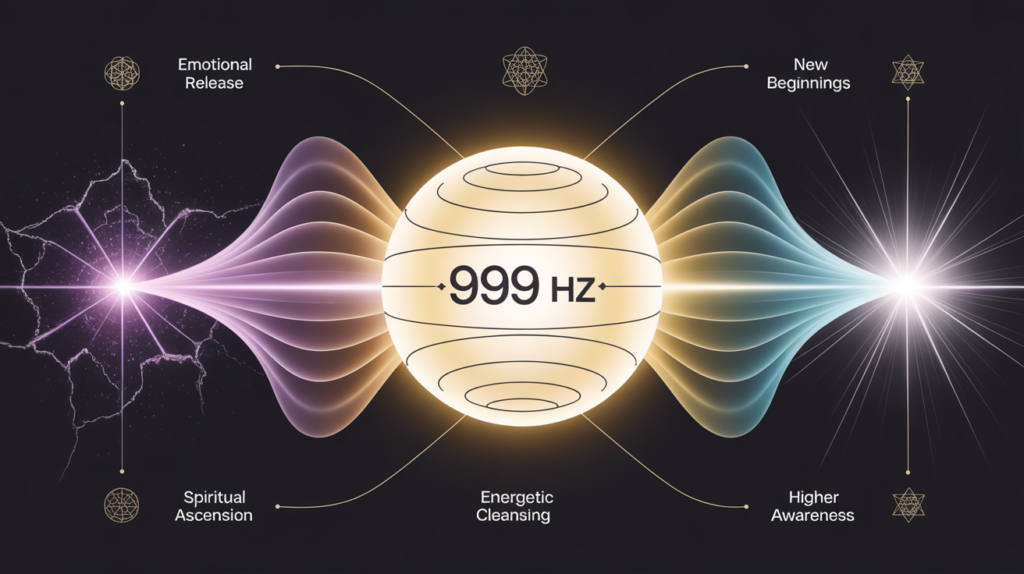
Short answer: 999 Hz is a modern sound-healing tone linked, through the numerology of 999, to completion, emotional release and new beginnings. It is not one of the nine Solfeggio frequencies. Musically it is a high tone just above B5 (987.77 Hz), about +20 cents sharp. Its claimed benefits come from practitioners and listeners; we found no controlled studies that test 999 Hz itself.
This guide keeps two things clearly apart: what people who use 999 Hz believe it does, and what is actually known about sound and wellbeing. If you want to check what a “999 Hz” track really contains, our frequency detector shows the dominant frequency of any sound in real time.
999 Hz: quick facts
| Property | Value |
|---|---|
| Frequency | 999 vibrations per second (999 Hz) |
| Nearest note (A4 = 440 Hz) | B5, +19.6 cents (between B5 at 987.77 Hz and C6 at 1046.50 Hz) |
| Period | 1.001 ms per cycle |
| Wavelength in air (20 °C) | about 34.3 cm |
| One octave lower | 499.5 Hz (just above B4) |
| Where you hear it | Top of the soprano range, a high whistle, a flute’s upper register |
| Part of the Solfeggio scale? | No |
What does 999 Hz mean?
In numerology and “angel number” traditions, 999 stands for endings, completion and the start of a new cycle. Sound-healing practitioners carried that meaning over to the 999 Hz tone, so it is described as a frequency for letting go of old patterns, closing a chapter and stepping into something new. Listeners also connect it with higher awareness, intuition and a sense of spiritual renewal.
999 Hz is not one of the Solfeggio frequencies. The list usually given for those is 174, 285, 396, 417, 528, 639, 741, 852 and 963 Hz. 999 Hz became popular later, mainly through meditation videos and playlists, which is why you will see it described as a “modern” healing frequency.
Claimed 999 Hz benefits vs what the evidence says
The table sums up the benefits most often claimed for 999 Hz. The middle column is the claim as practitioners state it; the right-hand column is our plain reading of the evidence.
| Claimed benefit | What users and practitioners say | What the evidence says |
|---|---|---|
| Emotional release | Helps let go of old pain, worry and repetitive thoughts | No 999 Hz studies. A calm listening ritual and expectation can make people feel better, whatever the tone. |
| New beginnings | Supports closing a chapter and life transitions | A symbolic meaning from numerology, not a measurable effect. |
| Spiritual awareness | Connects you with higher consciousness and your “higher self” | Not testable scientifically; a personal and spiritual experience. |
| Intuition | Sharpens inner guidance and decision-making | No evidence that a specific tone changes intuition. |
| Calm and peace | Reduces tension and overthinking | Relaxing music in general can lower self-reported stress, but that research uses music people like, not one 999 Hz tone. |
| Aura and energy cleansing | Clears stagnant energy and “repairs” the aura | Auras and energy fields are not measurable, so this cannot be tested. |
| Deeper meditation | Quiets mental noise, pairs with breathwork | Any steady, non-distracting sound can serve as a focus point; nothing specific to 999 Hz. |
What the science actually says
Research on music listening, for example before medical procedures, has found reductions in self-reported anxiety. Those studies use pleasant music chosen for relaxation. They do not show that a particular frequency, such as 999 Hz, has its own healing power, and we are not aware of published controlled trials on 999 Hz at all.
There is also nothing special about the number from an acoustic point of view. The hertz is a man-made unit (cycles per second), so “999” only looks meaningful because we count in base ten and measure time in seconds. The tone does not line up with standard tuning either: with A4 = 440 Hz the nearest note is B5 at 987.77 Hz, and with A4 = 432 Hz it would be about 969.81 Hz. The debate about tuning references is covered in 432 Hz vs 440 Hz.
So the fair summary is this: if a 999 Hz session helps you relax or reflect, that experience is real for you, but it is best understood as a meditation practice, not a treatment.
What 999 Hz sounds like in music
A pure 999 Hz sine wave sounds like a bright, steady whistle. It sits near the top note of many sopranos, in the high register of flute and violin, and well above most speaking voices (roughly 85 to 255 Hz). You can confirm the note name with the frequency to note converter or look it up in the musical note frequency chart.
Check what a “999 Hz” track really contains
Many videos labelled 999 Hz are ambient music, rain or pads with a quiet tone mixed in, or music shifted by an unknown amount. If the exact frequency matters to you, check it:
- Play the track on a speaker, or download it if you are allowed to.
- Open the frequency detector (linked at the top of this page) and hold your phone or laptop mic near the speaker; a pure tone should read close to 999 Hz, near B5.
- For a file, load it into the spectrogram viewer: a pure tone shows as one thin horizontal line at 999 Hz, while music shows many lines.
- The audio file pitch detector lists the notes over time, which reveals whether the “tone” is really a melody.
How people use 999 Hz
- Meditation: as a steady background tone for reflection or visualisation of a new start.
- Journaling and shadow work: as a focus sound while writing about what you want to let go of.
- Energy-healing sessions: practitioners play it during reiki or chakra work (the crown chakra is the one most often named).
- Affirmations: in the background while repeating intentions.
- Before sleep: some listeners use it at very low volume, though a high tone can keep others awake; softer, lower sounds usually suit sleep better.
Is 999 Hz safe to listen to?
At a comfortable volume, yes: it is simply a high tone. Practical guidelines:
- Keep the volume low, especially with headphones; high pure tones can feel harsh and tiring sooner than music.
- Sessions of 10 to 30 minutes are what practitioners usually suggest; stop if you feel discomfort, ringing or pressure in your ears.
- If you have tinnitus or sound sensitivity, ask a hearing professional before long sessions with high tones.
- Do not use 999 Hz instead of medical or mental-health care; see a professional for anxiety, pain or sleep problems.
999 Hz compared with nearby healing frequencies
| Frequency | Nearest note | What it is associated with |
|---|---|---|
| 800 Hz | G5 +35 cents | Newer wellness tone |
| 852 Hz | G#5 +44 cents | Solfeggio: intuition, “returning to spiritual order” |
| 932 Hz | A#5 -1 cents | Newer tone linked to the pineal gland |
| 963 Hz | B5 -44 cents | Solfeggio: “crown chakra”, oneness |
| 999 Hz | B5 +20 cents | Completion, release, new beginnings |
| 9,999 Hz | D#9 +8 cents | Online “master” frequency; very high, piercing tone |
9999 Hz, which also turns up in searches, is ten times higher than 999 Hz and not a multiple of it: it lands near D#9, far above any piano key, and sounds thin and piercing. Keep it especially quiet. For a wider look at which frequencies sound good in music, see the best frequency for music. More guides on sound, frequency and pitch are collected in the knowledge hub.
Frequently asked questions
What is the main benefit of 999 Hz?
Practitioners describe emotional release and a sense of completion and renewal as the main benefit. These are spiritual and personal claims; there is no clinical evidence for effects specific to 999 Hz.
What does 999 Hz mean spiritually?
It symbolises the end of an old cycle and the start of a new one, borrowed from the meaning of the number 999 in numerology.
Is 999 Hz a Solfeggio frequency?
No. The Solfeggio set usually listed runs from 174 Hz to 963 Hz. 999 Hz is a newer addition from the meditation-music scene.
What note is 999 Hz?
It is about +20 cents above B5 (987.77 Hz) when A4 = 440 Hz, so a tuner would show B5, slightly sharp.
Can I listen to 999 Hz every day?
Yes, at a comfortable volume. Treat it like any meditation sound: short sessions, breaks, and stop if it becomes unpleasant.
Does 999 Hz help anxiety?
Some listeners report feeling calmer, and relaxing sound in general can ease self-reported stress, but no study shows that 999 Hz treats anxiety. If anxiety affects your daily life, speak to a professional.
Ornella is a music technology writer and vocal tools specialist at Pitch Detector. She creates practical content around pitch detection, note recognition, vocal analysis, and singing education tools for beginners, singers, and audio creators.