Quick answer: there was no single historical pitch. Baroque A ranged from about 392 Hz in France to about 465 Hz on German organs; period ensembles now use A = 415 Hz by convention, a semitone below 440. Handel’s 1751 fork gives A = 422.5 Hz, France fixed 435 Hz in 1859, and A = 440 Hz was agreed in London in 1939 and fixed by ISO 16.
When a modern musician says “in tune”, they mean in tune with A4 = 440 Hz. For most of music history, though, the A of one city could sit a semitone or more away from the A of the next. This page gives the actual values behind each historical pitch standard, when and why they changed, and how far each one sits from A440 in cents (100 cents = one semitone).
Try it · free tuner with adjustable A4
Tune to 415, 430, 432 or 442 Hz
The Instrument Tuner lets you set A4 anywhere from 410 to 460 Hz, so you can tune a baroque instrument to 415, a classical one to 430 or match an orchestra at 442, and hear reference tones at that pitch.
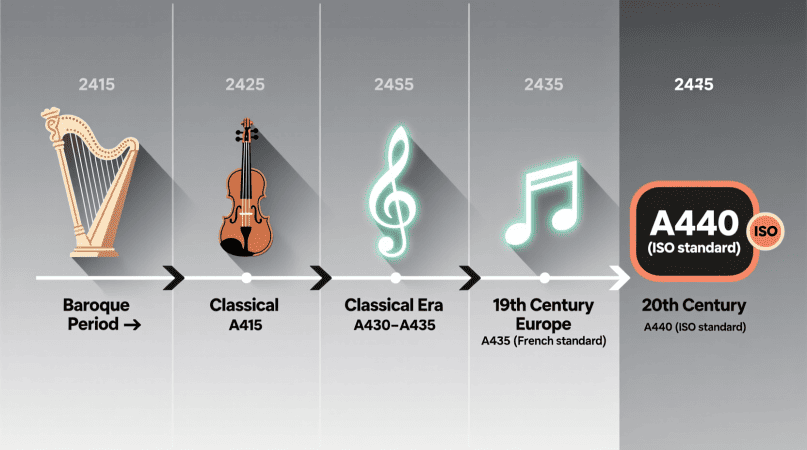
Open the instrument tuner →Historical Pitch Standards Timeline (A4 in Hz)
| Period | Standard | A (Hz) | Cents vs 440 | Where / notes |
|---|---|---|---|---|
| 17th–18th c. | Chorton (choir/organ pitch) | ≈ 465 | +95.7 | German and Venetian organs; played today at A = 466 (“cornetto pitch”) |
| Late 17th–18th c. | French baroque pitch | ≈ 392 | −200.0 | Paris and Versailles; about a whole tone below 440 |
| 18th c. | Kammerton / modern “baroque pitch” | 415 (convention) | −101.3 | Standard of today’s period ensembles for Bach, Handel, Vivaldi |
| 1751 | Handel’s tuning fork | 422.5 | −70.3 | London; often cited as the pitch of Handel’s oratorios |
| Late 18th c. | Classical pitch (period practice) | ≈ 430 | −39.8 | Used today for Mozart, Haydn and early Beethoven |
| 1834 | Stuttgart pitch (Scheibler) | 440 | +0.0 | Recommended by a congress of physicists in Stuttgart |
| 1846–1896 | Old Philharmonic pitch | ≈ 452.5 | +48.5 | London Philharmonic Society, a peak of pitch inflation |
| 1859 | Diapason normal | 435 | −19.8 | French government decree; first legal pitch standard |
| 1885 | Vienna conference | 435 | −19.8 | 435 adopted as international “normal pitch” by Austria, Italy and others |
| 1896 | New Philharmonic pitch | 439 (at 20 °C) | −3.9 | London; 435 re-stated for a warm concert hall |
| 1926 / 1936 | US industry / American Standards Association | 440 | +0.0 | Informal US standard, then a national recommendation |
| 1939 | International conference, London | 440 | +0.0 | A4 = 440 Hz recommended as international concert pitch |
| 1955 / 1975 | ISO/R 16, then ISO 16:1975 | 440 | +0.0 | The worldwide standard still in force |
| Today | Orchestras | 440–443 | 0 to +11.8 | Many European orchestras tune to 442–443 Hz |
What Is Baroque Pitch? A = 415 Hz and the Others
Baroque pitch was never one number. German churches often kept their organs at a high Chorton (choir pitch, around A = 465 Hz), while chamber and wind instruments played at a lower Kammerton a semitone or a whole tone below. In Bach’s Leipzig this meant organ and woodwind parts were sometimes written in different keys so that they sounded together. French baroque ensembles played lower still, around A = 392 Hz.
A = 415 Hz is a modern convention of the early-music movement, not a historical measurement. It sits almost exactly one equal-tempered semitone below 440 (the exact value is 415.30 Hz), so a harpsichord with a sliding, transposing keyboard can switch between 440 and 415, and players can share instruments and parts. The historically informed performance (HIP) world uses a small set of such reference pitches:
- A = 392 Hz: French baroque music (Lully, Rameau), −200.0 cents, about a whole tone low.
- A = 415 Hz: most baroque music (Bach, Handel, Vivaldi, Telemann), −101.3 cents.
- A = 430 Hz: classical-era music (Mozart, Haydn, early Beethoven), −39.8 cents.
- A = 466 Hz: some 17th-century Venetian and north German music, +100.0 cents, a semitone high.
What note is 415 Hz?
At modern pitch, 415 Hz is G♯4 / A♭4 (G♯4 = 415.30 Hz). So a baroque A sounds like a modern G♯, and a piece played at A = 415 sounds one semitone lower than the same notes at 440. The exact gap is 101.3 cents: a semitone plus about one cent. You can check any value in the frequency to note converter.
Handel’s Tuning Fork: A = 422.5 Hz
A tuning fork said to have belonged to George Frideric Handel, dated 1751, sounds A = 422.5 Hz. It is the most quoted piece of evidence for the pitch of Handel’s London oratorios such as Messiah, and some period performances of his oratorios use 422.5 Hz instead of the usual 415. It lies 70 cents below A440, roughly two thirds of a semitone.
For singers this matters because the voice’s registers and passaggi sit at fixed frequencies, not at fixed note names. At 422.5 or 415 Hz, a written high A or B♭ sounds lower than at 440, so high-lying soprano and tenor lines feel noticeably easier. That is one reason choirs compare pitch standards when they plan repertoire across the SATB vocal ranges.
Pitch Inflation in the 19th Century
From the late 18th century onwards, pitch crept upwards. Bigger halls, brass bands, and orchestras that wanted a more brilliant string sound all pushed the reference higher, and instrument makers followed. In London the Philharmonic Society’s “Old Philharmonic pitch” reached about A = 452.5 Hz, almost half a semitone above today’s A440. Singers complained loudly, because operas written for a lower pitch now sat higher in their voices.
Diapason Normal: France Sets A = 435 Hz (1859)
In 1859 the French government appointed a commission, whose members included Berlioz, Rossini and Meyerbeer, and then fixed the diapason normal at A = 435 Hz by decree. It was the first pitch standard set by law, and a reference fork was kept in Paris.
The 1885 Vienna conference adopted 435 Hz as an international “normal pitch” for Austria, Italy and several other countries. Britain went its own way: in 1896 the Philharmonic Society adopted the New Philharmonic pitch, A = 439 Hz at 68 °F (20 °C), commonly explained as the French 435 Hz (specified at a cooler temperature) re-stated for a warm concert hall, where wind instruments play sharper.
When Did A440 Become Standard?
- 1834: the acoustician Johann Scheibler proposed A = 440 Hz, and a congress of physicists in Stuttgart recommended it.
- 1926: the American music industry settled on 440 Hz informally; the American Standards Association recommended it in 1936.
- 1939: an international conference in London recommended A4 = 440 Hz as concert pitch.
- 1955 and 1975: the International Organization for Standardization published it as ISO/R 16, then as ISO 16:1975, still the current standard.
Why 440 and not 439? An often-cited reason is practical: 439 is a prime number and was harder to generate accurately with the electronic frequency dividers used by broadcasters, while 440 was close to the pitch orchestras were already playing in warm halls. The full story of the modern standard is in A440 explained.
Verdi Tuning and 432 Hz
Giuseppe Verdi did support a lower, unified pitch in the 1880s, close to the French 435 Hz. The label “Verdi tuning” for A = 432 Hz (or C = 256 Hz), however, was popularised a century later by the Schiller Institute, not by Verdi, and there is no evidence that his operas were written for exactly 432 Hz. Musically, 432 Hz is 31.8 cents below 440, about a third of a semitone. The claims and the physics are compared in 432 Hz vs 440 Hz.
Modern Concert Pitch: 440, 442 and 443 Hz
ISO 16 fixes 440 Hz, but many European orchestras tune slightly higher for a brighter sound: 442 Hz is +7.9 cents and 443 Hz is +11.8 cents above A440. Most American orchestras stay at 440 to 442 Hz. A chromatic tuner with calibration lets you match whatever the oboe gives.
Why Pitch Standards Changed
| Factor | Effect on pitch |
|---|---|
| Instruments | Gut strings, early wind instruments and organ pipes limited how high a pitch could go; stronger strings and new wind designs allowed higher tuning. |
| Venues and ensembles | Bigger halls, larger orchestras and brass bands favoured a brighter, higher pitch. |
| Temperature | Wind instruments play sharper as they warm up, so the measured pitch depends on the room (hence “439 Hz at 68 °F”). |
| Singers | Higher pitch means more strain; singers’ complaints helped bring about the 1859 French standard. |
| Technology | Tuning forks, then electronic oscillators, radio and recording made one shared reference necessary. |
How to Play or Tune at a Historical Pitch
- Set A4 in your tuner to the pitch you need (415, 422.5, 430, 432 or 442 Hz) and tune as usual.
- To get the frequency of any note at that pitch, type the note and the A4 value into the note to frequency converter.
- To play along with a recording made at A = 415, shift it by −100 cents (one semitone) with the pitch shifter, or tune your instrument down to match.
- Keep all instruments on the same reference and in the same temperament; the differences between tuning systems are explained in intonation and temperament.
Historical Pitch FAQ
What is baroque pitch?
Today it usually means A = 415 Hz, the convention for baroque music. Historically, baroque pitches ranged from about 392 Hz (France) to about 465 Hz (German organs).
Is A = 415 Hz a semitone below A = 440 Hz?
Yes, almost exactly: the equal-tempered semitone below 440 is 415.30 Hz, and 415 Hz is 101.3 cents below 440.
What was concert pitch before A440?
It depended on the place and decade: about 435 Hz in France after 1859, about 452 Hz in London before 1896, 439 Hz in Britain from 1896, and lower pitches of about 415 to 430 Hz in the 18th century.
What is the diapason normal?
The French legal pitch of 1859, A = 435 Hz. It was later adopted by the 1885 Vienna conference as an international standard.
Related: every note in Hz at 440 and 432 is listed in the musical note frequency chart, and all tuners and tuning guides are collected in the instrument tuning hub.
Ornella is a music technology writer and vocal tools specialist at Pitch Detector. She creates practical content around pitch detection, note recognition, vocal analysis, and singing education tools for beginners, singers, and audio creators.