
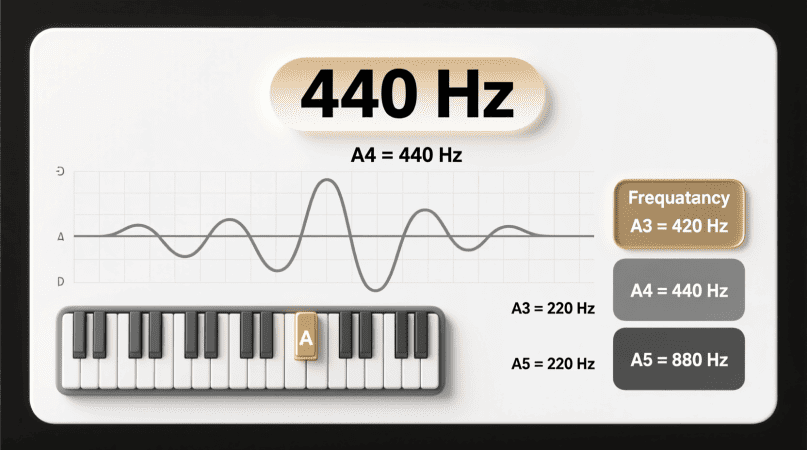
When you open a pitch detector tool, you might notice a reference to “A4 = 440 Hz.”
This number — A440 — defines the modern concert pitch standard used around the world.
It means that the musical note A above middle C (A4) vibrates 440 times per second, and every other note is tuned relative to it.
But where did this standard come from? And why do all modern tuners — including your Pitch Detector — use it by default?
Let’s explore how A440 became the universal reference point for music.
What Is A440?
A440 means:
- The note A4 (the A above middle C)
- Has a frequency of 440 Hertz (Hz)
- Used as the reference tone for tuning instruments worldwide
When you see “A4 = 440 Hz,” it means all other pitches are derived mathematically from this single frequency.
For example:
- A5 = 880 Hz (one octave higher)
- A3 = 220 Hz (one octave lower)
The Frequency-to-Note Converter on our site uses this exact standard.
A Short History of the A440 Standard
Musicians haven’t always agreed on what “A” means.
17th–19th Century: Chaos in Concert Pitch
Before global standardization:
- Baroque orchestras often used A = 415 Hz (lower and warmer).
- Classical European ensembles tuned between A = 430–450 Hz depending on region.
- Church organs and orchestras could differ by as much as a semitone.
This inconsistency made collaboration between ensembles — and even tuning across instruments — nearly impossible.
1939: The London Agreement
In 1939, a London conference recommended A = 440 Hz as the standard “concert pitch.”
This value was based on prior work by acousticians and the American Standards Association, which had adopted the same value earlier.
Why 440 Hz?
- It sits comfortably in the middle of prior tuning systems.
- It balances warmth (lower A) with brightness (higher A).
- It fits well within modern equal temperament tuning.
Since then, A440 has been the ISO 16:1975 standard — still used today.
Equal Temperament and the A440 System
What Is Equal Temperament?
Equal temperament divides an octave into 12 equal steps — each semitone is a frequency ratio of the 12th root of 2 (≈1.05946).
This means:
Frequency of any note = 440 × 2^((n - 49)/12)
(where n is the note’s MIDI number)
This system allows all keys to sound equally in tune, enabling modulations and harmony without retuning instruments.
Why A440 Works Perfectly With Equal Temperament
Because equal temperament uses logarithmic spacing, the A440 anchor ensures:
- All other frequencies are easy to calculate.
- Tuners and pitch detectors can show exact cent offsets (±0.01 semitone).
- Musicians across the globe can collaborate seamlessly.
Learn how that calculation works in our Accuracy Calibration Guide.
Alternative Pitch Standards
| Tuning Standard | Frequency (Hz) | Description |
|---|---|---|
| A415 (Baroque pitch) | 415 Hz | Used in Baroque and early classical music; warmer tone |
| A430 (Classical pitch) | 430 Hz | 19th-century orchestras (Vienna) |
| A435 (Diapason Normal) | 435 Hz | 1859 French government standard |
| A442 / A444 | 442–444 Hz | Used by some modern orchestras for brighter tone |
| A446–A450 | 446–450 Hz | Contemporary and pop tuning preferences |
Even today, certain ensembles use slightly different references — but all pitch detectors let you recalibrate accordingly.
👉 Adjust yours easily in the Accuracy Tests & Calibration Tool.
The Science Behind A440
Every sound wave has:
- Frequency (Hz) = pitch
- Amplitude = loudness
- Waveform = timbre
When a tuning fork or oscillator produces 440 Hz, the waveform repeats 440 times per second.
Your ear perceives that as “A4.”
Modern pitch detectors measure this vibration frequency directly using autocorrelation or Fourier transforms, then map it to the nearest equal-tempered note.
See the math in action in How FFT Works in Pitch Detection.
How Pitch Detectors Use the A440 Standard
Every tuner or pitch detector uses A440 as its calibration base unless you manually adjust it.
When you sing or play:
- The detector measures your sound’s frequency (e.g., 442.5 Hz).
- It compares it to the reference A440 grid.
- It displays:
- Nearest note (A4)
- Frequency deviation (e.g., +10 cents sharp)
- Visual needle or color indicator
You can verify precision using our Accuracy Tests.
A440 and Human Perception
The choice of 440 Hz isn’t arbitrary — it aligns with how humans perceive pitch comfort:
- It sits in the vocal resonance range for most adults.
- It doesn’t fatigue the ear like higher tunings (A450+).
- It balances well with equal temperament’s interval spacing.
Scientific studies in psychoacoustics confirm that small variations (~±5 Hz) affect tone warmth but not perceived note identity — which is why your Pitch Detector flags deviations over ±5 cents as “out of tune.”
Historical Note — Why Some Musicians Disagree
Some musicians argue for a return to A432 Hz, called the “Verdi tuning”, claiming it feels more natural or resonant.
However, scientific consensus finds no measurable psychological or physical difference beyond tonal warmth.
Pitch detectors can support both — simply recalibrate your base frequency to 432 Hz for experimentation.
Read more: Historical Pitch Standards (A415–A460).
Learn More
- Accuracy Calibration — Frequency→Note Conversion
- Historical Pitch Standards
- Intonation & Temperament Explained
- Frequency-to-Note Converter
- Science of Pitch Perception
FAQ: A440 & Tuning Standards
Q1: Why is 440 Hz the standard for tuning?
It was chosen as a global compromise for brightness, clarity, and practicality — standardized by ISO in 1975.
Q2: Can I tune my instrument to A432 or A442?
Yes. Most tuners and detectors allow you to adjust the reference pitch manually.
Q3: Does A440 sound different from A432?
Slightly — A432 sounds warmer and deeper, but both are musically valid. The difference is less than a semitone.
To see how today’s standard evolved, the overview of historical pitch standards gives useful background.
Many musicians compare systems using the guide to intonation and temperament for clearer tuning choices.
If you want to map notes precisely, the how to convert notes to frequency walkthrough is handy.
Visual learners often rely on a simple musical note frequency chart to double-check tuning.
Understanding pitch math is easier after reading about the difference between pitch and frequency.
For practical application, many players pair A440 with a reliable instrument tuner.
Those exploring alternatives can compare systems using the article on best frequency for music
Ornella is a music technology writer and vocal tools specialist at Pitch Detector. She creates practical content around pitch detection, note recognition, vocal analysis, and singing education tools for beginners, singers, and audio creators.