
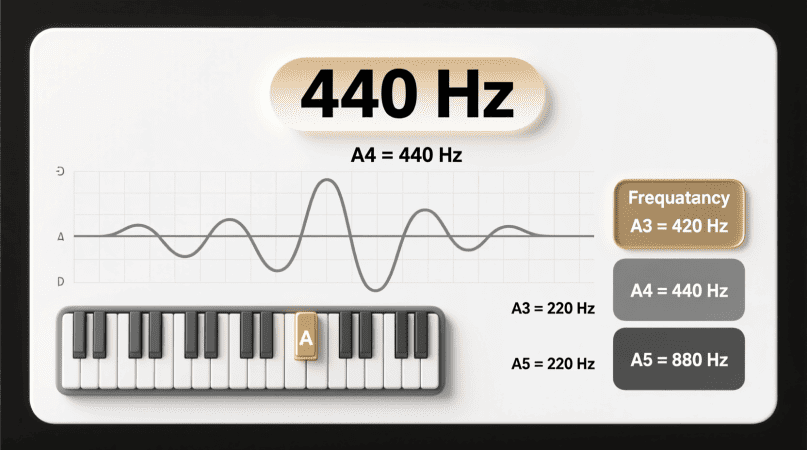
A440 is the note A4, the A above middle C, tuned to exactly 440 Hz (440 vibrations per second). It is the international concert pitch, recommended in 1939 and fixed by ISO 16, and every tuner uses it by default. All other notes follow from it: A3 = 220 Hz, A5 = 880 Hz, middle C = 261.63 Hz.
Hear it · free, in your browser
Play the A440 tuning note
Type A4 in the Note to Frequency Converter and press play to hear the 440 Hz reference tone, or switch the reference to 432, 442 or any custom value and hear the difference.
Play A440 →What Does A440 Mean?
- A is the note name.
- 4 is the octave number in scientific pitch notation, where octaves start on C; middle C is C4, so A4 is the A just above it.
- 440 is the frequency in hertz: the sound wave repeats 440 times per second.
| Property | A4 = A440 |
|---|---|
| Position | A above middle C; 49th key of an 88-key piano |
| MIDI note number | 69 |
| Helmholtz notation | a′ (one-line a) |
| Frequency | 440 Hz |
| Period | 2.273 ms per cycle |
| Wavelength in air (20 °C) | about 78 cm |
| Middle C at A440 | C4 = 261.63 Hz |
Every A on the Piano in Hz
Each octave doubles the frequency, so all the As are simple multiples of 440:
| Note | Frequency (Hz) | MIDI | Piano key |
|---|---|---|---|
| A0 | 27.50 | 21 | 1 |
| A1 | 55.00 | 33 | 13 |
| A2 | 110.00 | 45 | 25 |
| A3 | 220.00 | 57 | 37 |
| A4 (A above middle C) | 440.00 | 69 | 49 |
| A5 | 880.00 | 81 | 61 |
| A6 | 1,760.00 | 93 | 73 |
| A7 | 3,520.00 | 105 | 85 |
| A8 | 7,040.00 | 117 | – |
A440 as the Tuning Note
An orchestra tunes to an A given by the oboe, and pianos, tuning forks and electronic tuners all use A4 = 440 Hz as their reference unless you change it. On a guitar or clip-on tuner, “440” or “A4 = 440 Hz” is the calibration setting: it tells the tuner which frequency counts as a perfect A. Leave it at 440 unless your band or orchestra tunes to 442 or another value.
Guitar standard tuning at A440, from the low string up:
| String | Note | Frequency (Hz) |
|---|---|---|
| 6th (low E) | E2 | 82.41 |
| 5th (A) | A2 | 110.00 |
| 4th (D) | D3 | 146.83 |
| 3rd (G) | G3 | 196.00 |
| 2nd (B) | B3 | 246.94 |
| 1st (high E) | E4 | 329.63 |
Tune by microphone with the free guitar tuner, or use the instrument tuner to play reference tones for 34 instruments at A440 or any other A4.
ISO 16: the Official A440 Standard
The standard is ISO 16:1975, Acoustics — Standard tuning frequency (Standard musical pitch). It sets the frequency of the note A in the treble stave (A4) at 440 Hz. ISO first published the value in 1955 as recommendation ISO/R 16, and the 1975 edition is still the current one. In the United States, NIST’s time-signal stations WWV and WWVH also broadcast a 440 Hz tone once an hour, a legacy of the days when radio was the easiest way to share a reference pitch.
When Did A440 Become the Standard?
The value is older than the standard. Johann Scheibler proposed A = 440 Hz in 1834 and a congress in Stuttgart recommended it, but in the 19th century most of Europe used the French 435 Hz. The US music industry settled on 440 Hz informally in 1926 and the American Standards Association recommended it in 1936. An international conference in London recommended A4 = 440 Hz in 1939, and ISO confirmed it in 1955 and 1975. The full timeline, from baroque A = 415 onwards, is in historical pitch standards.
Why 440 Hz?
There is nothing acoustically special about 440 Hz. It won because it was practical:
- It was close to what orchestras already played: the French 435 Hz, measured in a cool room, comes out near 439 Hz in a warm concert hall.
- An often-cited technical reason: 439 is a prime number and was harder to generate accurately with the frequency dividers used by broadcasters, while 440 was easy.
- Radio, recording and instrument factories needed one shared number, and 440 was already the US standard.
A440 and Equal Temperament
In 12-tone equal temperament every semitone multiplies the frequency by the twelfth root of 2 (about 1.05946). With A4 = 440 Hz as the anchor, any note’s frequency is f = 440 × 2(m − 69)/12, where m is the MIDI note number (or f = 440 × 2(n − 49)/12 with n = the piano key number). Middle C is 9 semitones below A4: 440 × 2−9/12 = 261.63 Hz. The step-by-step method is in how to convert notes to frequency, every note is listed in the note frequency chart, and other tuning systems are compared in intonation and temperament.
A440 vs 432, 442 and Other Reference Pitches
| Reference | Cents vs A440 | Used for |
|---|---|---|
| A = 415 Hz | −101.3 | Baroque pitch (period ensembles) |
| A = 430 Hz | −39.8 | Classical-era pitch (period ensembles) |
| A = 432 Hz | −31.8 | “Verdi” / alternative tuning |
| A = 435 Hz | −19.8 | French diapason normal (1859) |
| A = 440 Hz | 0 | ISO 16 standard concert pitch |
| A = 442 Hz | +7.9 | Many European and some US orchestras |
| A = 443 Hz | +11.8 | Some German and Austrian orchestras |
| A = 444 Hz | +15.7 | Occasional brighter orchestral tuning |
How cents work is explained in what are cents in music. The popular 432 Hz claims are checked in 432 Hz vs 440 Hz: the difference is a third of a semitone, audible side by side but not a different kind of sound.
Piano Tuning and A440
A piano tuner sets A4 to 440 Hz (or 442 on request) first and tunes the rest of the piano from it. Because piano strings are stiff, their overtones run slightly sharp, so tuners “stretch” the octaves: the highest notes end up a little above the textbook values and the lowest a little below. What a pitch detector can and cannot do here is covered in pitch detection for piano tuning.
A440 FAQ
Which A is 440 Hz?
A4, the A above middle C (the 49th key on an 88-key piano). A3 below it is 220 Hz and A5 above it is 880 Hz.
What note is 440 Hz?
440 Hz is exactly A4 at standard pitch. For any other frequency, the frequency to note converter gives the note and how many cents sharp or flat it is.
Is 440 Hz standard tuning?
Yes. A4 = 440 Hz is the international standard (ISO 16) and the default on almost every tuner, piano and digital instrument. Some orchestras tune a little higher, to 442 or 443 Hz.
Is A440 the same as concert pitch?
Yes. “Concert pitch” means the agreed reference for A4, and today that is 440 Hz. The term is also used for non-transposing notation (for example, a B♭ trumpet’s written C sounds B♭ in concert pitch).
Related: tune any note with the chromatic tuner (A4 adjustable from 415 to 466 Hz), or browse every tuner and tuning chart in the instrument tuning hub.
Ornella is a music technology writer and vocal tools specialist at Pitch Detector. She creates practical content around pitch detection, note recognition, vocal analysis, and singing education tools for beginners, singers, and audio creators.