
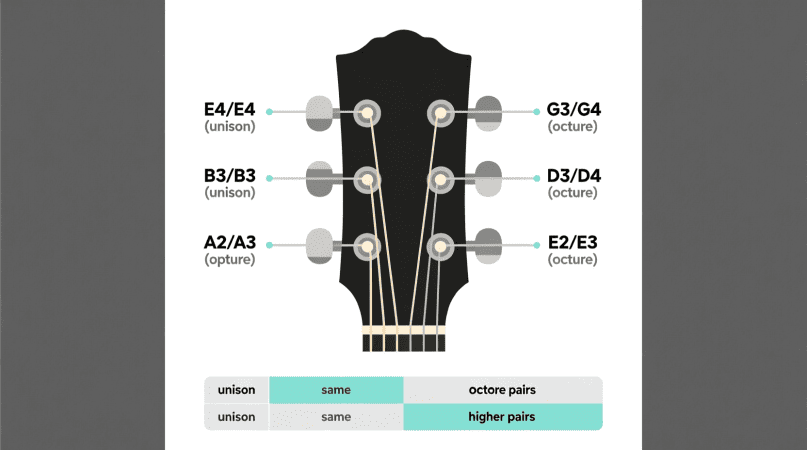
The 12-string guitar produces a shimmering, full, and chorus-like sound thanks to its paired strings, also known as courses.
Each course contains two strings, tuned either in unison or octaves, creating a fuller and richer tone than a standard 6-string guitar.
Understanding the 12-string guitar tuning chart is essential for beginners and professionals who want accurate tuning, stable tone, and proper instrument care.
12 String Guitar Tuning Chart (Standard E Tuning)
A 12-string guitar uses the same tuning notes as a 6-string, but with paired strings tuned differently.
Standard Tuning by Course
1st Course – High E (Unison)
- E4
- E4
2nd Course – B (Unison)
- B3
- B3
3rd Course – G (Octave)
- G3
- G4 (one octave higher)
4th Course – D (Octave)
- D3
- D4 (one octave higher)
5th Course – A (Octave)
- A2
- A3 (one octave higher)
6th Course – Low E (Octave)
- E2
- E3 (one octave higher)
When practicing new chords, the note detection tool ensures each string rings at the right frequency.
12-String Guitar Tuning Table (Quick Reference)
| String Course | Lower String | Higher String | Tuning Type |
|---|---|---|---|
| 1 | E4 | E4 | Unison |
| 2 | B3 | B3 | Unison |
| 3 | G3 | G4 | Octave |
| 4 | D3 | D4 | Octave |
| 5 | A2 | A3 | Octave |
| 6 | E2 | E3 | Octave |
This is the official standard tuning for acoustic and electric 12-string guitars.
Why 12-String Guitars Use Octave & Unison Pairs
Unison Pairs (E & B)
- Provide clarity
- Add brightness
- Help maintain pitch stability
Octave Pairs (G, D, A, E)
- Add harmonic depth
- Create the chorus-like shimmer
- Produce a fuller, richer sound
This tuning structure is what gives the 12-string guitar its iconic sparkle.
Alternate Tunings for 12-String Guitar
Many players use alternate tunings for vocal comfort, easier playability, or a different sonic character.
1. Half-Step Down (Eb Standard)
Eb Ab Db Gb Bb Eb
(Same pairing structure, just lower pitch)
Great for:
- Lower tension
- Easier fretting
- Warmer tone
2. Drop D (DADGBE)
Lower the 6th course one whole step:
- D2
- D3
Popular for:
- Rock
- Fingerstyle
- Power chords
3. Open G (D-G-D-G-B-D)
Excellent for:
- Slide guitar
- Blues
- Folk
4. Open D (D-A-D-F#-A-D)
Used in:
- Resonant fingerstyle
- Folk
- Atmospheric playing
5. Nashville Tuning (High-Octave Only)
Used in studio layering to create a shimmering doubled sound.
How to Tune a 12-String Guitar Correctly
1. Tune the thicker string first
Then bring the paired string to its octave or unison pitch.
2. Always tune up to pitch
If you pass the note, tune down below it and tune up again.
3. Use a precise digital tuner
Because every paired string must be individually tuned.
4. Tune slowly to protect the neck
12-strings have nearly double the tension of a 6-string.
5. Consider lighter gauge strings
This reduces neck stress and increases comfort.
12-String Guitar Tuning Tips for Beginners
- Tune in pairs but check each string separately
- Tune in small increments to avoid breakage
- Stretch strings lightly to help stabilize pitch
- Check tuning frequently—12-strings drift more easily
- Store the guitar in a stable humidity environment
Common Questions
What is the standard tuning for a 12-string guitar?
EADGBE, with unison pairs for the high E and B strings, and octave pairs for the remaining strings.
Why do some 12-string guitars sound brighter?
Because octave strings add harmonic sparkle and fullness.
Can I tune my 12-string down a whole step?
Yes. Many players tune down to reduce tension and improve playability.
Do I need special strings for a 12-string guitar?
Yes, 12-string sets include paired gauges for octave and unison courses.
Conclusion
The 12-string guitar tuning chart is essential for understanding how paired strings work, ensuring accurate tuning, and producing the full, shimmering tone that defines this instrument.
Whether you’re a beginner or an experienced musician, mastering standard and alternate tunings will expand your tonal possibilities and improve your playing experience.
To double-check string targets, the guitar tuning chart makes it easy to see every note at a glance.
When switching to bass, the bass guitar tuning chart shows how lower strings are laid out.
Players who want visual positions often rely on the basic guitar notes chart for quick reference.
If you’re practicing warm-ups before tuning, the beginner guitar warm ups are a helpful starting point.
For structured daily sessions, the beginner guitar practice routine keeps things on track.
To verify pitch accuracy while tuning, the instrument tuner gives instant feedback.
When using software, the guide on can a pitch detector tune a guitar explains what to expect.
Ornella is a music technology writer and vocal tools specialist at Pitch Detector. She creates practical content around pitch detection, note recognition, vocal analysis, and singing education tools for beginners, singers, and audio creators.