
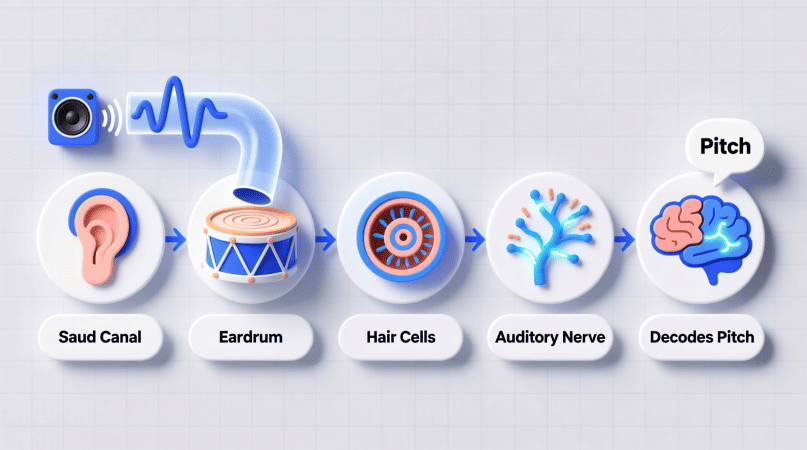
When you sing a note or tune your guitar, what you’re really doing is aligning with how your brain perceives vibration.
Pitch isn’t just a physical property — it’s a psychological experience.
It begins as a simple vibration in the air and ends as a precise musical perception in your brain.
Modern tools like the Pitch Detector mimic this process — measuring sound frequency just as your auditory system does, but with mathematical precision.
1. What Is Pitch?
Pitch is our perception of how “high” or “low” a sound is.
Scientifically, it’s related to frequency, or the number of sound wave vibrations per second — measured in Hertz (Hz).
| Note | Frequency (Hz) | Example |
|---|---|---|
| A2 | 110 | Low male voice |
| A4 | 440 | Standard tuning reference |
| A6 | 1760 | High flute tone |
But pitch isn’t exactly the same as frequency.
Two sounds with the same frequency can feel different depending on loudness, timbre, and harmonic content.
2. How the Ear Detects Pitch
Step 1: Air Vibrations Enter the Ear
Sound waves travel through the air and hit your eardrum, causing it to vibrate.
Step 2: Mechanical → Neural Conversion
These vibrations move through three tiny bones (ossicles) into the cochlea — a spiral-shaped organ filled with fluid and tiny hair cells.
Each hair cell responds best to a specific frequency:
- Low frequencies stimulate hair cells at the apex of the cochlea.
- High frequencies stimulate cells near the base.
⚡ Step 3: Brain Interpretation
The auditory nerve converts these mechanical signals into electrical impulses, which your auditory cortex interprets as pitch.
Essentially:
The ear measures frequency →
The brain labels it as a musical note.
3. Harmonics — The Hidden Layers of Pitch
Every note you play or sing isn’t one frequency — it’s a combination of many.
The lowest one is the fundamental frequency (F₀), which defines pitch.
The others are harmonics, integer multiples of the fundamental.
| Harmonic | Formula | Role |
|---|---|---|
| 1st | 1×F₀ | Defines the note |
| 2nd | 2×F₀ | Adds brightness |
| 3rd | 3×F₀ | Adds richness |
| 4th+ | n×F₀ | Defines timbre and tone color |
Pitch detectors isolate F₀ by filtering out harmonics — just like your brain naturally does when identifying melody in a noisy environment.
Learn how algorithms extract this in How FFT Works in Pitch Detection.
4. The “Missing Fundamental” Illusion
Here’s one of the most fascinating facts in psychoacoustics:
Even if the fundamental frequency (F₀) is missing, your brain still hears it.
Example:
- If a sound contains harmonics at 1000, 1200, 1400 Hz (multiples of 200 Hz)
- You’ll still perceive the pitch as 200 Hz, even though it’s not physically present.
This is called the missing fundamental effect, and it’s why:
- Small speakers still sound “bass-like.”
- Your brain can infer pitch from partial information.
Pitch detectors replicate this logic mathematically — analyzing frequency spacing to estimate F₀ even when it’s buried in harmonics.
5. Why Humans Hear Pitch Logarithmically
Pitch perception is logarithmic, not linear.
That means doubling a frequency sounds like a jump of one octave — not double the pitch.
| Frequency | Ratio | Perceived Distance |
|---|---|---|
| 220 → 440 Hz | ×2 | 1 octave |
| 440 → 880 Hz | ×2 | 1 octave |
| 440 → 660 Hz | ×1.5 | a perfect fifth |
That’s why musical scales are based on ratios like 2:1 (octave), 3:2 (fifth), 5:4 (third).
Pitch detectors follow this same scale in their internal note mapping (equal temperament).
See: Intonation & Temperament Explained
6. How Pitch Detectors Model Human Hearing
Modern pitch detection tools combine acoustic theory with human perception modeling:
| Step | Human Ear | Pitch Detector |
|---|---|---|
| 1. Sound reception | Cochlea senses vibrations | Microphone captures waveform |
| 2. Frequency recognition | Neural filters detect F₀ | FFT/YIN algorithm detects F₀ |
| 3. Perception smoothing | Brain averages variation | Temporal smoothing of frames |
| 4. Musical mapping | Brain maps pitch to note memory | Algorithm maps Hz → note name |
This psychoacoustic modeling is what makes pitch detectors “feel human” — they respond to tone stability, noise, and vibrato in familiar ways.
Learn more in Pitch Tracking vs Pitch Detection.
7. Pitch Perception and Emotion
Pitch perception isn’t purely mechanical — it’s emotional.
Our brains associate certain pitch ranges and intervals with feelings:
- Low pitches → power, warmth, or sadness
- High pitches → brightness, energy, tension
Musicians intuitively exploit this — and pitch detectors help visualize these emotional contours for training and analysis.
8. Why People Perceive Pitch Differently
Several factors affect pitch sensitivity:
- Age: higher frequency sensitivity declines with age.
- Training: musicians have narrower pitch discrimination thresholds (±2–3 cents).
- Hearing loss or EQ imbalance: can distort harmonic perception.
- Cultural context: some scales (Arabic, Indian) use microtones Western ears don’t natively perceive.
For example, an untrained ear might perceive two notes as “the same,” but a trained vocalist can hear (and see) a difference of just 5 cents using the Voice Pitch Analyzer.
9. The Limits of Human Pitch Accuracy
| Sound Source | Average Human Perception Limit |
|---|---|
| Trained musicians | ±2–3 cents |
| Average listener | ±5–10 cents |
| Digital pitch detector | ±0.5 cents |
That’s why even professional singers use digital pitch analyzers — they reveal micro deviations invisible to the ear, improving both awareness and performance.
10. How the Brain Links Pitch and Harmony
The brain doesn’t hear pitches in isolation — it hears relationships.
When two notes are played together:
- If their frequencies form simple ratios (like 2:1 or 3:2), they sound consonant.
- If they form complex ratios, they sound dissonant.
This is why equal temperament slightly alters intervals: to balance consonance across all keys.
See: Equal Temperament & A440
FAQ — Science of Pitch Perception
Q1: Why can’t I always sing exactly in tune even if I hear it?
Because your brain’s motor control and auditory feedback systems take milliseconds to adjust — a tiny delay that causes drift.
Q2: Why do some people have perfect pitch?
Their auditory memory forms stronger pitch-frequency associations during early childhood development.
Q3: Can pitch detectors “hear” better than humans?
In a way — they’re mathematically precise, but they don’t perceive music emotionally like we do.
To see how raw audio becomes usable data, the breakdown of how to measure pitch in music connects perception to analysis.
When human hearing meets software, the guide on how accurate pitch detectors are explains what machines can really hear.
Musicians often validate what they perceive by using a simple detect the pitch of my voice tool during practice.
If you’re translating sound into numbers, the article on what is a frequency note converter explains that perceptual bridge.
To explore how your own ear compares, the normal pitch for a 30-year-old provides a useful reference.
Studio professionals apply perception science with a pitch detection tool for audio engineers in production work.
For applied learning, the guide on using a pitch detector for singing shows how listeners train their ear with feedback.
Ornella is a music technology writer and vocal tools specialist at Pitch Detector. She creates practical content around pitch detection, note recognition, vocal analysis, and singing education tools for beginners, singers, and audio creators.