
Learning guitar becomes much easier when you understand the notes on the fretboard. A basic guitar notes chart is one of the most helpful tools for beginners because it shows the musical notes on each string and fret. Whether you’re learning chords, scales, or songs, knowing where notes are located will speed up your progress.
In this guide, we’ll explain what a guitar notes chart is, how to read it, and why it’s essential for building a strong foundation.
What Is a Guitar Notes Chart?
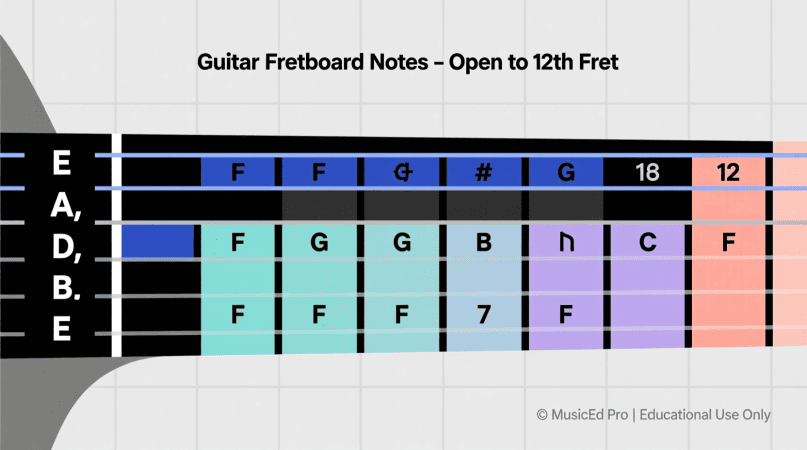
A guitar notes chart is a visual map of the guitar fretboard. It shows:
- All six guitar strings
- The notes played on each fret
- The open-string notes (E–A–D–G–B–E)
- Repeating notes at the 12th fret (one octave higher)
It helps beginners identify notes quickly without memorizing the entire fretboard at once.
Before your next practice session, try a pitch test for singing accuracy.
Standard Guitar Tuning (Open String Notes)
Before reading guitar notes, you must know the names of the open strings in standard tuning:
| String Number | Note | Description |
|---|---|---|
| 6th (thickest) | E | Low E string |
| 5th | A | A string |
| 4th | D | D string |
| 3rd | G | G string |
| 2nd | B | B string |
| 1st (thinnest) | E | High E string |
This is remembered as E – A – D – G – B – E. You can assess measurable performance differences by comparing results from the accuracy tests.
Basic Guitar Notes Chart (Up to the 12th Fret)
A typical guitar notes chart shows the notes from the open string to the 12th fret because after the 12th fret, the notes repeat.
For example:
- Open string: E
- 12th fret: E (one octave higher)
Here’s how a full notes chart is commonly presented:
Notes on Each Guitar String
6th & 1st Strings (E Strings)
E – F – F# – G – G# – A – A# – B – C – C# – D – D# – E
5th String (A String)
A – A# – B – C – C# – D – D# – E – F – F# – G – G# – A
4th String (D String)
D – D# – E – F – F# – G – G# – A – A# – B – C – C# – D
3rd String (G String)
G – G# – A – A# – B – C – C# – D – D# – E – F – F# – G
2nd String (B String)
B – C – C# – D – D# – E – F – F# – G – G# – A – A# – B
These patterns repeat across the entire fretboard.
Why Learning a Notes Chart Is Important
1. Helps You Understand the Fretboard
It becomes easier to visualize how notes connect and move across strings and frets.
2. Essential for Scales and Chords
Scales like major, minor, pentatonic, and blues are easier to understand when you know the notes.
3. Improves Soloing and Improvisation
Lead guitar playing relies heavily on knowing note positions.
4. Helps With Transposing Songs
You can easily change the key of a riff or chord progression.
5. Builds Musical Confidence
Knowing notes helps you become a complete musician, not just a chord player.
Tips to Memorize Guitar Notes Quickly
1. Start with Natural Notes
Focus on A, B, C, D, E, F, G—without sharps or flats.
2. Learn the Notes on the 6th and 5th Strings
These strings are used for barre chords, power chords, and scale shapes.
3. Use the 12th Fret as a Reference Point
Everything after the 12th fret repeats in an octave.
4. Practice with Simple Exercises
Say the notes out loud while playing them on your guitar.
5. Use Flashcards or Learning Apps
Many apps can help you memorize fretboard notes faster.
Final Thoughts
A basic guitar notes chart is one of the most important tools for learning guitar. It helps beginners understand the structure of the instrument, learn chords and scales faster, and improve overall playing skills.
- Many beginners find a guitar tuning reference helpful before memorizing where notes fall on the fretboard.
- To connect notes with real sounds, this online pitch detector lets you hear and verify each pitch.
- Understanding frequency makes more sense after reading this simple pitch vs frequency guide.
- If you want to practice scales from your notes, this scale conversion chart gives a useful visual shortcut.
- For low-end reference, a bass guitar tuning chart shows how deeper strings relate to standard notes.
- Players interested in theory often use this musical frequency chart to connect notes with hertz.
- To build muscle memory, following a beginner practice routine can make daily drills more effective.
Ornella is a music technology writer and vocal tools specialist at Pitch Detector. She creates practical content around pitch detection, note recognition, vocal analysis, and singing education tools for beginners, singers, and audio creators.