
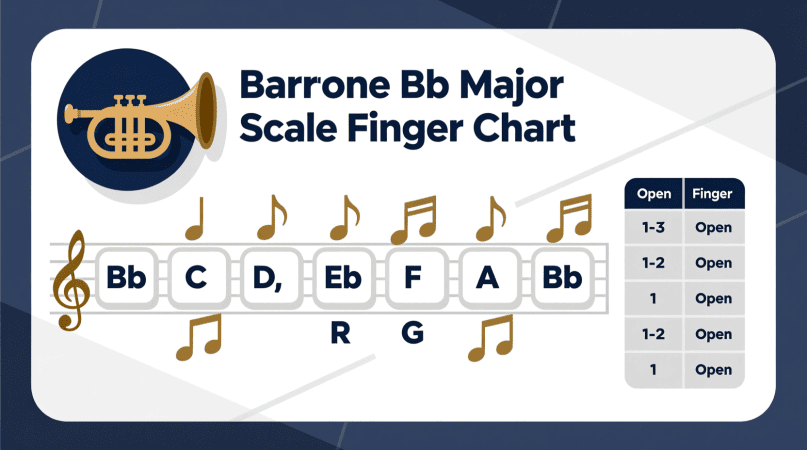
A baritone scale finger chart is one of the most valuable tools for new baritone horn players. It shows which valves to press for each note in a scale, helping beginners develop tonal accuracy, muscle memory, and smooth transitions. Whether you’re learning the baritone in school band or teaching yourself at home, mastering scales with clear fingering charts is the foundation for strong musicianship.
This SEO-optimized guide explains what a baritone scale finger chart is, why it matters, and includes finger charts for the most important major scales: Bb, F, Eb, and C. Charts are shown for both bass clef and treble clef so every player can follow correctly.
What Is a Baritone Scale Finger Chart?
A baritone scale finger chart is a visual guide that shows:
- Each note in a major scale
- The correct valve combination for that note
- The note’s position on the staff
- Versions for both treble and bass clef
Since the baritone horn uses combinations of three valves to create different pitches, these charts make it easier for beginners to remember the correct fingerings and practice scales accurately. For checking recorded vocals, pair this tool with the audio-file pitch detector.
Why Baritone Players Need Scale Finger Charts
Baritone scale finger charts help players:
- Learn new notes faster
- Develop smooth finger transitions
- Build strong embouchure and airflow control
- Improve intonation (pitch accuracy)
- Prepare for band tests and auditions
- Build confidence when reading music
Most band programs require players to learn Bb, Eb, F, and C major scales, so mastering these is essential.
Baritone Bb Major Scale Finger Chart
The Bb Major Scale is the first scale taught to baritone players. It appears in nearly every beginner band book and many concert band pieces.
Bb Major Scale – Bass Clef Fingering Chart
| Note | Fingering |
|---|---|
| Bb | Open |
| C | 1–3 |
| D | 1–2 |
| Eb | 1 |
| F | Open |
| G | 1–2 |
| A | 1 |
| Bb | Open |
Learning an instrument is easier when the online pitch detection tool shows how close you are to each target note.
Bb Major Scale – Treble Clef Fingering Chart
| Written Note | Fingering |
|---|---|
| C | Open |
| D | 1–3 |
| E | 1–2 |
| F | 1 |
| G | Open |
| A | 1–2 |
| B | 1 |
| C | Open |
Baritone F Major Scale Finger Chart
The F Major Scale helps develop smooth movement between low and mid-range notes.
F Major Scale Fingering Chart
| Note | Fingering |
|---|---|
| F | Open |
| G | 1–2 |
| A | 1 |
| Bb | Open |
| C | 1–3 |
| D | 1–2 |
| E | 1 |
| F | Open |
Baritone Eb Major Scale Finger Chart
The Eb Major Scale is commonly used in concert band repertoire and is essential for intermediate players.
Eb Major Scale Fingering Chart
| Note | Fingering |
|---|---|
| Eb | 1 |
| F | Open |
| G | 1–2 |
| A | 1 |
| Bb | Open |
| C | 1–3 |
| D | 1–2 |
| Eb | 1 |
Baritone C Major Scale Finger Chart
The C Major Scale builds finger coordination and strengthens 1–3 and 1–2 valve combinations.
C Major Scale Fingering Chart
| Note | Fingering |
|---|---|
| C | 1–3 |
| D | 1–2 |
| E | 1 |
| F | Open |
| G | 1–2 |
| A | 1 |
| B | 2 |
| C | Open |
Treble Clef vs Bass Clef Scale Charts
Although baritone fingerings stay the same, the written notes differ depending on the clef.
| Feature | Bass Clef | Treble Clef |
|---|---|---|
| Use | Concert band | Brass band |
| Pitch | Concert pitch | Transposed up a major 2nd |
| Best For | Standard baritone players | Trumpet players switching to baritone |
Both clefs use exactly the same valve combinations.
How to Practice Baritone Scales for Best Results
Follow these tips to improve your scale skills:
1. Start Slow
Play each scale at a comfortable tempo before increasing speed.
2. Use Proper Breath Support
Steady air equals steady pitch.
3. Use a Tuner
Scales help develop intonation, especially with 1–2 and 1–3 combinations.
4. Practice Daily
Repetition builds finger muscle memory.
5. Focus on Even Tone
Each note should sound connected and smooth.
Benefits of Using a Baritone Scale Finger Chart
A baritone scale finger chart gives beginners:
- Clear visual guidance
- Faster note recognition
- Better technical accuracy
- Stronger tone and control
- Improved reading skills
- Confidence in band class and performances
Music teachers recommend keeping a scale finger chart in your folder for daily reference.
Final Thoughts
A baritone scale finger chart is one of the simplest yet most powerful tools for learning the baritone horn. By using these charts and practicing major scales regularly, beginners can build a strong musical foundation and progress much faster.
Many players also reference a baritone notes finger chart to match scale tones with finger positions.
To understand how those notes are labeled, this vocal range notes guide gives clear pitch names.
When practicing scales, a real-time pitch tracker helps keep every note in tune.
To see how baritone pitches convert to numbers, this note frequency chart shows exact hertz values.
For tuning precision, this cents in music article explains fine pitch adjustments.
If you record practice sessions, this audio pitch testing guide helps review scale accuracy.
To see where baritone notes sit in the wider spectrum, this instrument frequency range overview adds useful context.
Ornella is a music technology writer and vocal tools specialist at Pitch Detector. She creates practical content around pitch detection, note recognition, vocal analysis, and singing education tools for beginners, singers, and audio creators.