
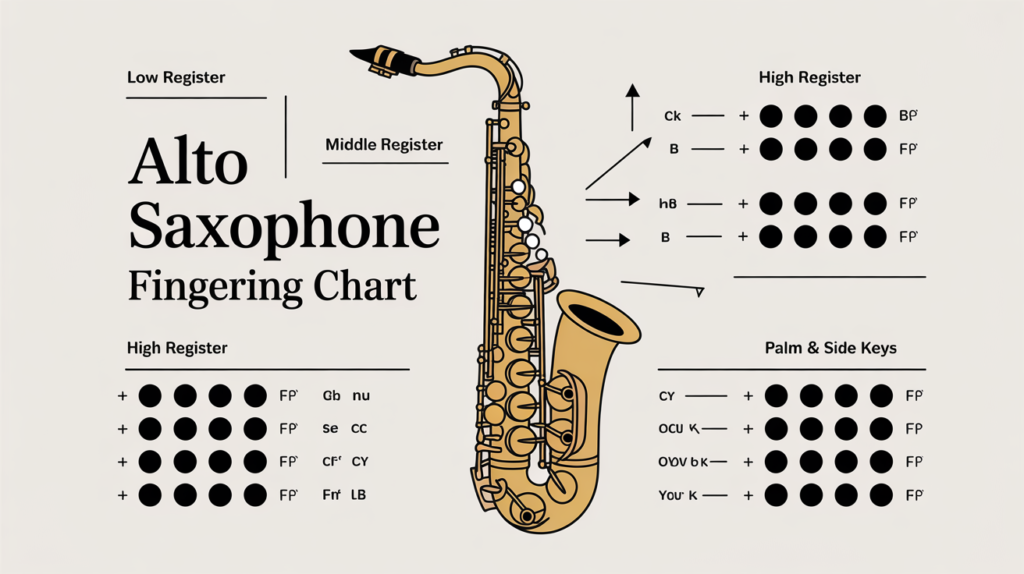
Learning the alto saxophone starts with understanding how to place your fingers correctly on the keys. An alto saxophone fingering chart helps beginners see exactly which keys to press for each note—from low B♭ all the way up to high F♯.
This complete guide explains every note on the alto sax, how the octave key changes register, how palm keys and side keys work, and how to read a fingering chart the right way.
Understanding Alto Saxophone Finger Placement
Before learning individual notes, know where your hands go:
Left Hand (Top Keys)
- Index finger → Key 1
- Middle finger → Key 2
- Ring finger → Key 3
- Left thumb → Octave key
- Also controls palm keys and side keys
Right Hand (Bottom Keys)
- Index → Key 4
- Middle → Key 5
- Ring → Key 6
- Pinky → Bottom cluster (C, B, B♭ keys)
- Thumb supports the sax
Proper hand position makes all fingerings easier.
The results make more sense when viewed alongside the pitch detection methodology that powers the tests.
Alto Sax Fingering Chart: Low Register (Low B♭ – Middle C)
Low B♭ (Bb2)
Left hand: 1–2–3
Right hand: 4–5–6
Right pinky: B♭ key
Low B
Same as above but use B key.
Low C
Right-hand pinky on C key only.
Low D / E♭ / E
Standard full fingerings (1–2–3 | 4–5–6)
E♭: use right pinky E♭ key
Middle C
Open fingering—no fingers, no octave key.
Middle Register (C♯ – G)
These notes use the octave key on the left thumb.
C♯ (C#)
Completely open (no fingers)
D
Finger 1–2–3 + 4–5–6 + octave key
E
1–2–3 + 4–5 + octave key
F
1–2–3 + 4 + octave key
G
1–2–3 only + octave key
Upper Register (High A – High F♯)
Top notes require octave key + palm keys.
High A
1–2 + octave key
High B
1 + octave key
High C
Octave key only
High D, E♭, E, F
Use palm keys on the left side of the sax.
Examples:
- High D = Palm D
- High E♭ = Palm D + E♭
- High F = D + E♭ + F palm keys
High F♯
Palm F + F♯ key (on modern saxes)
Side Keys & Pinky Keys (Essential for Fast Playing)
Side Keys
Used for:
- Side C
- Side B♭
- Trills between B–C
- Alternate notes in fast passages
Pinky Cluster Keys
Controls:
- Low C
- Low B
- Low B♭
- C♯
Beginners must learn smooth pinky movement for low notes.
Alternate Fingerings (Useful for Speed & Trills)
Advanced players use alternate fingerings for agility:
- Side B♭ fingering
- Forked F fingering
- Side C fingering
- High F♯ key (extra key on newer saxophones)
Alternate fingerings help create smoother transitions and cleaner phrasing.
How to Practice Using a Fingering Chart
- Practice long tones on every note
- Keep fingers close to keys
- Use steady airflow
- Add octave key only when needed
- Practice B♭, E♭, and F major scales
- Switch between notes slowly to build muscle memory
Singers working on vocal precision often rely on the real-time pitch detector to correct subtle tuning issues that are hard to hear naturally.
Common Beginner Mistakes (and Fixes)
| Mistake | Fix |
|---|---|
| Pressing keys too hard | Use a light touch |
| Lifting fingers too high | Keep fingers close to keys |
| Squeaky upper notes | Use steady air + correct octave key |
| Weak low notes | More air support + tight embouchure |
| Leaking fingers | Cover tone holes completely |
Why an Alto Saxophone Fingering Chart Matters
A fingering chart helps you:
- Learn notes faster
- Avoid bad habits
- Improve accuracy and tone
- Understand alternate fingerings
- Transition easily between registers
- Build confidence as a beginner
Every sax player—no matter the level—uses a chart as a reference.
FAQ: Alto Saxophone Fingering Chart
1. Is alto sax fingering the same as tenor sax?
Yes, fingerings are the same even though they are different keys.
2. What’s the easiest note for beginners?
G, A, and B are the easiest starting notes.
3. What fingering system is used for alto sax?
Standard Boehm key system—used worldwide.
4. Why are my high notes squeaking?
Too much air or incorrect octave-key pressure.
5. Do all alto saxes have a high F♯ key?
Newer models do, but many student models don’t.
Conclusion
An alto saxophone fingering chart is essential for learning every note, understanding how the octave key works, and mastering low, middle, and high registers. With steady practice and correct finger placement, beginners can quickly develop strong technique and clean, expressive tone.
To refine high-note control while practicing fingerings, the whistle high register tips can improve stability.
Players working on smoother tone often benefit from the vibrato pitch stability guide.
For consistent intonation across the range, the choir practice analyzer offers practical feedback.
If you want structured online help, the virtual singing lessons provide guided training.
Expanding into altissimo becomes easier with the range expansion tool.
For technical grounding, the voice pitch analyzer overview explains how feedback works.
Sax players who double on strings may also use the ukulele tuning tips for quick pitch checks.
Ornella is a music technology writer and vocal tools specialist at Pitch Detector. She creates practical content around pitch detection, note recognition, vocal analysis, and singing education tools for beginners, singers, and audio creators.