
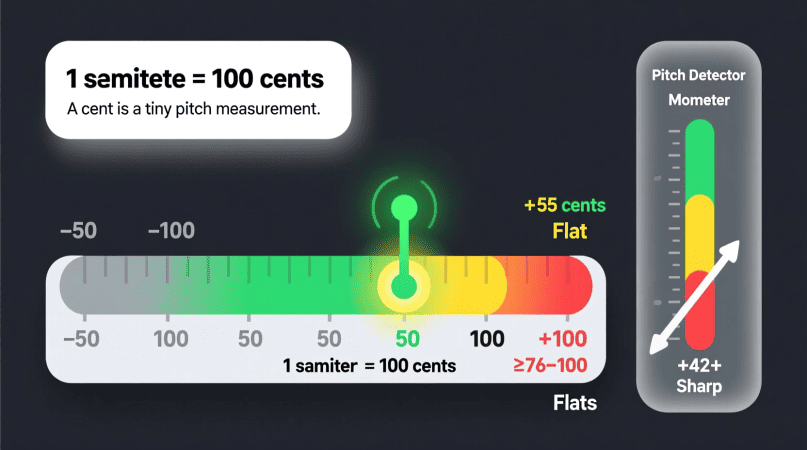
If you’ve ever looked at a tuner and wondered what “+5 cents sharp” really means, you’re not alone. Musicians talk about being “a little flat” or “slightly sharp,” but cents give us a way to measure pitch accuracy precisely. Let’s break down what cents are, how they’re calculated, and why they matter when tuning instruments or training your voice.
The Basics: What Is a Cent?
- A cent is a unit of pitch measurement.
- One semitone (the distance between two adjacent piano keys) is divided into 100 cents.
- There are 1200 cents in an octave.
This system is logarithmic, meaning the size of a cent feels the same no matter if you’re tuning a bass note or a high soprano pitch.
Why Musicians Use Cents
Cents help you understand how close you are to being in tune.
- Instrument tuning – Guitarists, pianists, and violinists can fine-tune beyond just “in tune” or “out of tune.”
- Vocal accuracy – A tool like our Online pitch detector shows exactly how many cents sharp or flat you are.
- Comparing tuning systems – In equal temperament, a major third is 400 cents, while in just intonation it’s ~386 cents. That 14-cent difference explains why chords feel sweeter in some tunings.
How to Calculate Cents
The formula for cents between two frequencies is:
cents = 1200 × log2 (f2 / f1)
- f1f_1 = reference frequency
- f2f_2 = measured frequency
Example:
- Reference note = A4 (440 Hz)
- Measured note = 445 Hz
- 1200×log2(445/440)≈+19.61200 \times \log_2(445/440) \approx +19.6 cents sharp
That’s nearly 20 cents off—clearly noticeable.
How Many Cents Can We Hear?
- 5 cents or less → Hard for most listeners to detect.
- 10 cents → Noticeable to trained ears.
- 20 cents or more → Very noticeable; sounds clearly out of tune.
That’s why most tuners highlight ±10 cents as the “green zone.” Try Our: mp3 pitch analysis online
Equal Temperament vs Just Intonation (in Cents)
| Interval | Equal Temperament | Just Intonation | Difference |
|---|---|---|---|
| Octave | 1200 | 1200 | 0 |
| Perfect Fifth | 700 | 702 | 2 cents |
| Major Third | 400 | 386 | 14 cents |
| Minor Third | 300 | 316 | 16 cents |
These small differences add up, which is why chords can sound slightly different depending on the tuning system.
You can also check your capabilities using this simple voicerangetest designed for quick results.
FAQs About Cents in Tuning
Q: How many cents are in a semitone?
100 cents.
Q: How many cents are in an octave?
1200 cents.
Q: Can humans hear a 5-cent difference?
Most can’t; trained musicians sometimes can.
Q: Why do tuners display cents?
It gives precise feedback, helping players and singers refine their accuracy.
Cents make more sense once you compare them to pitch versus frequency.
Fine tuning choices are easier when you know the best frequency for music.
Visual learners often grasp small pitch shifts using a 10-meter frequency chart.
Personal benchmarks become clearer after checking the normal pitch for your age.
Understanding how cents map to notes improves when you see how detectors find notes.
Applying cent accuracy to singing works better when you review what your detector reveals.
Instrument players also benefit from cent precision when they tune a guitar with a detector
Ornella is a music technology writer and vocal tools specialist at Pitch Detector. She creates practical content around pitch detection, note recognition, vocal analysis, and singing education tools for beginners, singers, and audio creators.