
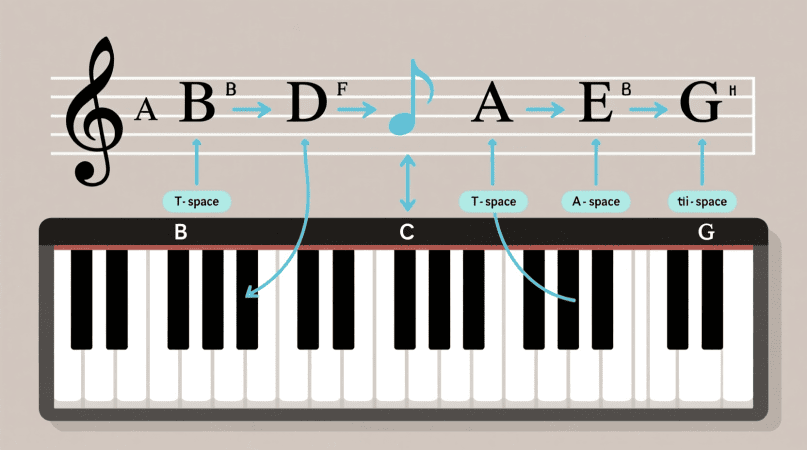
Learning to read bass clef notes is one of the most important skills for new piano students. The bass clef contains the lower notes played with the left hand, forming the foundation of harmony and chord structure in most music. A bass notes piano chart is a simple, visual tool that helps beginners understand how bass clef notes connect to the keys on the piano.
This guide explains what a bass notes piano chart is, why it’s important, and how beginners can use it to improve sight-reading and confidence at the keyboard.
What Is a Bass Notes Piano Chart?
A bass notes piano chart is a diagram that shows the notes written in the bass clef staff and their corresponding locations on the piano keyboard. It visually connects sheet music to the actual piano keys, helping students easily identify which left-hand notes they should play.
A typical chart includes:
- The bass clef staff
- Line and space notes
- Ledger line notes above and below the staff
- Piano keyboard mapping
- Middle C as a key reference point
This chart serves as a quick-reference guide for beginners learning to read music. If you’re curious how the engine works, the pitch detection methodology explains each step in detail.
Understanding the Bass Clef
The bass clef, also called the F clef, is used for lower-pitched notes. It features:
- Five lines
- Four spaces
- A symbol indicating where the note F is located on the staff
The bass clef is primarily used for:
- Left-hand piano notes
- Bass instruments
- Low melody lines
- Chords and harmony support
Bass Clef Line Notes (G–B–D–F–A)
The notes written on the lines of the bass clef (bottom to top) are:
- G
- B
- D
- F
- A
A popular mnemonic to remember this is:
Good Boys Do Fine Always
Learning these five notes helps students quickly identify most left-hand pitches.
Bass Clef Space Notes (A–C–E–G)
The notes written in the spaces (bottom to top) are:
- A
- C
- E
- G
A common memory phrase is:
All Cows Eat Grass
These notes help complete the basic foundation of bass clef reading.
If you struggle to recognize musical notes by ear, using the note detection tool in your daily practice routine can develop strong pitch awareness.
Mapping Bass Notes to the Piano Keyboard
The main purpose of a bass notes piano chart is to show how each bass clef note connects to the piano keys.
Key connections:
- G2 → bottom line of the staff
- A2 → bottom space
- C3 → second space
- E3 → third space
- G3 → top space
- Middle C (C4) → ledger line above the staff
The chart visually aligns each staff note with its correct white or black piano key.
Why a Bass Notes Piano Chart Is Important
Improves Sight-Reading
Seeing notes on the staff and keyboard helps beginners read music faster.
Builds Left-Hand Confidence
Most left-hand notes come from the bass clef.
Helps Avoid Confusing Treble and Bass Clef
Beginners often mix them up — charts remove the guesswork.
Supports Better Music Theory Understanding
Understanding bass notes helps with intervals, chords, and rhythm patterns.
Strengthens Overall Piano Playing
Left-hand reading is key to playing with both hands together.
How to Use a Bass Notes Piano Chart for Practice
1. Start with Line Notes
Memorize G–B–D–F–A and find them on the keyboard.
2. Practice Space Notes
Learn A–C–E–G and play them slowly.
3. Work Up and Down the Staff
Follow the chart to move from low notes to higher ones.
4. Use Middle C as a Guide
Middle C connects both treble and bass clefs.
5. Play Simple Bass Lines
Single-note left-hand exercises help reinforce learning.
6. Combine With Flashcards
Flashcards boost recognition speed when paired with the chart.
Common Mistakes Beginners Make
- Mixing up line and space notes
- Confusing bass clef and treble clef positions
- Relying only on finger memory instead of note reading
- Ignoring ledger line notes
- Playing without checking note placement
A bass notes chart helps prevent these issues by keeping note relationships clear.
Final Thoughts
A bass notes piano chart is one of the most useful tools for learning to read left-hand notes on piano. It visually connects bass clef notation to piano keys, improves sight-reading, and helps beginners build a strong foundation in music reading. With consistent practice and the help of this chart, students can quickly understand bass clef notes and gain confidence playing with both hands.
To connect piano bass notes with tuning accuracy, this piano tuning basics guide is a helpful reference.
Many learners compare what they read with a bass clef notes chart for clearer staff recognition.
To hear exact pitch values, this musical note frequency chart shows every bass note in hertz.
If you want to convert what you see into numbers, this note-to-frequency tool makes it straightforward.
When practicing from recordings, this audio pitch detection guide helps verify each low note.
To understand how low piano notes fit into the full spectrum, this frequency range overview adds useful context.
For technical accuracy, this FFT pitch explanation shows how those frequencies are measured.
PitchDetector.com is a project by Ornella, blending audio engineering and web technology to deliver precise, real-time pitch detection through your browser. Designed for musicians, producers, and learners who want fast, accurate tuning without installing any software.