
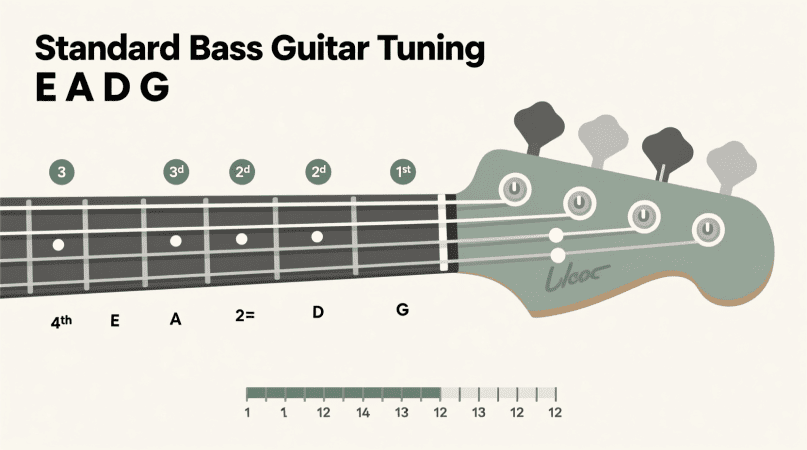
If you’re new to bass guitar, one of the first things you must learn is the names and order of the strings. Understanding how the strings are tuned forms the foundation for tuning your instrument, reading tabs, learning scales, and building bass lines. A bass guitar string chart is the simplest visual tool to help you memorize this information quickly and accurately.
In this SEO-optimized guide, you’ll learn everything you need to know about bass guitar strings, including standard tuning, string numbering, extended tunings, and why a string chart is essential for beginners.
What Is a Bass Guitar String Chart?
A bass guitar string chart is a visual diagram that shows the names and order of the bass guitar strings. It typically includes:
- Standard tuning notes
- String numbers (1–4)
- String thickness (from lowest to highest pitch)
- Optional fretboard note layouts
- Orientation reference (how strings look while holding the bass)
This chart helps beginners memorize the E–A–D–G tuning and understand how the bass is organized.
When analyzing vocals, you can pair your session with the voice pitch analyzer for more targeted feedback.
Standard Bass Guitar String Tuning (E–A–D–G)
A standard 4-string bass guitar is tuned in fourths:
| String Number | Note | Description |
|---|---|---|
| 4th string | E | Lowest pitch, thickest string |
| 3rd string | A | Second lowest pitch |
| 2nd string | D | Mid-range note |
| 1st string | G | Highest pitch, thinnest string |
This is written as: E – A – D – G
It’s the same as the lowest four strings on a guitar, but one octave lower.
Understanding String Numbers for Bass Guitar
Beginners often get confused about which string is “1st” or “4th.”
Here’s the correct order:
- 1st string = G (highest pitch)
- 2nd string = D
- 3rd string = A
- 4th string = E (lowest pitch)
Tabs, scales, and lesson materials all rely on this numbering system.
Practice sessions feel smoother when the Pitch Detector verifies every note you play.
What a Bass Guitar String Chart Typically Shows
A full string chart may include:
1. String Names
E, A, D, G (standard tuning)
2. String Numbers
Labeling each string from 1 to 4
3. Pitch Order
Visualizing lowest to highest tones
4. Fretboard Notes
Some charts show every note across all frets on each string
5. Orientation Guide
Helpful for beginners who get confused when looking down at the strings
Why a Bass Guitar String Chart Is Important
Helps With Tuning
Knowing each string’s name is essential for proper tuning.
Makes Reading Tabs Easier
Tabs show numbers on strings—knowing string order is critical.
Builds Fretboard Knowledge
Understanding the strings makes learning notes and scales smoother.
Supports Scale and Chord Learning
Many scales begin on the E or A string.
Improves Technique
Knowing string layout helps with plucking, muting, and shifting positions.
Extended String Charts (5-String & 6-String Bass)
Some bass guitars have more than four strings. A string chart helps you memorize extended tunings.
5-String Bass
Standard tuning: B – E – A – D – G
Adds a low B string for extra bass range.
6-String Bass
Standard tuning: B – E – A – D – G – C
Adds both a low B and a high C string.
How to Memorize Bass Guitar Strings Quickly
Use Mnemonics
For E–A–D–G, beginners often use:
Every • Athlete • Deserves • Glory
Say the Strings Aloud Daily
Name strings from low to high and high to low.
Practice With Open Strings
Pluck each string while saying its name.
Use Flashcards or Apps
Useful for beginner memory training.
Review the Chart Often
Visual repetition helps commit tuning to long-term memory.
Common Beginner Mistakes
- Confusing the 1st and 4th strings
- Tuning strings in the wrong direction
- Trying to learn scales before memorizing string names
- Reading tabs incorrectly due to unfamiliar string order
A bass string chart helps eliminate these issues early.
Final Thoughts
A bass guitar string chart is one of the most useful tools for beginners. It clearly shows the order and tuning of the strings, helping new players tune their bass correctly, read tabs, learn scales, and navigate the fretboard with confidence. Whether you’re just getting started or teaching someone new, mastering E–A–D–G tuning is the foundation of all bass playing.
Many beginners cross-check tuning with a bass guitar notation chart to see how open strings appear on the staff.
To confirm each string’s pitch, this browser pitch detection guide shows how online tools listen in real time.
If your readings jump around, these unstable pitch fixes can solve most common issues.
For understanding what those numbers mean, this note frequency breakdown adds helpful clarity.
Players who record practice sessions often use this audio pitch detector overview to analyze string accuracy.
To see how bass strings fit into the wider spectrum, this frequency range guide gives useful context.
When refining tuning precision, this sticky cents meter guide explains how to read small pitch shifts.
PitchDetector.com is a project by Ornella, blending audio engineering and web technology to deliver precise, real-time pitch detection through your browser. Designed for musicians, producers, and learners who want fast, accurate tuning without installing any software.