
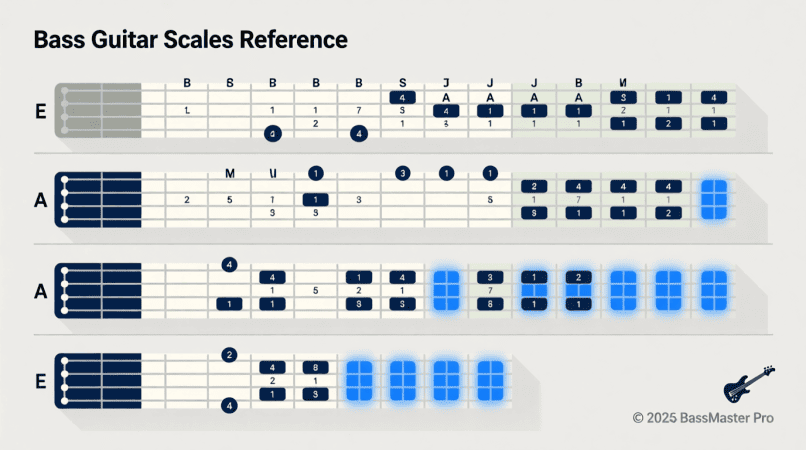
Learning scales is one of the most important steps for any aspiring bass guitarist. Scales help you build bass lines, understand music theory, improve technique, and unlock the entire fretboard. A bass guitar scales chart is a powerful visual tool that shows scale patterns, finger positions, and note layouts across the neck — making it ideal for beginners and intermediate players.
This guide explains what a bass guitar scales chart is, why it’s helpful, and how to use it to improve your playing quickly and effectively.
What Is a Bass Guitar Scales Chart?
A bass guitar scales chart is a diagram that displays:
- The notes in different scales
- Where those notes appear on the fretboard
- Finger numbers (1–4) for proper technique
- Movable scale shapes and patterns
- Root note locations
- Different scale types: major, minor, pentatonic, blues, and more
The chart helps beginners visualize scales as patterns on the neck, making it easier to learn, remember, and apply them in real music.
Why Learning Scales Is Important for Bass Guitarists
Helps Build Better Bass Lines
Most bass lines are built from scales such as major, minor, or pentatonic.
Strengthens Fretboard Knowledge
Scales help players understand where notes are located.
Improves Finger Technique
Scale patterns develop speed, strength, and clean playing.
Helps With Improvisation
Knowing scales gives you the confidence to create your own grooves.
Supports Music Theory
Scales connect to chords, intervals, and key signatures.
When analyzing vocals, you can pair your session with the voice pitch analyzer for more targeted feedback.
What a Bass Guitar Scales Chart Usually Includes
A typical bass guitar scales chart features the most commonly used scales, shown as diagrams across the fretboard.
1. Major Scale
Bright, familiar sound.
Pattern: W–W–H–W–W–W–H
Used in pop, funk, R&B, classical, and more.
2. Natural Minor Scale
Dark, emotional tone.
Pattern: W–H–W–W–H–W–W
Used in rock, metal, jazz, and cinematic music.
3. Major Pentatonic Scale
Five-note scale.
Simple, smooth, and widely used.
4. Minor Pentatonic Scale
Most popular beginner scale.
Perfect for bass lines and soloing.
5. Blues Scale
Minor pentatonic + “blue note.”
Great for grooves, riffs, and improvisation.
6. Modal Scales (Optional/Advanced)
Ionian, Dorian, Mixolydian, Aeolian, etc.
How a Bass Guitar Scales Chart Works
A scales chart is based on patterns that can be moved up and down the neck.
Each pattern shows:
Finger Numbers
1 = Index
2 = Middle
3 = Ring
4 = Pinky
Root Notes
The notes where the scale begins. Usually highlighted.
Fretboard Shapes
Diagrams with dots showing where to place your fingers.
Because these shapes are moveable, learning one scale shape allows you to play in any key simply by shifting your starting fret.
Example: Minor Pentatonic Scale (Most Popular Beginner Scale)
One of the easiest patterns is the minor pentatonic scale.
If you place the root note on the 5th fret of the E string, you are in A minor pentatonic.
Move the same pattern to the 7th fret → B minor pentatonic
Move it to the 3rd fret → G minor pentatonic
This moveable system makes learning scales fast and intuitive.
Benefits of Using a Bass Guitar Scales Chart
Faster Learning
Visual diagrams help you memorize patterns quickly.
Better Playing Technique
Charts show correct finger placement for clean and efficient movement.
Stronger Improvisation Skills
Scales give you the notes that always fit the key.
Clearer Understanding of Songs
Many bass lines are simply scale patterns disguised in music.
Freedom to Move Around the Neck
Charts help you break out of the “first few frets” and explore the whole fretboard.
Tips for Practicing Bass Guitar Scales
- Start slow and aim for clean tone
- Use alternate plucking (index–middle)
- Keep fingers curved and close to the frets
- Practice with a metronome
- Learn scales on one string before full patterns
- Play scales ascending and descending
- Practice scales in multiple positions
Over time, these habits build strong musical foundation.
Common Mistakes Beginners Make
Memorizing Shapes Without Knowing Notes
Learn the names of the notes you are playing.
Playing Too Fast
Speed comes after accuracy.
Neglecting Proper Finger Technique
Using finger numbers correctly prevents strain and improves tone.
Only Learning One Scale
Try major, minor, and pentatonic patterns for versatility.
For real-time pitch feedback, we link to PitchDetector.com.
Final Thoughts
A bass guitar scales chart is one of the most important learning tools for bassists. It shows the fretboard patterns for major, minor, pentatonic, and blues scales, helping beginners develop proper technique, build bass lines, and improve their improvisation skills. With consistent practice and a clear scale chart, you’ll gain confidence and control over the entire fretboard.
Before learning patterns, it helps to review a bass scale length chart to see how fret spacing affects scale shapes.
Many beginners pair their practice with a bass guitar tuning chart to keep every scale in key.
To understand how scale notes translate to sound, this frequency-to-note guide is a useful reference.
If you record yourself practicing, this pitch testing with recordings helps spot off-key notes.
For theory context, this music scale overview explains how different scales are built.
When working on intonation, a pitch detector for audio engineers gives very precise readings.
To connect written scales to real frequencies, this musical note frequency chart provides a complete reference.
PitchDetector.com is a project by Ornella, blending audio engineering and web technology to deliver precise, real-time pitch detection through your browser. Designed for musicians, producers, and learners who want fast, accurate tuning without installing any software.