
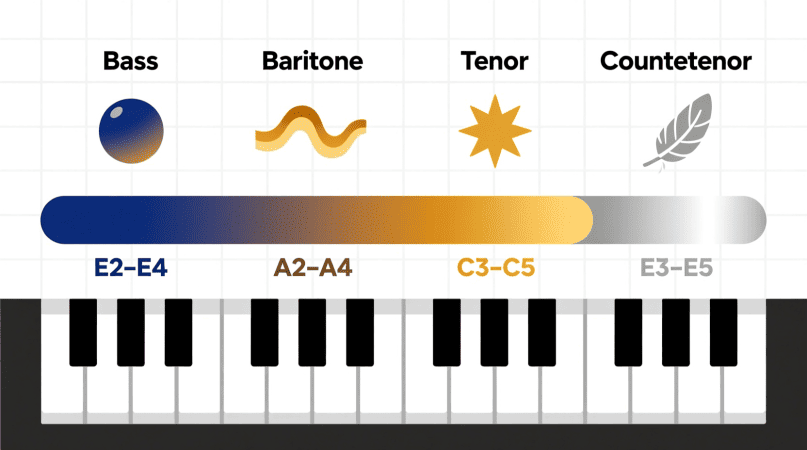
The male singing voice is diverse, powerful, and capable of great range. Whether you’re a new singer, a vocal coach, or simply curious, understanding the average vocal range for men helps you identify voice types, choose suitable songs, and improve vocal technique. This guide breaks down the typical male vocal range, the different male voice types, and how to find and expand your own range.
What Is the Average Vocal Range for Men?
The average vocal range for men spans from C2 to C4, which covers roughly two octaves. Most men can sing comfortably within this range without formal training.
However, men’s voices vary widely and are categorized into four main voice types:
- Bass
- Baritone
- Tenor
- Countertenor
Each voice type has its own typical range and sound quality.
Male Vocal Types and Their Ranges
1. Bass (Lowest Male Voice)
- Typical Range: E2 – E4
- Extended Range: C2 – G4
- Voice Characteristics:
Deep, rich, low, and resonant tones.
Common in classical, gospel, and choral music.
2. Baritone (Most Common Male Voice Type)
- Typical Range: A2 – A4
- Extended Range: F2 – C5
- Voice Characteristics:
Warm, full, and balanced sound.
Most men fall into this category because it sits in a comfortable mid-range.
3. Tenor (Higher Male Voice)
- Typical Range: C3 – C5
- Extended Range: A2 – E5
- Voice Characteristics:
Bright, ringing high notes.
Popular in pop, opera, R&B, and musical theatre.
4. Countertenor (Highest Male Voice – Rare)
- Typical Range: E3 – E5 (falsetto/head voice)
- Extended Range: G3 – G5
- Voice Characteristics:
Light, agile, and similar to a female alto.
Mostly used in classical and choral settings.
New musicians often struggle with staying in tune, but the online pitch analyzer provides the kind of immediate visual feedback that helps them progress faster.
Male Vocal Range Summary Chart
| Vocal Type | Typical Range | Extended Range | Characteristics |
|---|---|---|---|
| Bass | E2 – E4 | C2 – G4 | Deep, low, resonant |
| Baritone | A2 – A4 | F2 – C5 | Warm, most common |
| Tenor | C3 – C5 | A2 – E5 | Bright, high, expressive |
| Countertenor | E3 – E5 | G3 – G5 | High, rare, light |
You can examine the algorithm’s performance through our pitch accuracy tests for comparison.
What Determines a Man’s Vocal Range?
Several factors shape the vocal range of men:
1. Physiology
Vocal fold length, thickness, and vocal tract size influence pitch and tone.
2. Hormonal Changes
Testosterone deepens the male voice after puberty, lowering the vocal range.
3. Age
Younger males have higher voices. As men age, their vocal range may change due to vocal fold flexibility.
4. Training & Technique
Consistent vocal training can extend both the upper and lower limits of the voice.
5. Vocal Health
Hydration, lifestyle habits, rest, and proper technique keep the voice flexible and strong.
How to Find Your Vocal Range
You can determine your vocal range using a keyboard or piano:
- Start at a comfortable mid-range pitch.
- Move downward one note at a time until your lowest clear tone.
- Move upward until the highest note you can sing without straining.
- Record both notes — this span is your vocal range.
- Compare your notes to the vocal type chart.
A vocal coach can also help assess your range accurately.
Examples of Famous Male Vocal Ranges
Male singers often have ranges that extend well beyond the average. Here are a few notable examples:
- Freddie Mercury (Tenor): A2 – E6
- Elvis Presley (Baritone): A1 – A5
- Johnny Cash (Bass-Baritone): E2 – B4
- Bruno Mars (Tenor): B2 – D6
- Sam Smith (Countertenor): E3 – G5
These examples show how extraordinary male vocal ranges can be.
Can Men Improve Their Vocal Range?
Yes — vocal range can be expanded with proper training.
Effective methods include:
- Daily vocal warm-ups
- Breathing and diaphragm exercises
- Head voice and falsetto training
- Chest voice strengthening
- Mixed voice development
- Avoiding strain and over-singing
- Staying hydrated
- Consistent practice with a vocal coach
With practice, many male singers gain an additional octave or more.
FAQs
1. What is the average vocal range for men?
Most men sing comfortably between C2 and C4.
2. What is the most common male voice type?
Baritone is the most common voice type among men.
3. What is the rarest male voice type?
The countertenor, known for its unusually high range.
4. Can male singers increase their vocal range?
Yes. Training can significantly expand both low and high notes.
5. Does a man’s voice change with age?
Yes — puberty, adulthood, and aging can all affect range and tone.
Conclusion
The average vocal range for men spans from C2 to C4, but individual ranges vary greatly depending on physiology, training, and vocal type. Knowing whether you’re a bass, baritone, tenor, or countertenor can help you choose the right songs and develop better technique. With proper training and vocal care, every male singer can build a stronger, more flexible voice over time.
Many singers compare their notes against the human vocal range to see where male voices sit overall.
For a structured breakdown, this SATB vocal ranges chart shows how different male parts are classified.
To label each pitch accurately, this vocal range notes guide provides note-by-note detail.
When testing your voice live, a voice pitch tracker displays every note you hit.
To compare with extreme examples, this widest vocal range reference shows what’s possible.
If you want to match pitches to numbers, this musical frequency chart gives exact hertz values.
To see how training expands range, this range extension guide explains practical methods.
PitchDetector.com is a project by Ornella, blending audio engineering and web technology to deliver precise, real-time pitch detection through your browser. Designed for musicians, producers, and learners who want fast, accurate tuning without installing any software.