
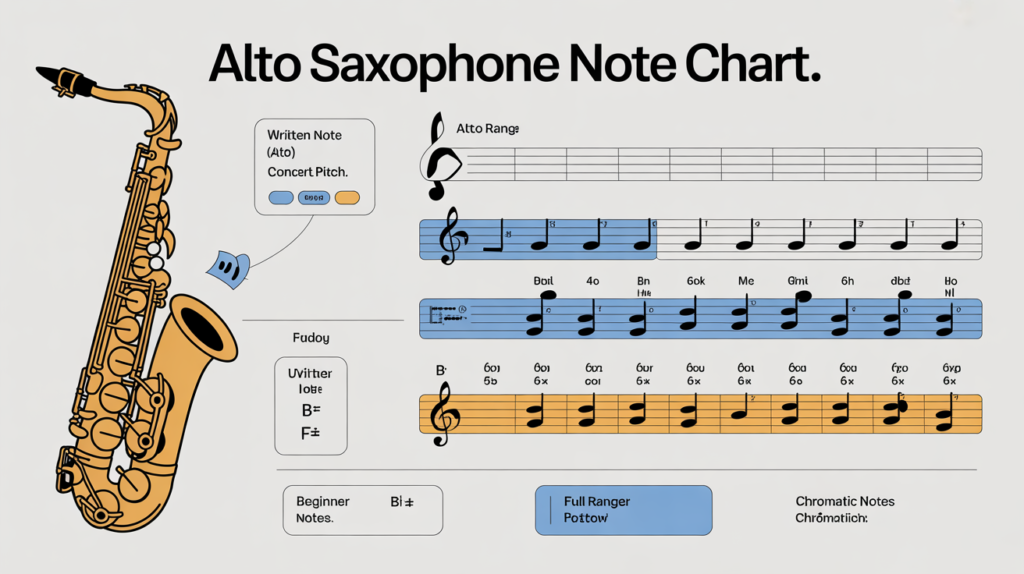
The alto saxophone is a transposing instrument in E♭, meaning written notes sound a major sixth lower than they appear. Understanding an alto saxophone note chart helps beginners recognize written notes, learn their fingerings, and understand how notes sound in concert pitch.
This guide breaks down every note on the alto sax—from low B♭ to high F♯—and explains how written music translates into real sound.
What Is an Alto Saxophone Note Chart?
An alto sax note chart shows:
- Where notes sit on the music staff
- How those notes sound in concert pitch
- The full playable range of the instrument
- Chromatic notes (sharps & flats)
- The relationship between written and sounding notes
Beginners use a note chart to connect sheet music, finger positions, and pitch awareness.
Written vs. Concert Pitch (Very Important for Beginners)
Because the alto sax is in E♭, written notes don’t match the pitch that comes out.
Here’s a quick conversion chart:
| Written Note (Alto) | Concert Pitch |
|---|---|
| C | E♭ |
| D | F |
| E | G |
| F | A♭ |
| G | B♭ |
| A | C |
| B | D |
| High C | E♭ (one octave higher) |
When you’re practicing difficult melodies, the pitch detection tool ensures you hit every note inside the correct frequency range.
This information is essential for:
- Playing with piano or guitar
- Band/orchestra tuning
- Transposing music correctly
Basic Alto Saxophone Notes Chart (Beginner Notes)
These are the first notes every alto sax learner starts with:
- G (simple, stable)
- A (easy tone)
- B (bright sound)
- C (open fingering)
- D (octave key required)
- E (common in beginner songs)
- F (essential scale note)
These notes allow beginners to play simple melodies immediately.
Full Alto Saxophone Note Chart (Low B♭ to High F♯)
The complete note range includes:
Low Notes (Bottom of the Staff)
- Low B♭
- Low B
- Low C
- Low C♯
These use the right-hand pinky keys.
Middle Register (Most Common)
- D
- E♭
- E
- F
- F♯
- G
- A
- B♭
- B
- High C
These notes appear in nearly all beginner and intermediate music.
Upper Register (Palm Key Notes)
- High D
- High E♭
- High E
- High F
- High F♯
These require palm keys and the octave key.
Alto Sax Chromatic Note Chart (Sharps & Flats)
A chromatic note chart shows every pitch from low B♭ to high F♯:
- C → C♯/D♭ → D
- D → D♯/E♭ → E
- F → F♯/G♭ → G
- G → G♯/A♭ → A
- A → A♯/B♭ → B
These notes require alternate fingerings, side keys, or pinky keys depending on the pitch.
How the Note Chart Connects to Fingerings
A note chart tells you what the note is, while a fingering chart tells you how to play it.
Example:
Written G
- Appears on the second line of the staff
- Uses left-hand 1–2–3 fingering
- Sounds as concert B♭
Middle C
- No fingers needed
- Sounds as concert E♭
Understanding this connection helps beginners read music faster.
How to Learn Alto Sax Notes Faster
- Memorize where each note sits on the staff
- Practice long tones for accuracy
- Use a tuner to check pitch
- Learn major scales (E♭, B♭, A♭) first
- Practice slowly with consistent airflow
- Use both the note chart and fingering chart together
Common Problems Beginners Face
| Issue | Cause | Solution |
|---|---|---|
| Notes sound flat/sharp | Weak air support | Use steady airflow |
| Difficulty reading notes | Not memorizing staff | Practice note naming |
| Confusion with sharps/flats | No chromatic reference | Use a chromatic chart |
| Trouble with high notes | Overblowing or wrong fingering | Use octave key correctly |
| Struggling to tune with piano | Not accounting for transposition | Use written vs. concert chart |
Why an Alto Sax Note Chart Is Essential
A note chart helps students:
- Learn written notes quickly
- Understand the full sax range
- Stay in tune with other instruments
- Play scales and songs accurately
- Learn sharps, flats, and transposition
- Build strong reading and performance skills
Every beginner should have a note chart on hand.
Frequently Asked Questions (FAQ)
1. How many notes does the alto sax have?
Typically from low B♭ to high F♯ (two and a half octaves).
2. Why does written C sound like E♭?
Because the alto sax is a transposing instrument in E♭.
3. What notes should beginners learn first?
G, A, B, C, D, E, F.
4. Is the alto sax note chart the same as tenor sax?
The written notes look the same, but they sound in different keys.
5. How do I memorize sax notes faster?
Practice long tones, major scales, and daily note-recognition drills.
Conclusion
The alto saxophone note chart is an essential tool for learning written notes, understanding transposition, mastering the saxophone range, and playing in tune. With practice and proper guidance, beginners can quickly develop strong reading skills and confidently play every note from low B♭ to high F♯.
To learn how notes line up on the staff, the bass clef notes chart offers a clear reference point.
Players comparing pitch ranges often check the frequency ranges for instruments to see where the alto sax sits.
If you’re translating notes into numbers, the how to convert frequency to musical notes guide is useful.
For live accuracy while practicing scales, the pitch accuracy checker gives instant feedback.
When recording exercises, the how audio file pitch detection works explains how software reads your tone.
To fine-tune intonation, the why singers go sharp or flat article helps spot pitch drift.
For ear training alongside charts, the pitch matching games make practice interactive.
PitchDetector.com is a project by Ornella, blending audio engineering and web technology to deliver precise, real-time pitch detection through your browser. Designed for musicians, producers, and learners who want fast, accurate tuning without installing any software.