
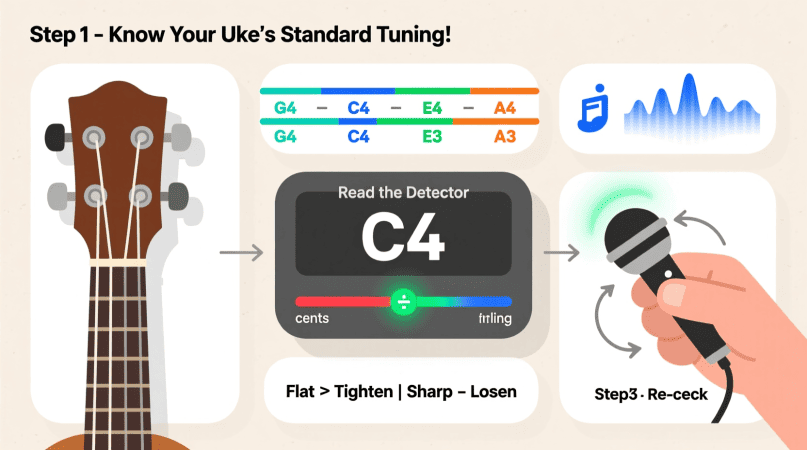
If your ukulele sounds a little “off,” even after you’ve tuned it, you’re not alone. The ukulele’s small size makes it sensitive to changes in temperature, string stretch, and even how hard you strum. Traditional tuners work well, but using a pitch detector gives you instant visual confirmation of whether your string is sharp, flat, or locked right in.
Why Tuning Accuracy Matters
- Better sound quality: Clean chords and melodies that ring out clearly.
- Faster ear training: Your brain starts to recognize what “in tune” feels like.
- Confidence boost: No hesitation before playing in front of others.
A well-tuned ukulele isn’t just about sound—it makes practicing more enjoyable and helps you progress faster.
Standard Ukulele Tuning Notes
Most soprano, concert, and tenor ukuleles use High-G tuning (gCEA):
- G4 (top string, closest to you)
- C4
- E4
- A4 (bottom string, closest to the floor)
👉 Use the Voice Pitch Analyzer to check each string against these target notes.
Step-by-Step: How to Tune With a Pitch Detector
1. Tune the G String (4th)
Pluck the top string. Adjust the peg until the detector centers on G4.
2. Tune the C String (3rd)
Play the next string down. Twist slowly until you hit C4 without wavering.
3. Tune the E String (2nd)
Pluck the second string. Adjust until the pitch locks to E4.
4. Tune the A String (1st)
Play the bottom string. Turn gently until it shows A4 steady.
👉 For live monitoring as you adjust, open the Free Pitch Detector and watch the line move in real time.
Extra Tuning Tips
- Always tune up: If you go sharp, loosen the string a little, then tighten back up.
- Strum and re-check: Strings may shift tension after you play.
- Quiet room works best: Background noise can confuse the mic input.
- Stretch new strings: Fresh strings take a few days to settle.
Common Ukulele Tuning Problems (and Fixes)
- Strings slip out of tune quickly → Stretch gently after tuning; retune daily until stable.
- Detector shows shaky pitch → Pluck softly; pressing too hard can bend pitch.
- Inconsistent readings → Make sure your microphone is close and your environment is quiet.
Getting started on the right pitch is easier when you use an instrument tuning tool.
Matching each string accurately works well with a simple note matching guide.
Seeing exact tone values becomes clearer using a frequency to note tool.
Keeping steady timing during tuning helps when you follow an online metronome.
Understanding why a string sounds off improves after reading about pitch and frequency differences.
Fine adjustments get easier when you know how to convert notes to hertz.
Practicing consistent intonation is smoother when you review vocal warmup techniques.
PitchDetector.com is a project by Ornella, blending audio engineering and web technology to deliver precise, real-time pitch detection through your browser. Designed for musicians, producers, and learners who want fast, accurate tuning without installing any software.