
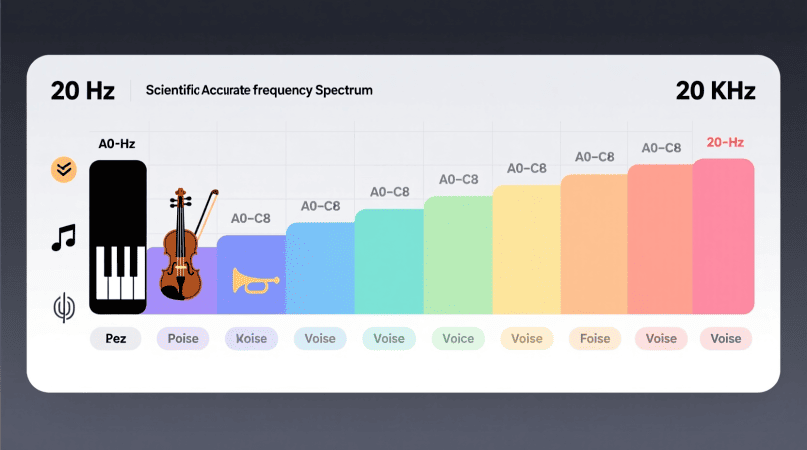
Musicians, singers, and audio engineers often need a frequency chart to understand the pitch ranges of instruments and voices. A Frequency → Note Converter is the perfect tool for mapping raw Hertz (Hz) data to musical notes for analysis, tuning, and training.
This guide provides a complete reference for frequency ranges across popular instruments and vocal types.
Why Frequency Range Knowledge Matters
- Instrument Tuning: Match instrument frequencies to correct pitch references.
- Vocal Training: Map voice types (soprano, alto, tenor, bass) to note and frequency ranges.
- Audio Mixing: Balance instruments and vocals in the correct tonal space.
- Music Education: Teach students about pitch, tuning, and sound frequencies.
For live analysis, try the Pitch Detector or Voice Pitch Analyzer.
Frequency Range Chart for Common Instruments
| Instrument | Typical Range (Hz) | Note Range |
|---|---|---|
| Piano | 27.5 Hz – 4186 Hz | A0 – C8 |
| Guitar (Standard) | 82.41 Hz – 1318.5 Hz | E2 – E6 |
| Violin | 196 Hz – 3136 Hz | G3 – D7 |
| Flute | 261.63 Hz – 2093 Hz | C4 – C7 |
| Trumpet | 164.81 Hz – 987.77 Hz | E3 – B5 |
| Double Bass | 41.2 Hz – 196 Hz | E1 – G3 |
For tuning orchestras, see Accuracy & Calibration: Frequency → Note Conversion.
Vocal Frequency Ranges
| Voice Type | Typical Range (Hz) | Note Range |
|---|---|---|
| Soprano | 261.63 Hz – 1046.5 Hz | C4 – C6 |
| Alto | 174.61 Hz – 698.46 Hz | F3 – F5 |
| Tenor | 130.81 Hz – 523.25 Hz | C3 – C5 |
| Bass | 82.41 Hz – 261.63 Hz | E2 – C4 |
To analyze choir recordings, use the Audio-File Pitch Detector for pitch stability testing.
Practical Use Cases
- Singers: Determine if notes stay in the correct vocal range.
- Teachers: Explain pitch relationships visually with frequency → note charts.
- Engineers: Optimize EQ and compression for specific instruments or voices.
Quick Reference Table: Middle Octaves
| Note Name | Frequency (Hz) | Use Case Example |
|---|---|---|
| A4 | 440 Hz | Tuning reference standard |
| C4 (Middle C) | 261.63 Hz | Piano, vocal warm-ups |
| G3 | 196 Hz | Low-range instruments |
| E5 | 659.26 Hz | Upper vocal registers |
FAQs
1. Does this chart work for all instruments?
Yes, covers most Western instruments and standard tunings.
2. Can I convert custom frequencies?
Yes, use the Frequency → Note Converter for any Hz value.
3. How about modern or electronic instruments?
Electronic synths often exceed traditional ranges; converter still works.
To see how these ranges convert into pitch labels, the how to convert frequency to musical notes guide is a useful companion.
Singers often compare where they sit using the vocal range chart for a quick visual.
For written references, the vocal range notes help map frequencies to staff positions.
If you want to measure your own voice, the vocal range tester provides an easy starting point.
Instrument players can verify tones with a real-time pitch tracker during practice.
To analyze recorded samples, the audio file pitch detector gives exact frequency readings.
For a deeper look at human limits, the human vocal range puts everything in perspective.
PitchDetector.com is a project by Ornella, blending audio engineering and web technology to deliver precise, real-time pitch detection through your browser. Designed for musicians, producers, and learners who want fast, accurate tuning without installing any software.