
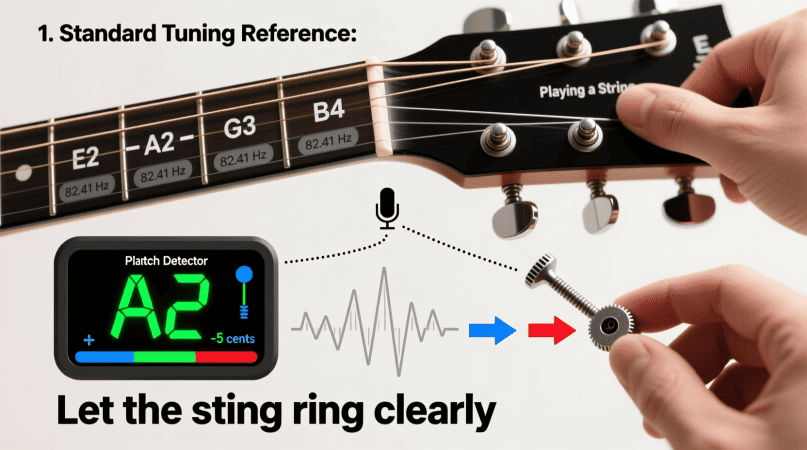
Yes. A pitch detector can tune a guitar by showing the exact frequency of each string and whether it’s sharp or flat. While it works well for practice at home, clip-on and pedal tuners remain more reliable in noisy or live performance settings.
How a Pitch Detector Works for Guitar
When you pluck a string, the pitch detector reads the fundamental frequency and matches it to the nearest musical note. For example:
- Low E string → about 82 Hz
- A string → about 110 Hz
- D string → about 147 Hz
- G string → about 196 Hz
- B string → about 247 Hz
- High E string → about 330 Hz
The detector then shows if your string is flat (too low) or sharp (too high). You adjust the tuning peg until the note aligns.
Try Our: note detection from recordings
Pitch Detector vs Dedicated Guitar Tuner
| Tool Type | Accuracy | Best Use Case | Limitations |
|---|---|---|---|
| Pitch Detector (apps, online tools) | ±10–20 cents | Home practice, casual tuning | Sensitive to noise, slower on low strings |
| Clip-On Tuner | ±1 cent | Rehearsals, live shows | Requires separate device |
| Pedal/Strobe Tuner | ±0.1 cent | Studio recording, professional use | More expensive |
Practical Tips for Using a Pitch Detector
- Tune in a quiet space: Background noise can confuse the mic.
- Pluck gently and steadily: Hard picking can cause the note to jump sharp before settling.
- Always tune up: Loosen the string slightly, then tighten to pitch for stability.
- Check more than once: After tuning all strings, recheck the first string as neck tension shifts.
- Stretch new strings: Play them lightly to reduce slipping.
Common Mistakes to Avoid
- Octave errors: Detectors sometimes show the wrong octave, especially on low E or drop tunings.
- Ignoring string settling: Strings often drift flat just after tuning—give them a moment.
- Tuning in noisy rooms: Other instruments or voices can throw off readings.
FAQs
Can I use a phone pitch detector to tune my guitar?
Yes. Most mobile pitch detector apps can tune a guitar as long as you’re in a quiet space.
Is a pitch detector as accurate as a guitar tuner?
Not quite. Guitar-specific tuners filter out overtones and respond faster, making them more stable.
What’s the best method for beginners?
Start with a pitch detector app—it’s simple and free. As you progress, consider a clip-on tuner for speed and accuracy.
Does vibrato affect tuning?
Yes. For best results, hold steady notes when tuning.
Can I use the same pitch detector for other instruments?
Absolutely. Pitch detectors can work for violins, ukuleles, and even voice.
Guitarists often start by opening an instrument tuner to get each string close to the right pitch.
For visual feedback while adjusting pegs, the real-time pitch tracker makes small changes easier to see.
When checking exact tones, a frequency detector shows how far each string is from target pitch.
If you prefer number-based tuning, the note to frequency converter helps match standard tuning values.
To understand why tuners sometimes show extra notes, this guide on harmonics and overtones clears it up.
Players using low strings can reference bass guitar tuning charts for accurate note targets.
For a broader view of tuning math, this explanation of pitch versus frequency ties everything together.
PitchDetector.com is a project by Ornella, blending audio engineering and web technology to deliver precise, real-time pitch detection through your browser. Designed for musicians, producers, and learners who want fast, accurate tuning without installing any software.