
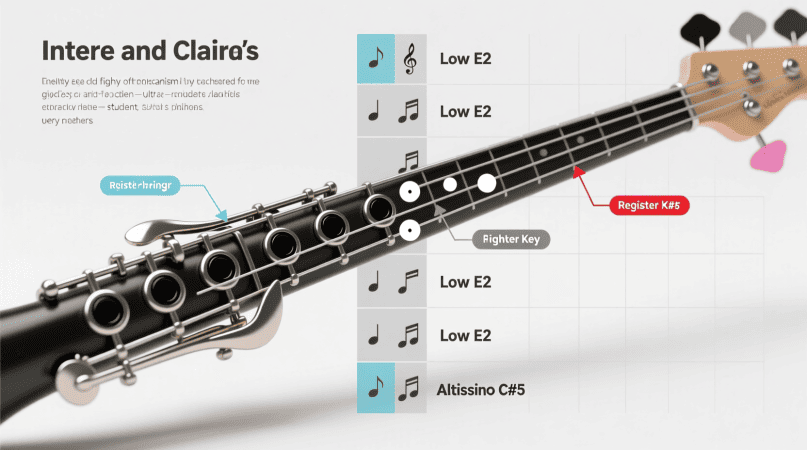
The bass clarinet is a rich, expressive woodwind instrument known for its deep tone and wide range. For beginners, one of the most essential tools to learn is the bass clarinet fingering chart. Whether you are new to the instrument or improving your technique, understanding how to read a fingering chart will dramatically improve your accuracy, tone production, and confidence.
This guide explains what a bass clarinet fingering chart is, how to use it, the registers of the instrument, and tips to help you learn fingerings faster.
What Is a Bass Clarinet Fingering Chart?
A bass clarinet fingering chart is a visual guide that shows which keys and holes you must press in order to play each note. Because the bass clarinet has more keys than a regular clarinet and plays across multiple octaves, a fingering chart helps players understand the correct finger placements for clean, accurate sound.
A standard fingering chart includes:
- Left-hand and right-hand key positions
- Register key (thumb key) usage
- Pinky keys for low notes
- Side keys for accidentals
- Alternate fingerings for sharp and flat notes
- Notes from low E2 up to the altissimo range
Why Learn a Bass Clarinet Fingering Chart?
Using a fingering chart is essential for beginners and intermediate players because it helps with:
1. Tone Accuracy
Correct finger placement prevents air leaks, squeaks, and muffled notes.
2. Muscle Memory
Repeatedly referring to the chart builds finger coordination and speed.
3. Register Transitions
The bass clarinet has multiple registers; proper fingerings help you switch between them smoothly.
4. Scale Practice
Major, minor, and chromatic scales depend on accurate fingering.
5. Sight-Reading Ability
Knowing fingerings makes reading new music faster and easier.
If you’re focusing on vocal performance, the voice pitch analyzer applies this methodology to speech and singing.
Bass Clarinet Range and Registers
The bass clarinet plays in several registers, each with its own fingering patterns.
Chalumeau Register (Low Notes)
Range: E2 to F#3
These are the lowest notes on the instrument. They require full finger coverage and multiple key combinations.
Throat Tones
Range: G3 to Bb3
These notes require fewer fingerings but more air support and embouchure control.
Clarion Register (Middle and High Notes)
Range: B3 to C5
These notes require pressing the register key (thumb key), similar to overblowing.
Altissimo Register (Very High Notes)
Range: C#5 and above
These fingerings vary depending on the instrument and require advanced technique.
Bass Clarinet Fingering Chart (Standard Fingerings)
Below is an overview of the notes and fingerings included in most standard fingering charts.
Chalumeau Register Notes
E2
F2
F#2
G2
A2
Bb2
B2
C3
C#3
D3
Eb3
E3
F3
F#3
Throat Tones
G3
G#3
A3
Bb3
Clarion Register
B3
C4
D4
Eb4
E4
F4
F#4
G4
A4
Bb4
B4
C5
Altissimo Notes
C#5 and higher (specific fingerings vary)
These are the core notes every player should learn as part of their fingering development.
Understanding frequency starts when you detect pitch with an online tool.
How to Read a Bass Clarinet Fingering Chart
Most fingering charts use the same symbols, making them easy to understand.
Filled Circles
Keys or tone holes that must be pressed.
Open Circles
Keys that remain untouched.
Side Keys
Displayed separately and used for accidentals (sharps and flats).
Register Key
Indicated as a thumb-operated key, used for jumping to higher notes.
Left-Hand Section
Controls upper holes and register key.
Right-Hand Section
Controls lower holes and pinky keys that play the lowest notes.
Once you learn this chart layout, you can read any clarinet fingering chart with ease.
Common Challenges Beginners Face (and Solutions)
Incorrect Tone or Squeaking
Often caused by air leaks. Ensure fingers fully cover tone holes.
Sharp Notes in the Clarion Register
Relax your mouth position and increase warm airflow.
Weak Throat Tones
Focus on steady air support and correct embouchure.
Struggling With Register Breaks
Practice slow transitions using the register key correctly.
Difficulty Playing Low Notes
Use proper right-hand pinky key combinations and maintain airtight coverage.
Tips for Mastering Bass Clarinet Fingerings
Start With Low Notes
The chalumeau register is foundational for all other registers.
Practice Long Tones
This improves tone quality while reinforcing finger positions.
Use a Printed Fingering Chart
Keep one near your stand for quick reference.
Learn the Chromatic Scale
This exercise helps you memorize every fingering in sequence.
Practice Slowly
Accuracy is more important than speed.
Final Thoughts
A bass clarinet fingering chart is one of the most important learning tools for new players. It helps beginners understand finger placement, improve tone quality, and navigate the instrument’s wide register range. With regular practice and a clear reference chart, players can quickly build confidence and develop strong musical skills.
- Beginners often compare low-register placement using a bass clef notes chart to better understand written pitches.
- For visual reference across the instrument, this bass recorder finger chart offers a useful comparison.
- To check intonation while learning fingerings, a real-time pitch tracker helps keep notes centered.
- Exploring lower tones is easier after reviewing the lowest vocal range for pitch context.
- If you want to understand how frequencies relate to notes, this note-to-hertz converter guide is helpful.
- When tuning before practice, this audio file pitch detector can verify recorded notes.
- To go deeper into sound science, this pitch perception article explains why certain fingerings sound brighter or darker.
PitchDetector.com is a project by Ornella, blending audio engineering and web technology to deliver precise, real-time pitch detection through your browser. Designed for musicians, producers, and learners who want fast, accurate tuning without installing any software.