
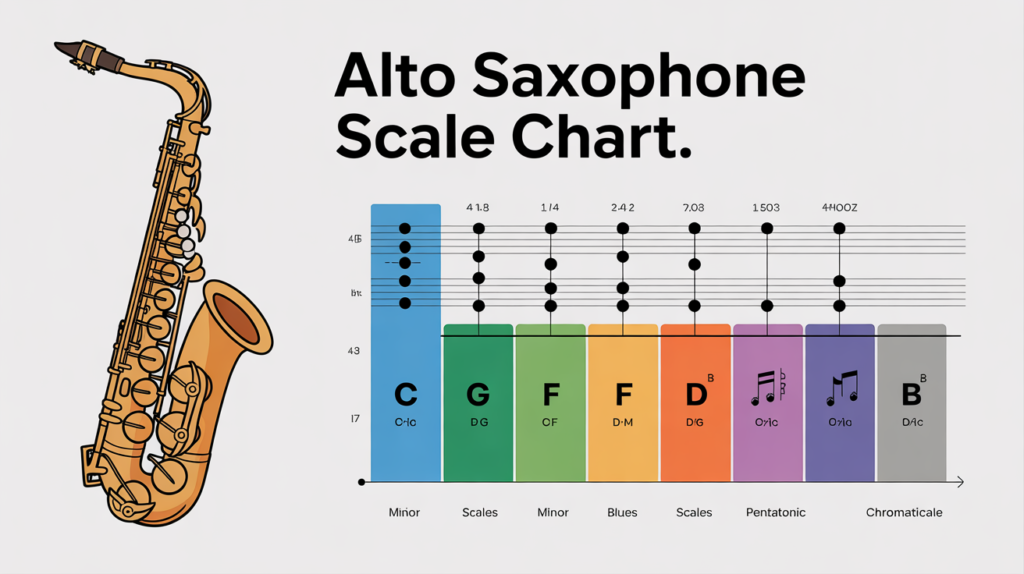
Learning scales is one of the most important steps in mastering the alto saxophone. Scales help you develop finger control, tone quality, breath support, intonation, and musical accuracy.
An alto saxophone scale chart provides a visual reference for all major, minor, blues, pentatonic, and chromatic scales written specifically for E♭ alto sax.
This guide covers every essential scale, complete with note sequences, keys, and beginner tips.
What Is an Alto Saxophone Scale Chart?
An alto sax scale chart includes:
- All 12 major scales
- Natural, harmonic & melodic minor scales
- Full chromatic scale
- Pentatonic scales
- Blues scales
- Written notes for E♭ alto sax
- Concert pitch equivalents
- Fingering patterns for each scale
Because the alto sax is a transposing instrument, written scales sound a major sixth lower. A chart helps beginners understand the correct notes and key signatures. New musicians often struggle with staying in tune, but the online pitch analyzer provides the kind of immediate visual feedback that helps them progress faster.
Alto Sax Major Scale Chart (12 Keys)
Here are the most important major scales written for alto sax:
C Major (Concert E♭ Major)
C – D – E – F – G – A – B – C
(Most common beginner scale)
G Major (Concert B♭ Major)
G – A – B – C – D – E – F♯ – G
(Great for school band music)
F Major (Concert A♭ Major)
F – G – A – B♭ – C – D – E – F
(Frequent in classical and jazz pieces)
D Major (Concert F Major)
D – E – F♯ – G – A – B – C♯ – D
B♭ Major (Concert D♭ Major)
B♭ – C – D – E♭ – F – G – A – B♭
(Essential for tonal exercises)
These scales form the foundation of almost all beginner alto sax playing.
Minor Scales for Alto Sax
Minor scales help you create emotional, expressive music.
There are three types:
Natural Minor
A – B – C – D – E – F – G – A
Harmonic Minor
A – B – C – D – E – F – G♯ – A
(Has a dramatic, classical sound)
Melodic Minor (Ascending)
A – B – C – D – E – F♯ – G♯ – A
(Important for jazz, pop, and classical music)
Chromatic Scale for Alto Sax
The chromatic scale uses every note, moving by half-steps:
Low B♭ → B → C → C♯ → D → E♭ → E → F → F♯ → G → G♯ → A → B♭ → … up to high F♯
Benefits of chromatic practice:
- Improves finger speed
- Strengthens technique
- Helps with sharps/flats
- Smooth transitions between notes
- Builds advanced tone control
Pentatonic Scales for Alto Sax
Pentatonic = 5-note scale, perfect for soloing.
A Minor Pentatonic
A – C – D – E – G
C Major Pentatonic
C – D – E – G – A
These scales are simple but extremely powerful for improvisation.
Blues Scales for Alto Sax
A must-learn for jazz, blues, rock, pop, and funk players.
A Blues Scale
A – C – D – D♯ – E – G – A
C Blues Scale
C – E♭ – F – F♯ – G – B♭ – C
Blues scales give your playing expression, grit, and improvisational flavor.
Essential Scales Every Alto Sax Beginner Should Master
- C Major
- G Major
- F Major
- D Major
- B♭ Major
- A Minor
- A Blues Scale
- Chromatic Scale
These scales appear in band music, jazz, classical pieces, and solo repertoire.
Why a Scale Chart Is Important
A scale chart helps beginners:
- Learn finger patterns faster
- Improve tone and intonation
- Strengthen breath support
- Build speed and accuracy
- Understand key signatures
- Develop improvisation skills
- Learn songs more easily
It is an essential part of every practice routine.
Tips for Practicing Saxophone Scales
- Start slow with a metronome
- Practice ascending & descending
- Use correct fingerings every time
- Keep fingers close to keys
- Play scales slurred and tongued
- Add dynamics (soft/loud)
- Use long tones to warm up
Consistent practice = mastery.
FAQ: Alto Saxophone Scale Chart
1. What scale should beginners learn first?
C Major and G Major.
2. Why does the written scale sound different?
The alto sax is in E♭, so written notes transpose.
3. Do I need to memorize all 12 major scales?
Yes, especially for band and jazz playing.
4. Are blues scales necessary for beginners?
Yes, for improvisation and expressive playing.
5. How often should I practice scales?
Daily—5 to 15 minutes per session.
Conclusion
The alto saxophone scale chart is a crucial tool for mastering major, minor, pentatonic, chromatic, and blues scales. For beginners, these scales build the foundation for tone control, finger accuracy, technique, and musical expression.
Many beginners also use an alto saxophone note chart to see how each scale note is fingered.
For more detailed technique, this alto saxophone fingering chart shows exactly how each key is pressed.
To verify pitch while practicing scales, a real-time pitch tracker gives instant tuning feedback.
Understanding where sax notes sit is easier with this instrument frequency range guide for context.
If you want to match written notes to numbers, this note-to-frequency guide makes it simple.
When recording scale runs, this audio pitch testing tool helps check intonation.
To understand why certain notes feel sharp or flat, these intonation tips explain the mechanics.
PitchDetector.com is a project by Ornella, blending audio engineering and web technology to deliver precise, real-time pitch detection through your browser. Designed for musicians, producers, and learners who want fast, accurate tuning without installing any software.