
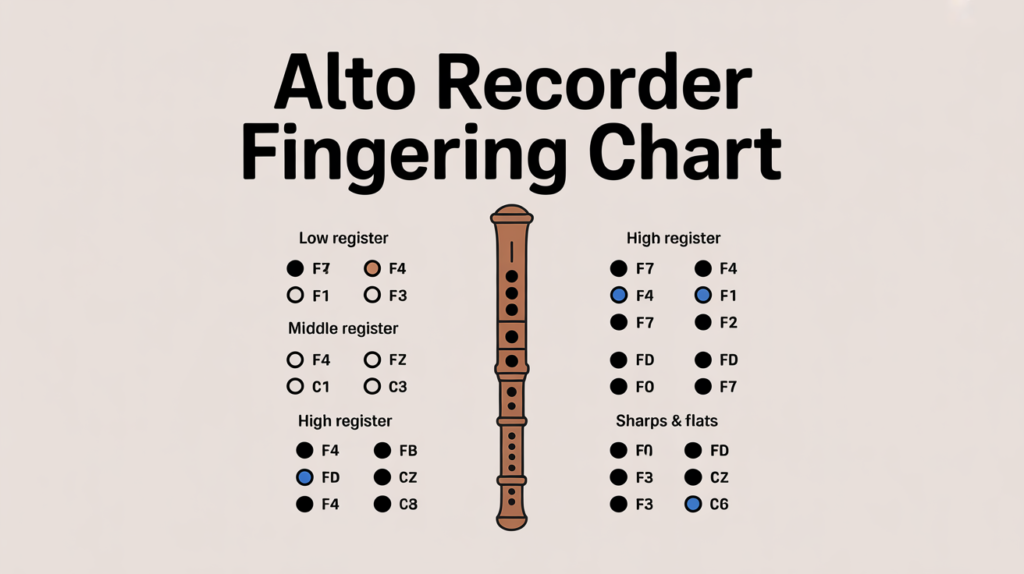
The alto recorder, also called the F recorder, is one of the most popular recorders for beginners and ensemble players. Unlike the soprano recorder (tuned in C), the alto recorder is tuned in F, which means its lowest note is F4 and the fingerings follow an F-major layout.
Learning the correct fingerings is essential for producing clean tone, accurate pitch, and smooth musical transitions—and an alto recorder fingering chart is the best tool to start with.
How to Read an Alto Recorder Fingering Chart
An alto recorder chart uses simple visual symbols:
- ● Black circle = hole covered
- ○ White circle = hole open
- ◐ Half-filled circle = half-hole
- T = Thumb hole
- Numbers = Left hand (1–3), Right hand (4–6)
Most alto recorders use Baroque fingering, which is standard in modern teaching.
Alto Recorder Fingering Chart: All Essential Notes
Below is a complete overview of the most important notes on the alto recorder.
Use this with the chart images above for accurate learning.
Low Register Notes (F4–D5)
These are the first notes every beginner learns.
| Note | Fingering | Description |
|---|---|---|
| F4 | T + 1-2-3-4-5-6 | Lowest note, all holes covered |
| G4 | T + 1-2-3-4-5 | Open 6 |
| A4 | T + 1-2-3-4 | Open 5–6 |
| B♭4 | T + 1-2-3 + half-hole | Common flat note |
| B4 | T + 1-2-3 | Clear, bright note |
| C5 | T + 1-2 | Simple fingering |
| D5 | T + 1 | Light breath needed |
Even advanced musicians can enhance their accuracy by using the Pitch Detector to fine-tune their ear and improve overall pitch stability.
Middle Register Notes (E5–G5)
These require thumb venting and careful breath control.
| Note | Fingering |
|---|---|
| E5 | Thumb half-hole + 1 |
| F5 | Thumb half-hole |
| G5 | Thumb vent only |
High Register Notes (A5–C7)
For more advanced playing.
| Note | Fingering |
|---|---|
| A5 | No thumb, fingers 1–2 |
| B♭5 / B5 | Half-hole combinations |
| C6 | Thumb vent + 1 |
| D6 | Thumb vent + 2 |
Higher notes require:
- Very soft breath
- Precise thumb venting
- Relaxed finger placement
Sharps & Flats (Accidentals)
Many accidentals require half-holing, where you partially uncover a hole.
Common examples:
- F# / G♭
- G# / A♭
- A# / B♭
- C# / D♭
- D# / E♭
Half-holing tips:
- Rotate the finger slightly instead of lifting straight
- Use a tuner to check pitch
- Keep breath soft to avoid squeaks
Baroque vs. German Fingering (Important)
Most alto recorders use Baroque fingering, not German.
Baroque Fingering
- Better tuning
- Standard for classical and ensemble playing
- Recommended for all serious players
German Fingering
- Easier for two early notes (F & B)
- Poor tuning in advanced notes
- Rarely used for alto recorders
Always make sure your fingering chart matches Baroque style.
Tips for Learning Alto Recorder Fingering
- Start with low notes (F–G–A–B–C)
- Practice daily with gentle breath
- Keep fingers rounded, covering holes completely
- Use a tuner to stay in tune
- Practice F major and D minor scales regularly
- Master half-holes before learning accidentals
Why You Need an Alto Recorder Fingering Chart
A fingering chart helps you:
- Visualize finger positions
- Avoid incorrect habits
- Learn notes faster
- Understand sharps & flats
- Improve tuning and tone quality
Essential for beginners and useful for intermediate players too.
Frequently Asked Questions (FAQ)
1. Is alto recorder fingering the same as soprano?
No — the alto recorder is in F, so fingerings differ for several notes.
2. Should beginners start with soprano or alto?
Soprano is easier for kids, while adults often prefer alto for its warm sound.
3. Which fingering system should I use?
Baroque (English) fingering is the modern standard.
4. How do I play sharps and flats on alto recorder?
By using half-holes and specific alternative fingerings.
5. Why does my recorder squeak on high notes?
Because of too much breath pressure or incorrect thumb venting.
Conclusion
The alto recorder fingering chart is an essential tool for learning how to play every note on the F recorder. With proper Baroque fingering, gentle breath control, and regular scale practice, beginners can quickly develop clean tone, accurate tuning, and confident musical technique.
To compare finger layouts across woodwinds, the alto saxophone fingering chart offers a helpful reference.
Many players also review the alto saxophone scale chart to understand how notes progress.
If you need a clear note map, the alto saxophone note chart keeps things organized.
For lower-register comparison, the bass recorder finger chart shows how fingering changes.
To match what you play with what you hear, the singing note detector helps verify pitch.
When you want precise feedback, the note matcher aligns your tone to the correct note.
For a broader tuning check, the instrument tuner keeps your recorder in tune.
PitchDetector.com is a project by Ornella, blending audio engineering and web technology to deliver precise, real-time pitch detection through your browser. Designed for musicians, producers, and learners who want fast, accurate tuning without installing any software.