
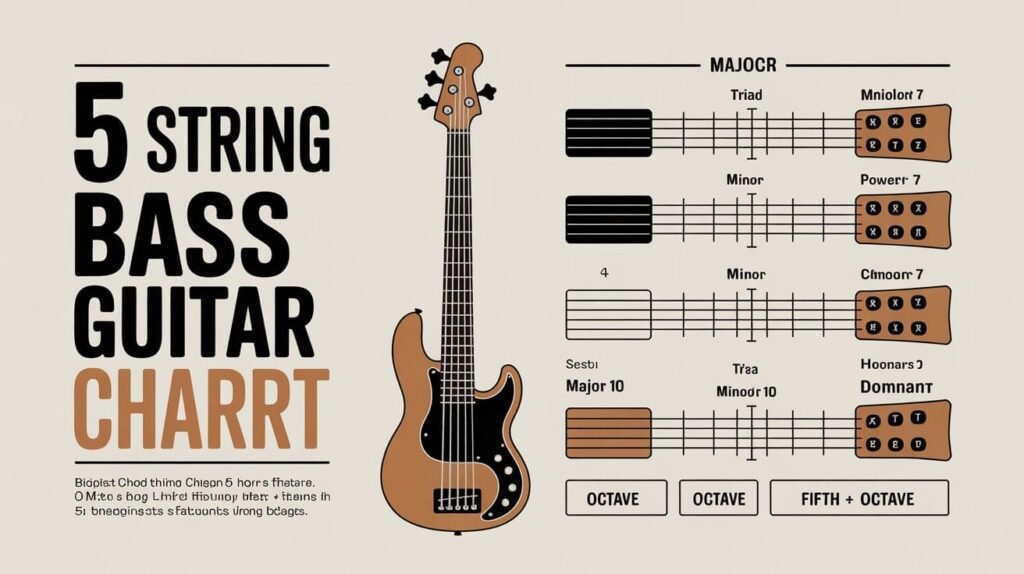
The 5-string bass guitar gives players a wider range, deeper tones, and more harmonic possibilities than a traditional 4-string. While the bass primarily plays single notes, learning basic bass chords can expand your musical creativity, add color to your lines, and help you play richer harmonies—especially in solo, jazz, ambient, or R&B settings.
This guide includes an easy-to-read 5 string bass guitar chords chart, beginner-friendly diagrams, and movable shapes you can use across the entire fretboard.
Vocalists can easily check vocal pitch accuracy.
5-String Bass Tuning (BEADG)
A standard 5-string bass is tuned: B – E – A – D – G
(from lowest to highest)
Why this tuning matters for chords:
- The extra low B string gives additional chord roots
- More flexibility for higher voicings
- Allows more complete triads and dyads
- Perfect for extended-range styles like jazz, gospel, and chordal bass
Can You Play Chords on a 5-String Bass?
Yes—absolutely!
But bass chords must be played higher on the neck (5th fret and above) to avoid muddiness.
Bass chords are ideal for:
- Intros & outros
- Fills and transitions
- Solo bass performances
- Looper setups
- Ambient and melodic playing
Essential 5 String Bass Guitar Chords Chart (With Diagrams)
Below are the most important and cleanest-sounding beginner chords for 5-string bass.
1. Major Chord Shape
(3-note major triad)
Major Shape
G – 4
D – 2
A – 3
E – X
B – X
Example: C Major
G – 5
D – 2
A – 3
2. Minor Chord Shape
(3-note minor triad)
Minor Shape
G – 3
D – 1
A – 3
Example: A Minor
G – 5
D – 2
A – 3
3. Power Chord (5th Chord)
Perfect for rock and clean chordal playing.
Power Chord
D – 2
A – 4
4. Major 7 Chord (Smooth/Jazzy)
Major 7
G – 4
D – 1
A – 3
5. Minor 7 Chord
Minor 7
G – 3
D – 1
A – 3
6. Dominant 7 Chord (Blues/Funk)
Dominant 7
G – 3
D – 2
A – 3
Movable Chord Shapes for 5-String Bass
These shapes can be moved anywhere across the fretboard to form new chords.
1. Major 10th (Beautiful, Clean Dyad)
Major 10th
E – 2
G – 4
Great for: Neo-soul, gospel, ambient music.
2. Minor 10th
E – 2
G – 3
Why it’s great:
Extremely clean, guitar-like harmony on bass.
3. Octave Shape (Universal)
E – 5
D – 7
4. Fifth + Octave (Triad Outline)
A – 5
G – 7
Perfect for funk lines and upper-register chord accents.
Beginner-Friendly Chord Progressions for 5-String Bass
Test these progressions above the 5th fret:
1. Cmaj7 → Dmin7 → G7
Smooth jazz beginner progression.
2. Am → C → Em
Popular in pop/folk genres.
3. E5 → G5 → A5
Rock-style power chords.
Tips for Playing Chords on a 5-String Bass
- Play chords lightly to avoid buzz
- Keep chord voicings above the 5th fret
- Mute unused strings with your thumb and palm
- Use chords sparingly in a band mix
- Experiment with harmonics for bright, clean tones
- Start with dyads before full 3-note chords
FAQ: 5 String Bass Guitar Chords Chart
1. Should beginners learn chords on bass?
Yes—chords help with music theory, fretboard knowledge, and composition.
2. Why do some bass chords sound muddy?
Playing them too low on the neck creates overpowering low-end frequencies.
3. Are chords easier on a 5-string bass?
Yes—the BEADG tuning offers more voicing options.
4. What chords should beginners start with?
Start with 10ths, octaves, power chords, and 3-note major/minor shapes.
Conclusion
This 5 string bass guitar chords chart gives beginners everything they need to start exploring harmony and chordal techniques on bass. Whether you want to play smooth jazz chords, add melodic fills, or experiment with solo bass, these chord shapes will help you develop richer musical expression.
To understand how low notes are structured, the bass clef notes for piano offers a clear reference.
If you want to explore melodic movement, the bass guitar notation chart helps connect chords to written music.
Finger placement becomes easier when you check the bass guitar fingering chart for proper technique.
Players comparing instruments often review the bass trombone vs tenor trombone for tonal range context.
Woodwind learners may find similar pattern logic in the bass recorder finger chart when reading layouts.
For harmonic structure, the baritone scale finger chart shows how scales support chords.
To see how chords sit inside broader progressions, the all types of music scales provides a complete overview.
PitchDetector.com is a project by Ornella, blending audio engineering and web technology to deliver precise, real-time pitch detection through your browser. Designed for musicians, producers, and learners who want fast, accurate tuning without installing any software.