
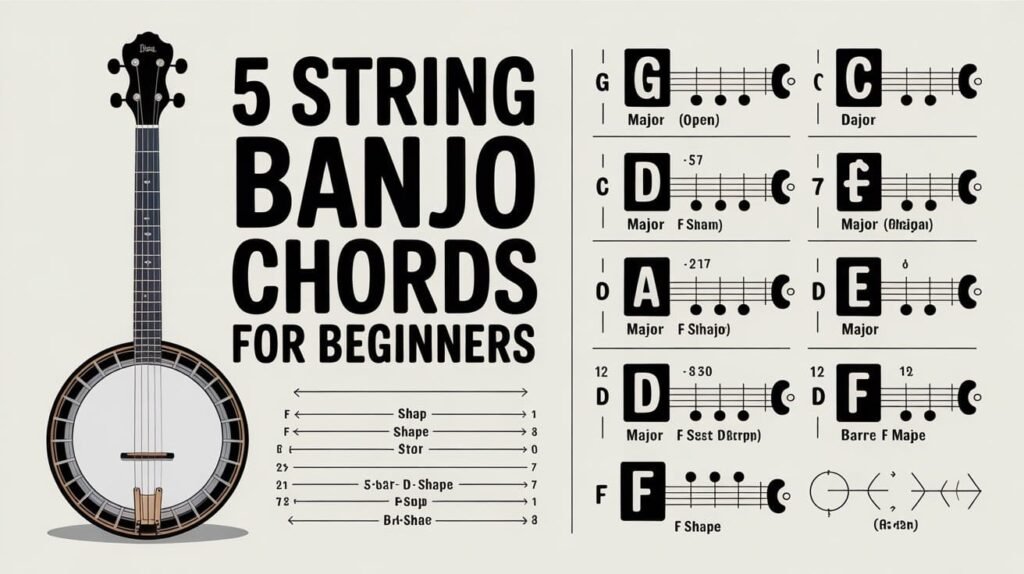
If you’re learning to play the 5-string banjo, the very first step is mastering a few simple chords. These beginner banjo chords make it possible to play bluegrass, folk, and country songs—often within your first session.
This guide covers the easiest 5 string banjo chords for beginners, complete with diagrams, explanations, and tips to help you improve quickly.
Understanding G Tuning (gDGBD) for Beginners
Before diving into chords, you need to know the standard banjo tuning:
g – D – G – B – D
(5th string → 1st string)
Why G tuning is perfect for beginners:
- Strumming all open strings makes a G major chord
- Many easy songs use G–C–D7
- Perfect for fingerpicking and bluegrass rolls
- Makes chords simple and ergonomic
Essential 5 String Banjo Chords for Beginners
Below are the simplest and most important chords to learn first. Beginners gain confidence when the pitch detection tool visually confirms correct notes.
1. G Major (Open Chord)
The easiest banjo chord—no fingers needed.
G Major
g – 0
D – 0
G – 0
B – 0
D – 0
2. C Major
A must-have chord in many beginner-friendly progressions.
C Major
g – 0
D – 2
G – 0
B – 1
D – 2
3. D7 (Beginner-Friendly D Chord)
Much easier to play than a full D major.
D7
g – 0
D – 0
G – 0
B – 1
D – 2
4. D Major (Simple Barre Shape)
Great for learning movable shapes.
D Major
g – 0
D – 2
G – 2
B – 2
D – 2
5. A Major
Common in folk and traditional banjo music.
A Major
g – 0
D – 2
G – 2
B – 2
D – 0
6. E Minor
One of the easiest chords for beginners.
E Minor
g – 0
D – 2
G – 0
B – 0
D – 0
7. F Major
Slightly harder but essential for advancing.
F Major
g – 0
D – 3
G – 2
B – 1
D – 3
Movable Chord Shapes for New Players
Once the basic chords feel comfortable, movable shapes help you play any major chord on the fretboard.
F-Shape (Movable Major Chord Shape)
Example: G using F-shape
F-Shape G
g – 5
D – 5
G – 4
B – 3
D – 3
D-Shape (Movable Major Chord Shape)
Example: G using D-shape
D-Shape G
g – 9
D – 7
G – 7
B – 8
D – 9
Barre Shape (Easiest Movable Chord)
Example: G at the 5th fret
Barre G
g – 0
D – 5
G – 5
B – 5
D – 5
Beginner Banjo Chord Progressions to Practice
Once you learn the basics, try these simple sequences: 1. G – C – D7 – G
Classic bluegrass progression.
2. G – Em – C – D
Perfect for folk songs.
3. C – G – A – D7
Great for rhythm practice.
Tips for Learning Banjo Chords Faster
- Practice transitions slowly (G → C → D7)
- Keep your fingers curved and close to the frets
- Don’t press too hard—banjo strings are light
- Use a metronome for stable rhythm
- Practice 10 minutes daily
- Add rolls only after mastering basic chords
This guide pairs well when you analyze your pitch online.
FAQ:
1. Are these chords suitable for complete beginners?
Yes—these are the easiest and most commonly used beginner banjo chords.
2. Do I need fingerpicking skills first?
No. Start with chords, then add rolls later.
3. Can I use these chords for bluegrass?
Absolutely—G, C, and D7 are bluegrass essentials.
4. Is G tuning required for these chords?
Yes, these shapes are designed for gDGBD tuning.
Conclusion
Learning these 5 string banjo chords for beginners is the fastest way to start playing real music. With just a handful of simple chords—G, C, D7, Em, A—you can strum along to hundreds of bluegrass, folk, and country songs. Add the movable shapes, and you’ll be able to play every major chord on the banjo.
Beginners often reinforce chord shapes by checking the basic guitar notes chart for quick note recognition.
To understand how chords fit into larger patterns, the all types of music scales offers helpful context.
If you’re tuning up before practice, a simple instrument tuner keeps everything in key.
For rhythm while changing chords, the built-in online metronome is an easy companion.
Players who want visual fretboard guidance can reference the baritone ukulele chord chart for shape comparisons.
To see how bass notes support chords, the bass guitar string chart lays out the fundamentals.
When you’re ready to explore harmony deeper, the bass guitar scales chart connects chords to scales.
PitchDetector.com is a project by Ornella, blending audio engineering and web technology to deliver precise, real-time pitch detection through your browser. Designed for musicians, producers, and learners who want fast, accurate tuning without installing any software.