
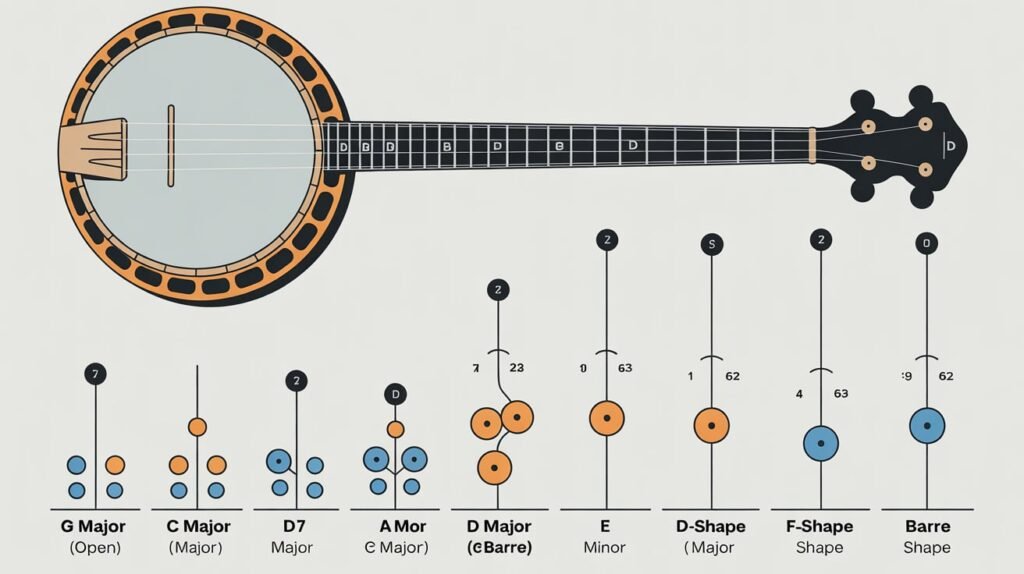
If you’re learning to play the banjo, one of the most valuable tools you’ll need is a 5 string banjo chord chart. Chords are the foundation of bluegrass, folk, and country music, and understanding how they work will help you strum along to countless songs.
This guide provides easy banjo chords, diagram-style text charts, movable shapes, and tips to help you learn faster—even if you’re a complete beginner.
Understanding Standard Banjo Tuning (gDGBD)
Most 5-string banjos are tuned to standard G tuning, written as:
g – D – G – B – D
(5th string → 1st string)
Why this tuning matters:
- The open strings form a G major chord
- Makes beginner chords easier to learn
- Perfect for bluegrass and folk styles
- Great for fingerpicking and rolls
Now let’s dive into the most essential chords.
Basic Chords in the 5 String Banjo Chord Chart
These beginner-friendly chords will allow you to play hundreds of traditional songs.
G Major (Open Chord)
The easiest chord on the banjo—no fingers required.
G Major
g – 0
D – 0
G – 0
B – 0
D – 0
C Major
A must-know chord used in classic G–C–D progressions.
C Major
g – 0
D – 2
G – 0
B – 1
D – 2
D7 Chord
Perfect for folk and bluegrass transitions.
D7
g – 0
D – 0
G – 0
B – 1
D – 2
D Major (Barre Shape)
One of the most useful chords—easy to slide up for new shapes.
D Major
g – 0
D – 2
G – 2
B – 2
D – 2
Instrument tuning feels effortless once the online pitch detector verifies your pitch instantly.
A Major
Often used in country-style songs.
A Major
g – 0
D – 2
G – 2
B – 2
D – 0
E Minor
Simple and emotional-sounding beginner chord.
E Minor
g – 0
D – 2
G – 0
B – 0
D – 0
F Major
Great for developing finger strength.
F Major
g – 0
D – 3
G – 2
B – 1
D – 3
Movable Chord Shapes for 5-String Banjo
These shapes work like “templates”—slide them up the neck to form new chords.
F-Shape Chord
Example: G chord at 3rd fret
F-Shape
g – 5
D – 5
G – 4
B – 3
D – 3
D-Shape Chord
Example: G chord at 7th fret
D-Shape
g – 9
D – 7
G – 7
B – 8
D – 9
Barre Chord Shape
Example: G chord at 5th fret
Barre Shape
g – 0
D – 5
G – 5
B – 5
D – 5
How to Read a 5 String Banjo Chord Chart
To read a banjo chord chart correctly:
- Vertical lines = strings
- Horizontal lines = frets
- Numbers = finger placement
- 0 = open string
- X = don’t play (very rare on banjo)
Learning this helps you read any chord diagram instantly.
Beginner-Friendly Banjo Chord Progressions
Start practicing with these simple progressions: 1. G – C – D7 – G
A classic bluegrass sequence.
2. G – Em – C – D
Perfect for folk and slower songs.
3. C – G – D – C
Great for training transitions.
Tips for Learning Banjo Chords Faster
- Practice slowly and increase speed gradually
- Keep fingers curved and close to the strings
- Strum lightly before adding fingerpicking
- Use a metronome for timing
- Practice at least 10 minutes daily
- Avoid pressing too hard—banjo strings are light
FAQ: 5 String Banjo Chord Chart
1. Is the 5-string banjo good for beginners?
Yes. With G tuning, beginners can play easy chords quickly.
2. Do I need to read music to play banjo chords?
No. Banjo chord charts are visual and easy to understand.
3. Can I use these chords for bluegrass?
Absolutely—these are the foundation of most bluegrass songs.
4. Are these chords the same for clawhammer banjo?
Yes. The chord shapes remain the same regardless of playing style.
Conclusion
A 5 string banjo chord chart is one of the most essential learning tools for new players. With just a few simple chords like G, C, D7, and Em, you can start playing songs almost immediately. Add the movable shapes, and you’ll unlock every chord in every key directly on your banjo neck.
To explore finger placement in more detail, the baritone notes finger chart shows how notes align across strings.
Players moving between instruments often compare layouts with the baritone scale finger chart for consistency.
For wind players looking at chord theory, the alto saxophone note chart provides a different mapping of pitches.
Fingering patterns become clearer when viewed through the alto saxophone fingering chart as a reference.
Recorder players use the alto recorder fingering chart to understand note positions.
Guitarists exploring harmony might like the 12-string guitar tuning chart for broader chord textures.
For scale-based learning, the all types of music scales offers a structured overview.
PitchDetector.com is a project by Ornella, blending audio engineering and web technology to deliver precise, real-time pitch detection through your browser. Designed for musicians, producers, and learners who want fast, accurate tuning without installing any software.