
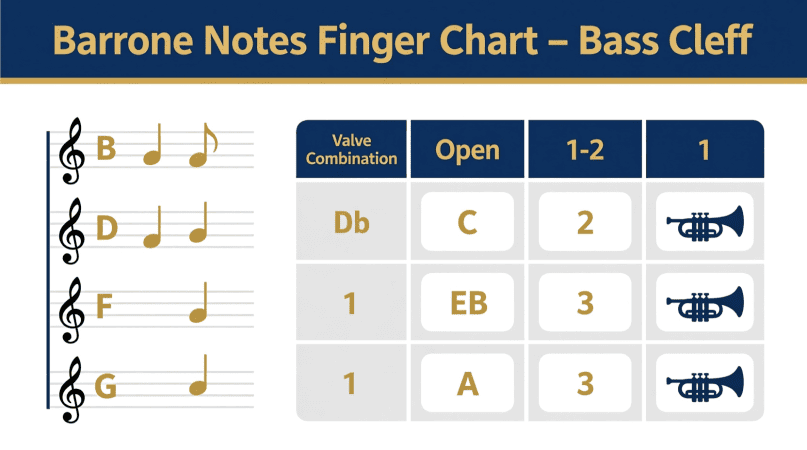
A baritone notes finger chart is an essential learning tool for anyone starting with the baritone horn. It helps players understand which valves to press to produce specific notes. Whether you are a student, parent, or music educator, this guide covers everything you need to know about baritone finger charts in clear, beginner-friendly language.
What Is a Baritone Notes Finger Chart?
A baritone notes finger chart is a visual diagram that shows:
- Each musical note
- The position of the note on the staff
- Which valve combinations (1, 2, 3) to press
- Open notes (no valves pressed)
These charts help beginners develop quick recognition of note-to-valve relationships.
How Baritone Valves Work
The baritone horn typically has three valves. Each valve lowers the pitch:
- The first valve lowers the pitch by a whole step
- The second valve lowers the pitch by a half step
- The third valve lowers the pitch by one and a half steps
- Open means no valves are pressed
By combining these valves, the baritone can produce all notes in its range.
Baritone Notes Finger Chart (Bass Clef)
The bass clef version of the chart is commonly used in concert bands and school ensembles in the United States. Music is written in concert pitch.
Bass Clef Fingering Table
| Note (Concert Pitch) | Fingering |
|---|---|
| Bb (low) | Open |
| C | 1–3 |
| D | 1–2 |
| Eb | 1 |
| F | Open |
| G | 1–2 |
| A | 1 |
| Bb (middle) | Open |
| C | 1–3 |
| D | 1–2 |
| Eb | 1 |
| F | Open |
| G | 1–2 |
| A | 1 |
| Bb (high) | Open |
This is the most common range for beginner and intermediate baritone players. If you’re preparing for a performance, letting the Pitch Detector evaluate your pitch accuracy can significantly improve your confidence on stage.
Baritone Notes Finger Chart (Treble Clef)
Treble clef is widely used in British brass bands and by players transitioning from trumpet. Although the written notes are different, the fingerings are identical to those in bass clef.
Treble Clef Fingering Table
| Written Note | Fingering |
|---|---|
| C (low) | Open |
| D | 1–3 |
| E | 1–2 |
| F | 1 |
| G | Open |
| A | 1–2 |
| B | 1 |
| C (middle) | Open |
| D | 1–3 |
| E | 1–2 |
| F | 1 |
| G | Open |
Treble Clef vs Bass Clef: Key Differences
| Feature | Bass Clef | Treble Clef |
|---|---|---|
| Pitch | Concert pitch | Transposed up a whole step |
| Common Use | Concert bands (US) | Brass bands (UK) |
| Best For | Standard baritone players | Trumpet players switching instruments |
| Fingering | Same for both | Same for both |
Even though the notation differs, both clefs follow the same valve fingerings.
How to Read a Baritone Finger Chart
- Identify whether the music uses treble or bass clef
- Find the note on the chart
- Check the valve combination
- Press the correct valves (1, 2, 3, or combinations)
- Use proper embouchure to match pitch
- Blow steady air while maintaining control
Consistency is essential for developing accurate fingerings and tone.
Tips for Learning Baritone Fingerings
- Practice open notes first. These provide the foundation for your scale patterns.
- Use a tuner to check pitch accuracy, especially for valve combinations.
- Practice major scales daily to build muscle memory.
- Use long-tone exercises to improve breath control and tone quality.
Why Every Beginner Should Use a Baritone Notes Finger Chart
A fingering chart helps new players:
- Learn notes faster
- Build correct habits early
- Improve reading and playing accuracy
- Transition between clefs more easily
- Strengthen muscle memory and coordination
Music teachers often recommend keeping a fingering chart in your practice folder for quick reference.
Frequently Asked Questions
Are baritone and euphonium finger charts the same?
Yes. Both instruments use the same valve system and fingerings.
Is it better to learn in treble clef or bass clef?
Bass clef is standard for concert bands. Treble clef is useful if you previously played trumpet.
Can I use a euphonium fingering chart for baritone?
Yes. Both charts are interchangeable.
Do I need to memorize all the fingerings?
With consistent practice, memorization becomes natural.
Final Thoughts
A baritone notes finger chart is an important learning aid for all baritone horn players. It provides a clear visual guide to help you learn notes, improve your technique, and grow as a musician. Whether you use treble or bass clef, mastering fingerings is the first step toward becoming confident on the baritone.