
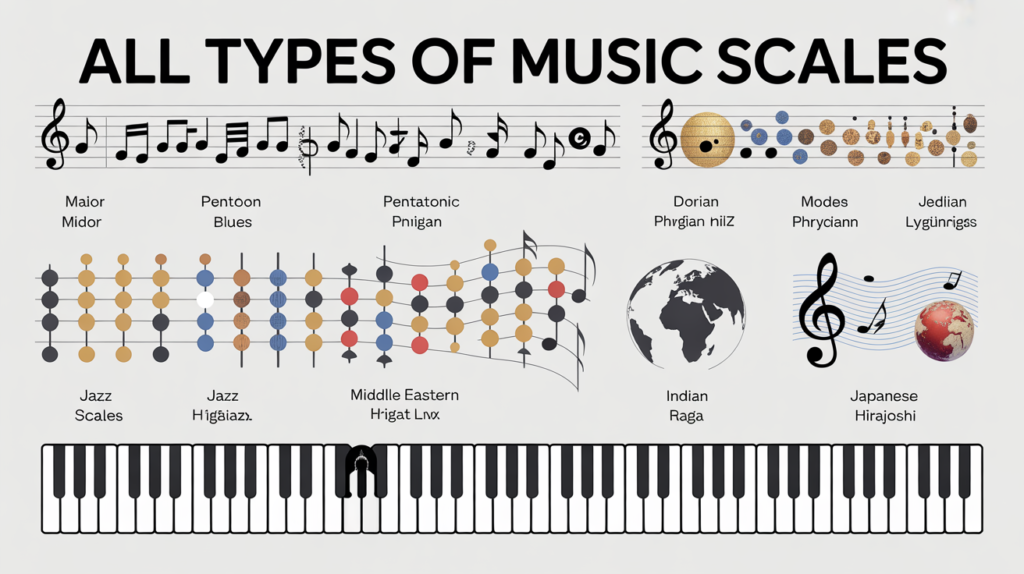
Music scales are the building blocks of melody, harmony, and improvisation. Whether you play guitar, piano, violin, or produce music, understanding different scales helps you write better melodies, learn chords, and create more expressive solos.
This guide breaks down all major types of music scales, from Western classical scales to world music scales used in India, the Middle East, China, Japan, and jazz.
1. Major Scale
The major scale is the most common scale in Western music.
Formula: W–W–H–W–W–W–H
Sound: Bright, happy, uplifting
Used in: Pop, classical, folk, country
Example: C Major — C D E F G A B
2. Natural Minor Scale
The natural minor scale has a darker, emotional tone.
Formula: W–H–W–W–H–W–W
Sound: Sad, emotional, dramatic
Used in: Rock, metal, cinematic music
Example: A Minor — A B C D E F G
3. Harmonic Minor Scale
Creates a dramatic, exotic sound with a raised 7th.
Formula: W–H–W–W–H–A2–H
Used in: Classical, metal, Middle Eastern fusion
4. Melodic Minor Scale (Jazz Minor)
Ascending: Raised 6th & 7th
Descending: Natural minor
Sound: Smooth, modern, jazzy
Used in: Jazz, fusion, classical
Guitar players can quickly find tuning issues when the pitch detection tool highlights sharp or flat notes.
5. Pentatonic Scales (Major & Minor)
Major Pentatonic: Bright, open
Minor Pentatonic: Best for guitar solos
Used in: Rock, blues, pop, folk, R&B
6. Blues Scale
The blues scale = minor pentatonic + ♭5 (“blue note”).
Sound: Gritty, expressive, soulful
Used in: Blues, rock, jazz, funk
7. The 7 Music Modes (Greek / Church Modes)
- Ionian (major)
- Dorian (minor with raised 6)
- Phrygian (dark, Spanish)
- Lydian (dreamy, raised 4)
- Mixolydian (bluesy major, flat 7)
- Aeolian (natural minor)
- Locrian (diminished and tense)
Used in: Jazz, rock, metal, film scoring
8. Chromatic Scale
Contains all 12 notes.
Used for: tension, transitions, modern and experimental music.
9. Whole Tone Scale
All whole steps, no half steps.
Sound: Floating, dreamy, mysterious
Used in: Jazz fusion, impressionist music (Debussy)
10. Diminished Scales (Symmetrical Scales)
Two types:
- Whole–Half Diminished
- Half–Whole Diminished
Sound: Tense, complex, exotic
Used in: Jazz, metal, classical
You can also compare your live vocals to recordings using the audio-file pitch detector for improved tracking.
11. Middle Eastern / Arabic Scales
Common Arabic scales include:
- Hijaz
- Rast
- Nahawand
- Bayati
These scales often use microtones not found in Western music.
12. Indian Classical Scales (Ragas)
Indian music uses hundreds of ragas, each with:
- Specific ascending/descending patterns
- Emotional purpose
- Time-of-day associations
Examples:
Raga Yaman, Bhairav, Kafi, Todi
13. Japanese Scales
Examples:
- Hirajoshi
- In (Insen) Scale
- Yo Scale
Sound: Haunting, simple, traditional
Used in: Japanese classical and folk music
14. Chinese Pentatonic Scales
Based on 5 notes:
Gong, Shang, Jiao, Zhi, Yu
Used in: Traditional Chinese opera, folk, guzheng, erhu
15. Gypsy & Eastern European Scales
Includes:
- Gypsy Minor
- Hungarian Minor
- Byzantine Scale
Sound: Dramatic, expressive, fiery
Used in: Romani music, folk, metal, film
16. Jazz Scales
Jazz musicians use advanced scales such as:
- Melodic minor (jazz minor)
- Lydian dominant
- Altered scale (Super Locrian)
- Diminished scales
- Bebop scales (major & dominant)
These scales create tension, color, and sophistication in solos.
17. Microtonal Scales
Used in:
- Arabic music
- Persian music
- Turkish maqams
- Indian ragas
- Experimental Western music
These scales use intervals smaller than a half step (e.g., quarter tones).
After reviewing your accuracy score, try validating your pitch with the pitch accuracy checker for consistent practice.
Frequently Asked Questions (FAQ)
1. How many types of music scales are there?
Hundreds. But most fall into major, minor, modal, pentatonic, symmetrical, jazz, and world traditions.
2. Which music scale is best for beginners?
Major scale and minor pentatonic scale.
3. What is the most used scale in modern music?
Major scale, natural minor, and minor pentatonic.
4. What scale should I learn for guitar solos?
Minor pentatonic and blues scale.
5. Are world music scales different from Western scales?
Yes — many world scales use microtones and unique intervals.
Conclusion
The world of music scales is vast and full of creative possibilities. By learning the major, minor, pentatonic, modal, jazz, and world scales, you can write better melodies, improve improvisation, and understand music on a deeper level.
To see how scales translate into real notes, the musical note frequency chart offers a clear reference.
When you want to convert between pitches, the how to convert musical notes to frequency guide makes the math simple.
Understanding tuning systems becomes easier with the intonation and temperament explained overview.
To hear how intervals line up, the pitch matching games provide hands-on practice.
Singers working through scales often rely on the singing note detector for instant feedback.
If you’re mapping your voice, the what does your pitch detector tell you article adds context.
For tuning accuracy while practicing, the pitch accuracy checker keeps everything in line.
Ornella is a music technology writer and vocal tools specialist at Pitch Detector. She creates practical content around pitch detection, note recognition, vocal analysis, and singing education tools for beginners, singers, and audio creators.