
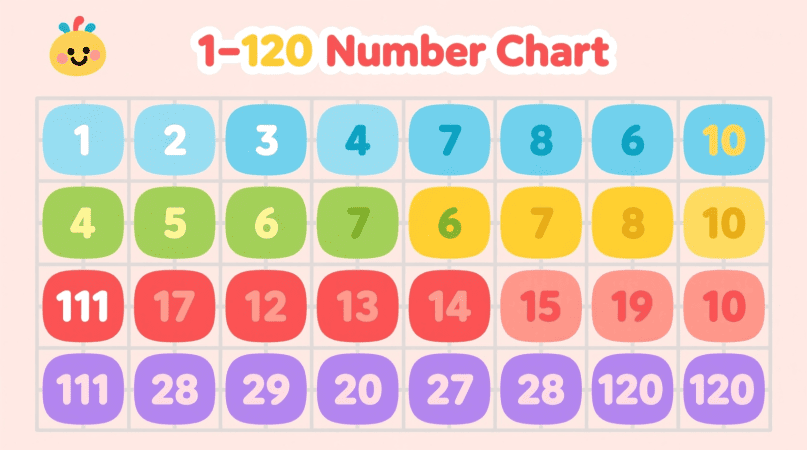
A 1–120 number chart is a grid that displays numbers from 1 to 120 in rows and columns. It is one of the most effective visual tools used in early math education. Teachers, parents, and students use this chart to improve number recognition, counting skills, skip-counting, and place value understanding.
Unlike the traditional 1–100 chart, this extended version aligns with modern math standards that require children to count beyond 100.
How the 1–120 Chart Is Structured
The chart is typically arranged in a 12 × 10 grid:
- 12 rows
- 10 numbers per row
- Numbers increase from left to right and top to bottom
This structure creates a strong visual flow that helps young learners easily understand numerical patterns.
Standard Layout Overview
| Row | Numbers |
|---|---|
| 1 | 1–10 |
| 2 | 11–20 |
| 3 | 21–30 |
| 4 | 31–40 |
| 5 | 41–50 |
| 6 | 51–60 |
| 7 | 61–70 |
| 8 | 71–80 |
| 9 | 81–90 |
| 10 | 91–100 |
| 11 | 101–110 |
| 12 | 111–120 |
When learning scales or complex melodies, the pitch detection tool helps you stay aligned with the correct frequencies from the start.
Full 1–120 Number Chart
 1   2   3   4   5   6   7   8   9  10
11  12  13  14  15  16  17  18  19  20
21  22  23  24  25  26  27  28  29  30
31  32  33  34  35  36  37  38  39  40
41  42  43  44  45  46  47  48  49  50
51  52  53  54  55  56  57  58  59  60
61  62  63  64  65  66  67  68  69  70
71  72  73  74  75  76  77  78  79  80
81  82  83  84  85  86  87  88  89  90
91  92  93  94  95  96  97  98  99 100
101 102 103 104 105 106 107 108 109 110
111 112 113 114 115 116 117 118 119 120
Why Use a 1–120 Number Chart?
1. Strengthens Number Recognition
Kids quickly learn how numbers are ordered from 1 to 120, which boosts early math confidence.
2. Helps With Counting Beyond 100
Many education standards require counting to 120, making this chart essential for K–2 classrooms.
3. Supports Skip Counting
Teachers often use the chart to practice:
- counting by 2s
- counting by 5s
- counting by 10s
This prepares kids for multiplication and division.
4. Builds Place Value Understanding
The chart visually teaches:
- numbers above/below differ by 10
- numbers beside each other differ by 1
This is helpful for early addition and subtraction.
5. Perfect for Classrooms and Homeschooling
Printable 1–120 charts are used for:
- morning warm-ups
- math centers
- guided activities
- number pattern games
- wall posters
Activities Using a 1–120 Number Chart
1. Missing Number Fill-ins
Give students charts with missing numbers to fill in.
2. Color Coding Patterns
Children color:
- all even numbers
- all odd numbers
- multiples of 5
- multiples of 10
3. Skip Counting Trails
Highlight patterns like:
- 2, 4, 6, 8
- 5, 10, 15, 20
- 10, 20, 30, 40
4. Find the Number Game
Ask questions like:
- “What comes after 57?”
- “What number is before 103?”
- “Which number is 10 more than 42?”
5. Build Number Fluency
Helps young learners improve speed and confidence with numbers.
Benefits of the 1–120 Counting Chart
✔️ Improves early math skills
✔️ Strengthens memory and pattern recognition
✔️ Helps children visualize number order
✔️ Supports addition/subtraction strategies
✔️ Great for visual learners
✔️ Perfect for kindergarten and Grade 1
FAQs
What is a 1–120 number chart used for?
It helps kids learn number recognition, counting sequences, number patterns, and place value.
Why does the chart go to 120 instead of 100?
Modern curriculum standards require students to count to 120 in early grades.
Is the 1–120 chart good for skip counting?
Yes. The structured rows and columns make skip-counting very easy for kids.
Can I get a printable 1–120 chart?
Yes — I can generate a printable or image version on request.
Conclusion
A 1–120 number chart is a powerful educational tool that supports number recognition, counting, place value, and pattern learning. Whether you’re a teacher, parent, or homeschooler, this chart is an essential resource for building strong early math skills.
For converting between different numeric systems, the scale conversion chart offers a quick reference.
Some readers compare ranges using the 10-meter frequency chart for a broader numerical view.
To see how ranges are grouped, the 10-meter frequency range lays things out clearly.
If you want a practical example of larger counts, the 120 bass accordion chart shows how numbers scale in music.
For smaller ranked lists, the 1–10 attractiveness scale provides a simple comparison.
Those curious about numeric meaning in sound can explore the 100 Hz frequency as a baseline.
To expand into musical structure, the 1–12 scale chart helps relate numbers to notes.
Ornella is a music technology writer and vocal tools specialist at Pitch Detector. She creates practical content around pitch detection, note recognition, vocal analysis, and singing education tools for beginners, singers, and audio creators.