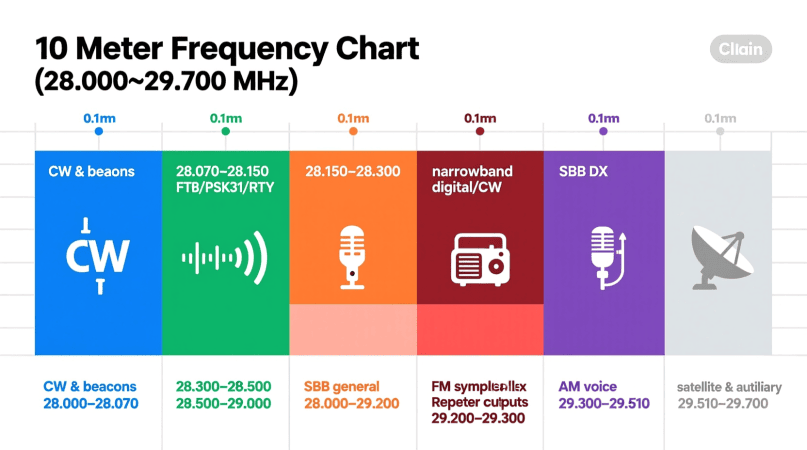
Full 10 Meter Frequency Chart (28.000 – 29.700 MHz)
Below is the official 10-meter ham radio band plan used worldwide.
28.000 – 28.070 MHz — CW & Beacons
- CW (Morse Code only)
- Propagation beacons
- 28.060 MHz – QRP CW calling frequency
Perfect for weak-signal work and DXing.
28.070 – 28.150 MHz — Digital Modes
Most active part of the digital sub-band.
- FT8 → 28.074 MHz
- FT4
- PSK31
- RTTY
- Olivia, JS8Call
- Other narrow digital signals
The FT8 segment is especially busy during openings.
28.150 – 28.300 MHz — Narrowband Modes
- Low-bandwidth digital
- CW
- Light SSB in some regions
- Experimental digital signals
Often used by weak-signal experimenters.
28.300 – 28.500 MHz — SSB Voice (DX Zone)
The most active voice portion of 10 meters.
- USB voice only
- Heavy DX traffic
- 28.400 MHz – Worldwide SSB DX calling frequency
- Popular for contests and pileups
When solar conditions are good, this section bursts with activity.
28.500 – 29.000 MHz — General SSB Voice
- Local SSB contacts
- Ragchewing
- Statewide nets
- Mobile operations
Great for beginners and casual contact.
If you struggle to maintain consistent pitch, letting the Pitch Detector analyze your notes can dramatically improve your accuracy over time.
29.000 – 29.200 MHz — FM Simplex & Inputs
- FM simplex
- 29.060 MHz – FM calling frequency
- 29.100–29.200 MHz → FM repeater inputs
FM activity peaks during strong band openings.
29.200 – 29.300 MHz — FM Repeater Outputs
- FM repeater outputs
- Standard offset is –100 kHz
This segment often comes alive during sporadic-E.
29.300 – 29.510 MHz — AM Voice Window
- AM QSOs
- Vintage radios
- AM nets
A favorite spot for classic radio enthusiasts.
29.510 – 29.700 MHz — Satellites & Links
- Amateur FM satellites
- Packet radio
- Downlinks
- Telecommand
- Experimental signals
Used mainly by satellite operators.
10 Meter Frequency Chart Table (Quick View)
| Frequency Range | Mode / Usage |
|---|---|
| 28.000–28.070 MHz | CW, beacons, QRP CW |
| 28.070–28.150 MHz | Digital modes: FT8, FT4, PSK31, RTTY |
| 28.150–28.300 MHz | Narrowband digital & CW |
| 28.300–28.500 MHz | SSB voice (DX calling 28.400) |
| 28.500–29.000 MHz | SSB voice (general) |
| 29.000–29.200 MHz | FM simplex & repeater inputs |
| 29.200–29.300 MHz | FM repeater outputs |
| 29.300–29.510 MHz | AM voice |
| 29.510–29.700 MHz | Satellites & auxiliary links |
Tracking your pitch over time becomes easier when you review the data with the pitch accuracy checker.
Why the 10-Meter Band Is Amazing
✔ Powerful DX capability
During solar peak, 10 meters can open worldwide.
✔ Small antennas
A simple 16–17 ft dipole works perfectly.
✔ Quiet noise floor
Less atmospheric noise compared to lower HF bands.
✔ Multi-mode flexibility
CW, digital, SSB, FM, AM, and satellites — all in one band.
✔ Available to many entry-level licenses
Depending on country (e.g., USA Technician license has 200 kHz).
Propagation on the 10-Meter Band
The band opens best when:
Strong solar cycles
High sunspot numbers open the F2 layer.
Daytime operation
Best between 10 AM – 5 PM local time.
Sporadic-E Season (May–August & December)
Short-skip miracles happen, even at solar minimum.
Key Calling Frequencies
- 28.060 MHz → QRP CW
- 28.074 MHz → FT8
- 28.400 MHz → SSB DX
- 29.060 MHz → FM calling
- 29.500 MHz → AM window
Recommended 10-Meter Equipment
- HF transceiver (ICOM, Yaesu, Kenwood)
- 10m mobile rigs
- Vertical antennas (5/8-wave, half-wave)
- Dipole or inverted-V
- Yagi beams for DX
- FM repeaters & satellite rigs
FAQs
What is the frequency range of the 10-meter band?
28.000 MHz to 29.700 MHz.
What is the 10-meter SSB calling frequency?
28.400 MHz.
What frequency is FT8 on 10 meters?
28.074 MHz.
Is 10 meters good for DX?
Yes — especially during solar maximum and Sporadic-E events.
Can beginners use the 10-meter band?
Yes, depending on your country’s licensing rules.
Conclusion
The 10-meter frequency chart provides a clear and complete guide to the 28 MHz amateur radio band. With excellent propagation, small antennas, and support for all major ham modes, 10 meters remains one of the best and most active HF bands.
Whether you’re into DXing, digital modes, FM repeaters, or AM, 10 meters has something for everyone.