
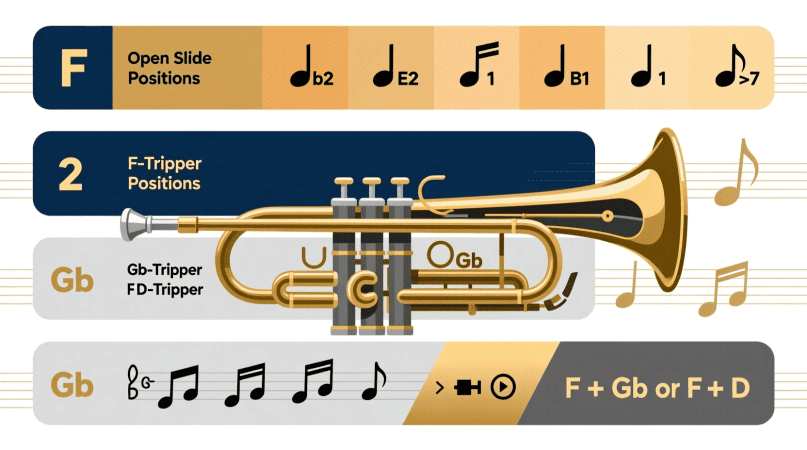
The bass trombone is powerful, versatile, and more complex than the tenor trombone. With two valves (F and Gb/D) and an extended low register, mastering the instrument requires a clear understanding of slide positions. A bass trombone slide chart provides the precise information needed to play accurately and confidently.
This guide covers everything you need to know about bass trombone slide charts, including slide positions, valve functions, practice tips, and FAQs.
What Is a Bass Trombone Slide Chart?
A bass trombone slide chart is a reference guide that shows the exact slide positions required to play every note on the instrument. Because the bass trombone has more tubing and usually two rotary valves, slide charts include:
- Open (no valve) positions
- F-trigger positions
- Gb or D trigger positions
- Combined-valve positions for extended low notes
Compared to tenor trombone slide charts, bass trombone charts are more detailed and essential for mastering the low register.
How Bass Trombone Valves Work
Modern bass trombones include two valves:
1. F Valve (First Trigger)
- Lowers the pitch by a perfect fourth
- Allows easier playing of low notes such as F2, E2, Eb2, and D2
- Reduces how far the slide needs to travel
2. Gb/D Valve (Second Trigger)
There are two common configurations:
F/Gb System (most common)
- Second valve alone lowers pitch to Gb
- Combined with F valve lowers pitch to D
F/D System
- Second valve lowers to D
- Combined valves create a different set of low-note positions
- Preferred by some orchestral players for specific repertoire
Knowing your valve setup is essential for using a slide chart correctly.
During music lessons, students can improve accuracy significantly when the Pitch Detector gives immediate feedback on each played note.
Complete Bass Trombone Slide Chart
Below are clear, easy-to-read charts for all valve setups. These tables are optimized for readability and SEO.
Open (No Valves) Slide Positions
| Note | Slide Position |
|---|---|
| Bb2 | 1st |
| A2 | 2nd |
| Ab2 | 3rd |
| G2 | 4th |
| Gb2 | 5th |
| F2 | 6th |
| E2 | 7th |
These positions match tenor trombone slide positions but may feel different due to the larger bore.
F-Trigger Slide Positions
| Note | Slide Position |
|---|---|
| F2 | 1st |
| E2 | 2nd |
| Eb2 | 3rd |
| D2 | 4th |
| C2 | 6th |
| B1 | 7th |
The F-trigger reduces slide movement and improves intonation options in the low and mid registers.
Gb-Trigger Slide Chart (For F/Gb Instruments)
| Note | Slide Position |
|---|---|
| Gb2 | 1st |
| F2 | 2nd |
| E2 | 3rd |
| Eb2 | 4th |
| D2 | 5th |
D-Trigger Slide Chart (For F/D Instruments)
| Note | Slide Position |
|---|---|
| D2 | 1st |
| C#2 | 2nd |
| C2 | 3rd |
| B1 | 4th |
This chart applies to horns built with an F/D tuning system.
Combined Valves (F + Gb / F + D)
Combined valves open the deepest register of the bass trombone and are essential for orchestral and ensemble playing.
Combined Valves – F/Gb Setup (D Tuning)
| Note | Position |
|---|---|
| D2 | 1st |
| C#2 | 2nd |
| C2 | 3rd |
| B1 | 4th |
| Bb1 | 5th |
| A1 | 6th |
| Ab1 | 7th |
Combined Valves – F/D Setup
| Note | Position |
|---|---|
| Bb1 | 1st |
| A1 | 2nd |
| Ab1 | 3rd |
| G1 | 4th |
Benefits of Using a Bass Trombone Slide Chart
Using a slide chart gives players several advantages:
Faster Learning
Slide positions become easier to memorize, especially with valve combinations.
More Accurate Intonation
Low-register notes are sensitive; charts help avoid sharp or flat tendencies.
Better Low-Range Control
Complex orchestral and jazz passages become more manageable with proper slide reference.
Helpful for Teachers and Students
Slide charts make lessons smoother and improve practice efficiency.
How to Practice with a Slide Chart
Use these methods to get the most value from your chart:
1. Practice Slow Chromatic Scales
This builds familiarity with all positions.
2. Train Valve Transitions
Switching between open, F, Gb/D, and combined valves requires coordination.
3. Use a Tuner During Practice
Slide positions vary depending on temperature and instrument tendencies.
4. Include Long Tones
The bass trombone requires strong breath support and consistency.
5. Apply Slide Charts to Real Music
Use repertoire and technical etudes to reinforce memorization.
Frequently Asked Questions
What is a bass trombone slide chart?
It is a reference guide showing slide positions for all notes with and without valve combinations.
Are slide positions the same as a tenor trombone?
Only the open positions match. Valve positions are different because the bass trombone has more tubing and a double-valve system.
How do I know whether my trombone is F/Gb or F/D?
Check your manufacturer description or look at any tuning labels near the valve section.
Do beginner players need a slide chart?
Yes. It helps develop accurate slide placement and improves intonation from the start.
Can slide charts help with difficult orchestral passages?
Absolutely. Many low-register excerpts require fast valve changes and complex positions.
Final Thoughts
A bass trombone slide chart is a valuable tool for any trombonist learning the instrument or refining technique. With the bass trombone’s extended low range and dual-valve system, understanding slide positions is essential for accuracy, tone quality, and musical confidence.