
Learning to read bass clef notes is one of the most important steps for beginner piano students. While the treble clef focuses on higher notes played with the right hand, the bass clef shows lower notes typically played with the left hand.
A bass clef notes for piano chart is a valuable visual tool that helps students quickly understand where written notes belong on the piano keyboard.
This complete guide explains what the bass clef is, how to read bass clef notes, and how a chart can help you learn faster and more accurately.
What Is the Bass Clef?
The bass clef, also known as the F clef, is a musical symbol used to write low-pitched notes.
The two dots of the symbol surround the F line on the staff, making it easy to identify where the F note is located.
Pianists use the bass clef to read lower notes on the keyboard such as:
- Low F, G, A, B
- Notes below middle C
- Left-hand chords and accompaniment patterns
Because piano music uses both treble and bass clefs, reading the bass clef is essential for becoming a complete pianist.
Whether you’re rehearsing your vocals or testing your instrument, the Pitch Detector provides instant note recognition.
What Is a Bass Clef Notes for Piano Chart?
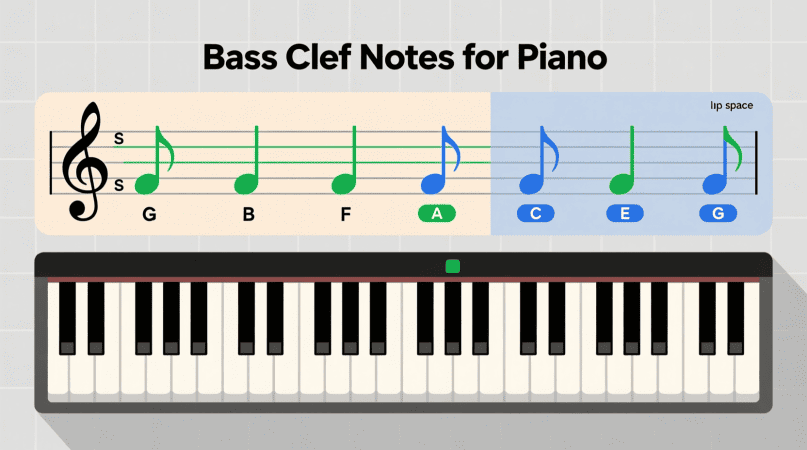
A bass clef notes chart for piano is a diagram that shows:
- The lines and spaces of the bass clef staff
- The note names written on each line and space
- How those notes correspond to specific keys on the piano
This chart visually connects sheet music to the keyboard layout, making it easier for beginners to understand how music is written and played.
Bass Clef Line Notes (G – B – D – F – A)
The bass clef staff has five lines, each representing a note.
From bottom to top, the line notes are:
- G
- B
- D
- F
- A
A popular memory phrase for remembering these is:
Good Boys Do Fine Always
These notes represent lower-pitched tones often played with the left hand.
Bass Clef Space Notes (A – C – E – G)
The spaces between the lines also represent notes.
From bottom to top, the space notes are:
- A
- C
- E
- G
A classic mnemonic for remembering these is:
All Cows Eat Grass
This helps beginners quickly memorize the notes without confusion.
Bass Clef Notes on the Piano Keyboard
A bass clef chart also shows how staff notes connect to the piano.
Key Points:
- Bottom-line G sits below middle C
- Top-line A is just below middle C
- Middle C sits on a ledger line above the bass clef
- Lower notes like F, E, D, C, and B extend below the staff
- Ledger lines help identify very low notes on the piano
Connecting the written notes to piano keys helps students understand left-hand playing faster.
Why a Bass Clef Notes Chart Is Important
Helps Beginners Read Left-Hand Notes
Most left-hand parts are written in the bass clef, so recognizing notes instantly is important.
Improves Sight-Reading
A chart boosts reading speed and reduces hesitation.
Builds Confidence
Seeing the relationship between staff notes and piano keys makes learning easier.
Supports Music Theory Understanding
Bass clef knowledge helps with harmony, intervals, and chord building.
You can also compare your live vocals to recordings using the audio-file pitch detector for improved tracking.
How to Memorize Bass Clef Notes Quickly
Use Mnemonics
Line notes → Good Boys Do Fine Always
Space notes → All Cows Eat Grass
Practice Daily
Spend a few minutes each day reading bass clef flashcards or sheet music.
Play While Reading
Match staff notes to piano keys in real time.
Learn Middle C as a Reference
Middle C anchors both treble and bass clefs.
Use a Printed Bass Clef Chart
Visual repetition strengthens memory.
Common Mistakes Beginners Make
Confusing Treble and Bass Notes
A bass clef chart helps separate left-hand and right-hand reading.
Playing Notes Too High
Remember: bass clef represents low-pitched notes.
Ignoring Ledger Lines
Ledger lines show notes above and below the staff—important for reading correctly.
Reading Too Slowly
Speed improves with regular practice.
Who Should Use a Bass Clef Notes Chart?
A bass clef chart is ideal for:
- Piano beginners
- Music theory students
- Teachers creating learning materials
- Adults returning to piano after years
- Anyone struggling with left-hand reading
Final Thoughts
A bass clef notes for piano chart is one of the best tools for learning how to read left-hand notes on the piano. It clearly shows how each note on the bass clef staff aligns with the keys on the keyboard, making reading sheet music easier and more intuitive. By studying the chart regularly and practicing with simple exercises, beginners can build strong sight-reading skills and gain confidence playing lower-pitched notes.