
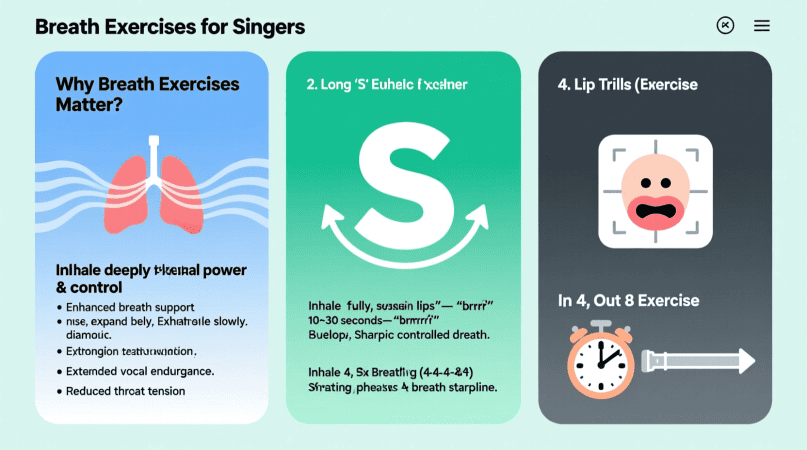
Breath control is the foundation of great singing. Whether you’re a beginner vocalist or an advanced performer, mastering breath exercises for singers is essential for improving tone, stamina, range, and vocal consistency. Good breathing technique allows singers to support long phrases, hit higher or stronger notes, and maintain vocal health.
This comprehensive guide covers the best breath exercises for singers, how often to practice them, and why they are crucial for vocal development.
Many artists start with a fast pitch test.
What Are Breath Exercises for Singers?
Breath exercises for singers are techniques designed to strengthen the diaphragm, improve airflow control, expand lung capacity, and develop smooth, steady breath support. These exercises build the foundation for all vocal techniques, from belting to soft singing.
Breath exercises help singers:
- Sustain long musical phrases
- Increase vocal power without strain
- Improve pitch stability
- Reduce throat tension
- Strengthen the diaphragm
- Support smoother transitions between registers
- Improve vocal stamina
Musicians often rely on the Pitch Detector to verify tuning accuracy during practice.
Why Breath Exercises Are Important for Singers
Breath control affects almost every aspect of singing. Without proper breathing:
- High notes become strained
- Notes sound unstable or shaky
- Phrasing becomes choppy
- Tone loses fullness
- Singers run out of air quickly
- Tension builds in the throat and shoulders
Breathing exercises help develop support, the key to vocal freedom and power.
1. Diaphragmatic Breathing (The Foundation of Singing)
Diaphragmatic breathing—often called “belly breathing”—is the most important breathing technique for singers.
How to Do It:
- Place one hand on your stomach.
- Inhale through the nose and let your belly expand outward.
- Avoid lifting your shoulders or chest.
- Exhale slowly while keeping your belly firm.
Why It’s Effective:
- Strengthens the diaphragm
- Increases breath capacity
- Supports fuller, richer sound
- Reduces vocal strain
2. The Long “S” Exercise (Steady Airflow Training)
This exercise teaches singers how to release air slowly and evenly.
How to Do It:
- Take a deep diaphragmatic breath.
- Exhale while making a long “Sssss” sound.
- Aim for 10–20 seconds, then increase to 30–45 seconds.
Benefits:
- Improves breath stamina
- Trains steady, controlled airflow
- Helps singers sustain long phrases
3. Lip Trills (Lip Rolls)
Lip trills are one of the best breath exercises and vocal warm-ups combined.
How to Do It:
- Relax your lips.
- Blow air to create a vibrating “brrrr” sound.
- Maintain steady airflow without tension.
- Add scales or pitch slides for extra training.
Benefits:
- Improves airflow control
- Reduces tension in lips and jaw
- Connects breath support with vocal tone
4. Box Breathing (4-4-4-4 Method)
A calming but effective breathing pattern that helps singers maintain control.
How to Do It:
- Inhale for 4 seconds
- Hold for 4 seconds
- Exhale for 4 seconds
- Hold for 4 seconds
Benefits:
- Stabilizes breath rhythm
- Helps manage performance anxiety
- Strengthens overall breath control
5. “In for 4, Out for 8” Breathing Technique
A simple but powerful way to improve breath efficiency.
How to Do It:
- Breathe in deeply for 4 seconds.
- Exhale for 8 seconds.
- Increase to In 4, Out 12 or In 4, Out 16 over time.
Benefits:
- Builds lung capacity
- Improves long-phrase endurance
- Trains controlled exhalation
6. Straw Phonation (SOVT Exercise)
This is one of the safest and most effective breath and vocal balance exercises.
How to Do It:
- Put a straw between your lips.
- Hum through it gently.
- Keep the airflow smooth and steady.
- Add pitch slides (“sirens”) when ready.
Benefits:
- Reduces strain on vocal cords
- Balances breath pressure
- Supports smoother transitions between registers
After checking your speaking or singing pitch, you can measure your precision with the pitch accuracy checker for deeper insights.
7. Wall Breathing or Floor Breathing
Great for beginners who struggle to feel proper breath support.
How to Do It:
- Lie on your back or stand with your back flat against a wall.
- Place a hand or book on your stomach.
- Inhale deeply, pushing the book upward with your belly.
- Exhale slowly and evenly.
Benefits:
- Helps singers feel diaphragmatic expansion
- Improves posture for singing
- Prevents chest breathing
How Often Should Singers Practice Breath Exercises?
For best results:
- 5–10 minutes daily
- Before vocal warm-ups
- Before rehearsals
- Before performances
Consistency creates strong breath support and better vocal control.
Signs Your Breath Control Is Improving
You will notice progress when:
- You can sing longer phrases
- Your tone becomes fuller and steadier
- High notes feel easier
- You no longer gasp for air
- Your voice feels more supported
- You experience less throat tension
Frequently Asked Questions
Do breath exercises make you sing better?
Yes. Breath exercises improve support, tone quality, stamina, and pitch accuracy.
How long should singers practice breathing each day?
Just 5–10 minutes daily can create significant improvement.
Should beginners start with diaphragmatic breathing?
Absolutely—it’s the foundation of all healthy singing technique.
Can breath exercises help with high notes?
Yes. Proper breath support makes high notes easier and reduces strain.
Final Thoughts
Breath exercises for singers are essential for building strong technique, vocal stamina, and consistent tone quality. Whether you’re practicing lip trills, diaphragmatic breathing, straw phonation, or long-exhale exercises, consistent breath training will transform the way you sing.
Many singers combine breathing drills with a vocal warm-up routine to stabilize airflow before singing.
To understand how breath affects pitch, this voice pitch analyzer guide shows how airflow changes tone.
When testing control in real time, a live pitch tracker makes subtle shifts visible.
If notes wander, these pitch stability tips explain how to stay centered.
To relate breathing to intonation, this singer tuning guide breaks down common problems.
For understanding fine pitch movement, this cents in music article adds precision.
To explore how the ear processes steady tones, this pitch perception piece gives useful insight.
Ornella is a music technology writer and vocal tools specialist at Pitch Detector. She creates practical content around pitch detection, note recognition, vocal analysis, and singing education tools for beginners, singers, and audio creators.