
Starting guitar can feel overwhelming, and many beginners struggle because they don’t know what to practice or how long to practice. That’s where having a clear beginner guitar practice routine becomes essential. A routine gives structure, avoids frustration, and helps you build skills the right way—step by step.
This complete guide covers everything you need to know, including warm-ups, chords, strumming, songs, technique, tips, and a sample 30-minute routine.
Guitarists can quickly verify pitch accuracy online.
What Is a Beginner Guitar Practice Routine?
A beginner guitar practice routine is a structured plan that helps new guitar players build essential skills in a balanced, manageable way. Instead of practicing randomly, beginners follow a routine that improves:
- Finger strength
- Rhythm and timing
- Chord transitions
- Picking accuracy
- Musical confidence
A good routine focuses on short, consistent sessions that build strong habits over time. If you’re learning ear training, the online pitch analyzer can help you identify notes more clearly.
Why Beginners Need a Practice Routine
A structured routine helps beginners:
- Make faster progress
- Avoid bad habits
- Stay motivated
- Improve timing and rhythm
- Build consistent practice habits
- Learn real songs more quickly
Beginners who follow a routine improve 2–3 times faster than those who practice without a plan.
How Long Should a Beginner Guitarist Practice?
The ideal practice time for beginners is:
20–30 minutes per day
4–6 days a week
Short, regular sessions are better than long, inconsistent ones. To ensure you’re practicing in the right key, the song key finder can help you identify the harmony of your track.
Core Elements of a Beginner Guitar Practice Routine
A solid routine has five essential parts. These build a strong foundation and prepare beginners for real songs.
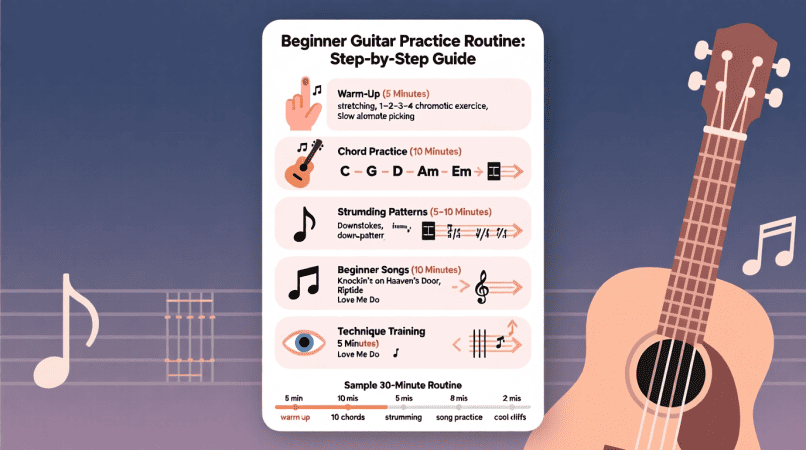
1. Warm-Up Exercises (5 minutes)
Warm-ups prepare your fingers, improve coordination, and prevent tension.
Effective beginner warm-ups include:
- Finger stretching
- 1–2–3–4 chromatic exercise
- Slow alternate picking
- Simple hammer-ons and pull-offs
- Spider exercise (basic version)
These exercises make everything you practice afterward easier.
2. Chord Practice (10 minutes)
Chords are the heart of guitar playing. Beginners should focus on learning and switching between the most common open chords.
Essential beginner chords:
- C major
- G major
- D major
- A minor
- E minor
Practice chord transitions:
- G → C
- C → D
- Em → G
- Am → C
Smooth transitions are more important than speed.
3. Strumming Patterns (5–10 minutes)
Strumming is the rhythm engine of guitar playing. Most beginners struggle here, so structured practice helps a lot.
Beginner strumming patterns:
- Downstrokes only
- Down–up pattern (D U D U)
- Basic 4/4 pop rhythm
- Folk/pop strum pattern
Practice with:
- A metronome
- Backing tracks
- Drum loops
Good strumming = better timing + better sounding songs.
4. Learn Simple Songs (10 minutes)
Playing songs keeps beginners motivated and brings all skills together.
Perfect beginner songs:
- “Knockin’ on Heaven’s Door” – Bob Dylan
- “Riptide” – Vance Joy
- “Love Me Do” – The Beatles
- “Horse with No Name” – America
- “Stand By Me” – Ben E. King
Choose songs with 2–4 chords and easy strumming.
5. Technique Training (5 minutes)
This section improves hand accuracy, clarity, and control.
Beginner technique skills:
- Clean fretting (no buzzing)
- Picking accuracy
- Finger placement closer to frets
- Simple riffs (e.g., “Smoke on the Water”)
- Ear training (playing simple melodies)
Strong technique = cleaner tone + faster progress.
Sample 30-Minute Beginner Guitar Practice Routine
Here is a complete daily routine you can follow:
5 minutes — Warm-ups
10 minutes — Chord practice + transitions
5 minutes — Strumming patterns
8 minutes — Learn or review a beginner-friendly song
2 minutes — Cool-down finger stretch
Repeat this routine 4–6 days per week for the best results.
If you need to check the note you’re tuning to, the note-to-frequency converter can show the exact Hz value.
Extra Tips to Improve Faster
- Practice slowly → speed comes naturally
- Use a metronome to improve rhythm
- Keep fingers close to the strings
- Press lightly to avoid hand fatigue
- Record videos weekly to track progress
- Learn songs you enjoy
- Stay consistent—small wins build big progress
Common Beginner Mistakes to Avoid
Avoid these habits and you’ll improve much faster:
- Practicing without a routine
- Ignoring rhythm and timing
- Squeezing the strings too hard
- Skipping warm-ups
- Jumping into advanced songs too early
- Neglecting chord transitions
Fixing these early prevents long-term frustration.
Frequently Asked Questions
How many chords should a beginner learn first?
Start with five chords: G, C, D, Am, and Em.
Is 30 minutes of practice enough for beginners?
Yes. Consistent 30-minute sessions are ideal for quick progress.
Should beginners practice chords or songs first?
Both—learn basic chords first, then apply them to simple songs.
How long does it take to learn guitar as a beginner?
Most beginners can play real songs within 4–8 weeks with a structured routine.
Final Thoughts
A beginner guitar practice routine is the key to steady progress, confidence, and long-term enjoyment. By practicing warm-ups, chords, strumming, songs, and technique every week, new players build strong foundations without feeling overwhelmed.
Whether you dream of playing pop, rock, worship, or fingerstyle music, this routine is the perfect place to start.
Before starting each session, these beginner guitar warm-ups help loosen your fingers and prevent strain.
Keeping your instrument in tune is easier with this guitar tuning chart as a quick reference.
To check whether your notes are landing correctly, this online pitch detector can also be used for instruments.
Understanding what you’re hearing becomes clearer with this pitch vs frequency guide.
If you want to relate practice notes to real values, this musical frequency chart gives precise numbers.
For structured theory alongside playing, this music scales overview ties patterns together.
When recording your progress, this audio pitch detection guide helps review each take.
Ornella is a music technology writer and vocal tools specialist at Pitch Detector. She creates practical content around pitch detection, note recognition, vocal analysis, and singing education tools for beginners, singers, and audio creators.