
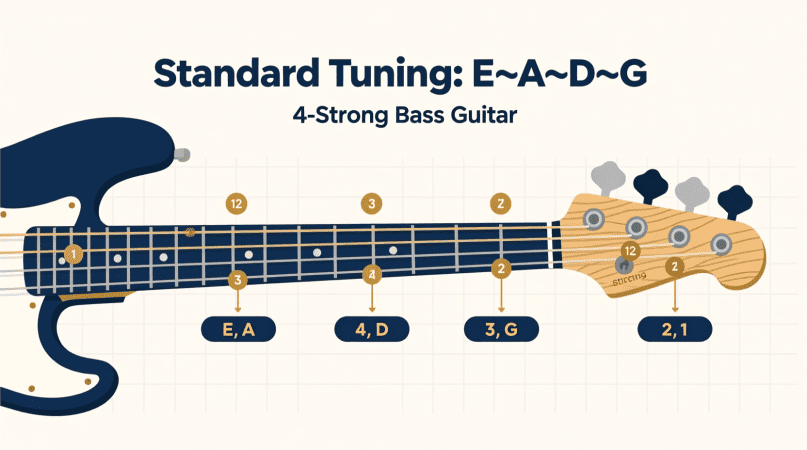
Tuning your bass guitar correctly is the foundation of great sound, clean technique, and accurate playing. Whether you’re a beginner learning how to tune for the first time or an intermediate bassist exploring alternate tunings, a bass guitar tuning chart is an essential tool. It shows the correct notes for each string, helps you understand tuning order, and gives you a reference for standard, extended, and alternate setups.
This SEO-optimized guide covers everything you need to know about bass tuning charts and how to use them effectively.
What Is a Bass Guitar Tuning Chart?
A bass guitar tuning chart is a diagram that displays the correct pitch for each string on the bass guitar. It typically includes:
- Standard tuning (E–A–D–G)
- String numbers (1st to 4th)
- Lowest-to-highest pitch order
- Optionally: alternate tunings and extended bass tunings (5-string, 6-string)
This chart helps beginners quickly learn which pitch each string should be tuned to and ensure their instrument sounds accurate during practice or performance. Your tuning becomes much easier once the Pitch Detector gives you accurate real-time feedback.
Standard Bass Guitar Tuning (E–A–D–G)
The most common tuning for a 4-string bass is:
| String Number | Note | Description |
|---|---|---|
| 4th string | E | Lowest pitch, thickest string |
| 3rd string | A | |
| 2nd string | D | |
| 1st string | G | Highest pitch, thinnest string |
This is usually written as: E – A – D – G
Standard tuning is used in rock, jazz, blues, metal, funk, pop, and nearly every musical style. If you’re curious how the engine works, the pitch detection methodology explains each step in detail.
Understanding Bass Guitar String Numbers
String numbering is important for reading tabs and tuning charts:
- 1st string = G (highest pitch)
- 2nd string = D
- 3rd string = A
- 4th string = E (lowest pitch)
Many beginners mistakenly reverse the numbers, so a tuning chart is helpful for quick reference.
Why Every Player Needs a Bass Guitar Tuning Chart
A tuning chart is helpful because it:
Ensures Accurate Tuning
Each string must match a specific pitch to sound correct.
Helps Beginners Learn String Order
Many new players confuse the E and G strings.
Supports Scale and Fretboard Learning
Correct tuning ensures notes fall exactly where they should.
Improves Tone and Musicality
An untuned bass affects your technique, rhythm, and ensemble sound.
Makes Tab Reading Easier
Tabs rely on the correct string numbering and tuning.
Extended Tuning Charts for 5-String & 6-String Bass
Many modern bassists use more than four strings.
5-String Bass Tuning
Standard tuning: B – E – A – D – G
Adds a low B for deeper range (common in metal, worship, and modern rock).
6-String Bass Tuning
Standard tuning: B – E – A – D – G – C
Adds low B and high C (great for jazz, soloing, and advanced chord work).
Popular Alternate Bass Guitar Tunings
A tuning chart often includes alternate tunings used in rock, metal, and experimental genres.
Drop D Tuning
D – A – D – G
Lower the E string one whole step to D.
Drop C
C – G – C – F
Used in heavy metal and modern hard rock.
D Standard
D – G – C – F
All strings tuned down one full step.
Half-Step Down
Eb – Ab – Db – Gb
Common in blues, rock, and grunge.
Alternate tunings allow for deeper tones and different musical textures.
How to Use a Bass Guitar Tuning Chart
Step 1: Identify Each String
Use the chart to learn the names and numbers of the strings.
Step 2: Use a Digital Tuner
Match each string to its pitch (E, A, D, G).
Step 3: Tune From Low to High
Start with the thickest string (E or B).
Step 4: Retune as Needed
Adjust slightly after tuning all strings — tension affects neighboring strings.
Step 5: Practice Open Strings
Develop an ear for each pitch by practicing open notes.
Common Tuning Mistakes Beginners Should Avoid
- Tuning a string an entire octave too high (can break the string)
- Confusing which string is G or E
- Turning tuning pegs too quickly
- Switching tunings without understanding pitch differences
- Ignoring a tuning chart and guessing the notes
A tuning chart prevents these errors with clear visual guidance.
Final Thoughts
A bass guitar tuning chart is one of the most important tools for any beginner or intermediate player. It provides a clear reference for standard tuning (E–A–D–G), extended tunings like B–E–A–D–G, and alternate tunings used in many musical styles. With consistent reference to a tuning chart, you’ll tune faster, learn notes more easily, and develop strong foundational skills on the bass.
To double-check open strings, this instrument quick start shows how tuners handle different instruments.
Many bassists use a real-time pitch tool to see small tuning changes as they adjust each peg.
If background noise throws things off, these noise interference tips help keep readings clean.
Understanding tuning standards is easier after reading this historical pitch guide for context.
When precision matters, this calibration reference explains how to get exact results.
To convert what you see into musical names, this note to frequency guide makes the process simple.
For troubleshooting odd readings, this pitch flicker fix covers the most common problems.
Ornella is a music technology writer and vocal tools specialist at Pitch Detector. She creates practical content around pitch detection, note recognition, vocal analysis, and singing education tools for beginners, singers, and audio creators.