Learning to read music is one of the most valuable skills a bass guitarist can develop. While tablature (tabs) is popular for quick learning, standard music notation offers deeper understanding, better accuracy, and the ability to play in bands, orchestras, and studio environments.
A bass guitar notation chart helps beginners bridge the gap between written music and the bass guitar fretboard by showing where each note on the bass clef appears on the instrument.
This SEO-friendly guide explains what a bass guitar notation chart is, why it’s important, and how to use it effectively.
What Is a Bass Guitar Notation Chart?
A bass guitar notation chart is a diagram that shows:
- Notes written on the bass clef staff
- The corresponding fret and string positions on the bass guitar
- All possible locations of each pitch
- Open-string notes and octave variations
- A visual map linking written music to the fretboard
This chart is essential for beginners learning to read music because it clearly connects notation → fret → string, making reading sheet music easier.
Why You Should Learn Bass Guitar Notation
Most beginners start with tabs because they are simple, but tabs do not show:
- Rhythm
- Pitch accuracy
- Duration
- Dynamics
- Musical expression
Learning notation makes you a more complete musician and opens the door to:
- Jazz ensemble
- Concert band
- Worship teams
- Studio recording
- Reading charts and lead sheets
- Writing your own music
A notation chart helps you take the first steps toward mastering music literacy.
Most beginners improve quickly because the online pitch detector shows exactly where they’re off-key.
Understanding the Bass Clef
Bass guitar uses the bass clef, also called the F clef, because it centers around the low-pitched notes the bass produces.
Bass Clef Structure:
- Line notes: G – B – D – F – A
- Space notes: A – C – E – G
These notes represent the foundation of reading music for bass guitar.
A notation chart visually maps each of these notes to their correct fret positions.
Bass Guitar Open String Notes in Notation
Standard tuning for bass guitar is:
- E (lowest)
- A
- D
- G (highest)
Here’s where these open strings appear on the bass clef:
| String | Note | Staff Location |
|---|---|---|
| E | E2 | Bottom space |
| A | A2 | Second space |
| D | D3 | Middle line |
| G | G3 | Top space |
A notation chart uses these open strings as reference points to understand where all other notes sit. The results make more sense when viewed alongside the pitch detection methodology that powers the tests.
How a Bass Guitar Notation Chart Maps Notes to the Fretboard
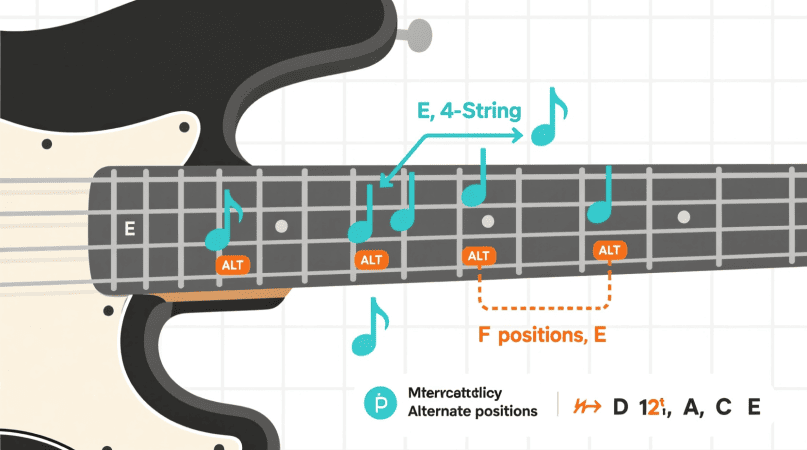
The most powerful feature of a notation chart is that it shows multiple fret locations for the same pitch.
For example:
- Written G can be played on:
- E string, 3rd fret
- D string, 5th fret
- G string, open
- Written C can be played on:
- A string, 3rd fret
- D string, 10th fret
A good notation chart highlights each option so beginners understand how to choose the most comfortable position.
Benefits of Using a Bass Guitar Notation Chart
1. Faster Learning
It becomes easier to read sheet music when you know where notes land on the fretboard.
2. Better Fretboard Knowledge
Seeing multiple note locations strengthens your understanding of the bass neck.
3. Improved Technique
You’ll choose smoother positions for riffs, scales, and bass lines.
4. Stronger Musical Foundation
Notation helps you learn rhythm, timing, dynamics, and phrasing — things tabs cannot teach.
5. More Opportunities
Reading music makes you more qualified for school bands, jazz ensembles, orchestras, and studio work.
How to Use a Bass Guitar Notation Chart (Beginners’ Steps)
Step 1: Learn the Open-String Notes
Understand where E, A, D, and G appear on the bass clef.
Step 2: Practice Natural Notes
Start with A–B–C–D–E–F–G before learning sharps and flats.
Step 3: Connect Notes to the Fretboard
Use the notation chart to match each written note with its string and fret.
Step 4: Learn Multiple Positions
Find at least two places to play each note.
Step 5: Practice Simple Reading Exercises
Use one-octave scales, simple rhythms, and beginner bass lines.
Step 6: Read While Playing
Look at sheet music, point to the note, and play it on the bass.
Who Should Use a Bass Guitar Notation Chart?
A notation chart is useful for:
- Absolute beginners
- Intermediate players learning to read
- School band and jazz band students
- Bass teachers & music educators
- Self-taught players transitioning from tabs
- Musicians wanting to improvise over written chord charts
Common Mistakes to Avoid
- Confusing treble clef with bass clef
- Memorizing note names but not fretboard positions
- Ignoring alternate fret positions
- Relying only on tabs
- Trying to read complex rhythms too soon
A notation chart prevents many of these mistakes by simplifying visual reference.
Final Thoughts
A bass guitar notation chart is one of the most valuable tools for developing strong musical skills. It connects written music to the fretboard, improves reading speed, and deepens your understanding of the instrument. Whether you want to play professionally, join a band, study music, or simply improve your technique, learning to use a notation chart will elevate your playing.
Many players first review a bass guitar fingering chart to match written notes with their hand positions.
To understand how notation connects to pitch, this note vs frequency guide is a helpful reference.
For checking accuracy while reading music, a real-time pitch tracker keeps you on target.
If you want to confirm exact values, this musical note frequency chart shows every pitch in hertz.
When practicing from recordings, this audio pitch detection guide verifies each note you play.
To understand tuning precision, this cents in music article adds important context.
For technical insight, this autocorrelation vs YIN comparison explains how pitch is detected.
Ornella is a music technology writer and vocal tools specialist at Pitch Detector. She creates practical content around pitch detection, note recognition, vocal analysis, and singing education tools for beginners, singers, and audio creators.