
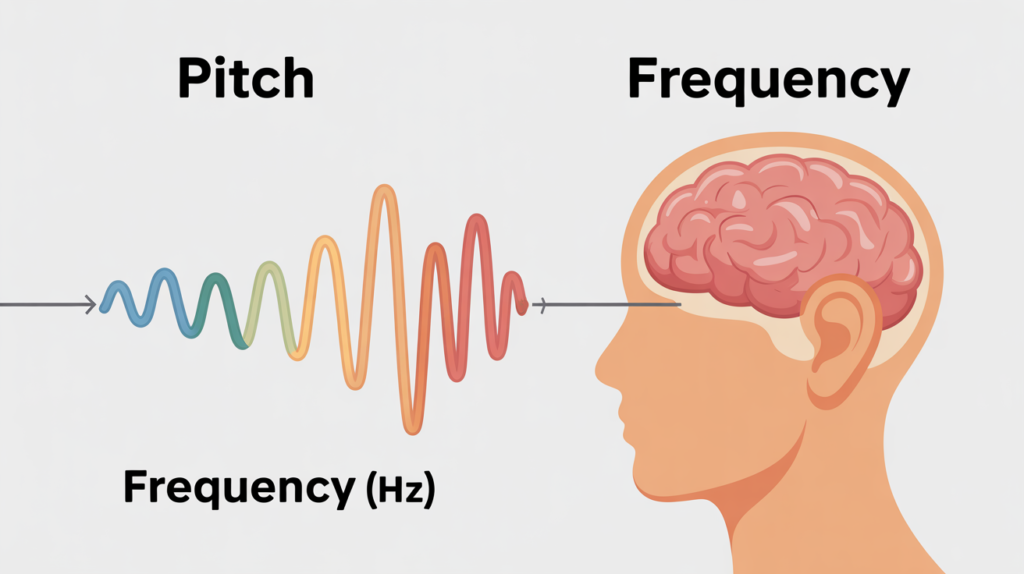
Many learners in physics, music, and audio engineering often ask: Are pitch and frequency the same thing? no. They are closely related, but they refer to two different concepts. Pitch is how we hear sound, while frequency is how sound waves actually behave. This article explains the difference in clear, easy-to-understand terms.
What Is Frequency?
Frequency refers to the number of sound wave vibrations per second.
It is a measurable, scientific property expressed in Hertz (Hz).
Key characteristics of frequency
- Objective and scientifically measurable
- Higher Hz means faster vibrations
- Lower Hz means slower vibrations
- Used in physics, engineering, and audio technology
Example:
A sound with 440 Hz vibrates 440 times per second.
If you’re preparing for a performance, letting the PitchDetector evaluate your pitch accuracy can significantly improve your confidence on stage.
What Is Pitch?
Pitch is the human perception of how high or low a sound seems.
It depends mainly on frequency, but it also changes based on how the brain interprets sound.
Key characteristics of pitch
- A subjective human experience
- Influenced by frequency, loudness, and harmonics
- Described with words like “high” or “low”
- Important in music, singing, and speech analysis
Example:
A sound at 440 Hz is heard as the musical note A4.
Pitch vs Frequency: What Is the Difference?
| Feature | Pitch | Frequency |
|---|---|---|
| Definition | Human perception of sound | Vibrations per second in a sound wave |
| Nature | Subjective | Objective |
| Unit | No unit | Hertz (Hz) |
| Depends on | Frequency, loudness, timbre | Number of wave cycles per second |
| Example | High or low tone | 500 Hz, 1000 Hz |
In simple terms:
Frequency belongs to physics, while pitch belongs to perception.
How Pitch and Frequency Are Connected
Even though they are different, pitch and frequency are strongly related.
- Higher frequency produces a higher pitch
- Lower frequency produces a lower pitch
General examples
- 20–250 Hz: Deep, low-pitched sounds
- 250–2000 Hz: Middle-range sounds (speech)
- 2000–20,000 Hz: High-pitched sounds
However, pitch may vary depending on:
- Age and hearing ability
- Sound volume
- Harmonics or richness of the sound
This explains why two sounds with the same frequency can feel slightly different.
Real-Life Examples of Pitch and Frequency
1. Musical Instruments
A piano and a guitar can produce the same frequency (for example, 440 Hz),
but the pitch quality feels different due to unique harmonics.
2. Human Voices
- Lower frequencies in male voices create deeper pitch
- Higher frequencies in children’s voices create higher pitch
3. Audio Technology
Devices such as audio analyzers measure frequency,
but pitch can only be determined by human hearing.
Why This Difference Matters in 2025
Understanding the difference between pitch and frequency is important in:
- Music production and tuning
- Audio recording and sound design
- Physics and science education
- Speech therapy
- Acoustic engineering
As digital audio grows rapidly in 2025, knowing how pitch and frequency differ is essential for sound quality and communication.
Common Misconceptions
- “Pitch and frequency are identical.”
They are related but not the same. - “Pitch can be measured with instruments.”
Only frequency is measurable; pitch is perceived. - “Same frequency means same pitch.”
Timbre, loudness, and hearing ability can change perceived pitch.
FAQs About Pitch and Frequency
1. Are pitch and frequency the same thing?
No. Pitch is perception, while frequency is a physical measurement.
2. What determines pitch?
Mainly frequency, but also loudness and harmonics.
3. What frequencies can humans hear?
Most humans can hear from about 20 Hz to 20,000 Hz.
4. Why do two instruments sound different at the same frequency?
Because each instrument produces unique overtones and harmonics.
5. What tools measure frequency?
Oscilloscopes, tuners, and spectrum analyzers measure frequency accurately.
Conclusion
So, are pitch and frequency the same thing?
The answer is no. Frequency describes the vibrations of a sound wave, while pitch describes how the brain interprets those vibrations.
Many readers start by reviewing a simple pitch detector overview to see how pitch is actually measured.
To understand the math behind sound, this note frequency converter explains how hertz relate to musical notes.
For a technical comparison, this pitch tracking vs detection article breaks down how systems interpret frequency.
If you want to see real numbers, this musical note frequency chart shows exact pitch values in hertz.
To learn how algorithms find pitch, this YIN vs autocorrelation guide compares detection methods.
When background noise affects readings, these interference fixes explain what changes frequency analysis.
For practical testing, this audio file pitch detector lets you analyze recorded sounds.
Ornella is a music technology writer and vocal tools specialist at Pitch Detector. She creates practical content around pitch detection, note recognition, vocal analysis, and singing education tools for beginners, singers, and audio creators.